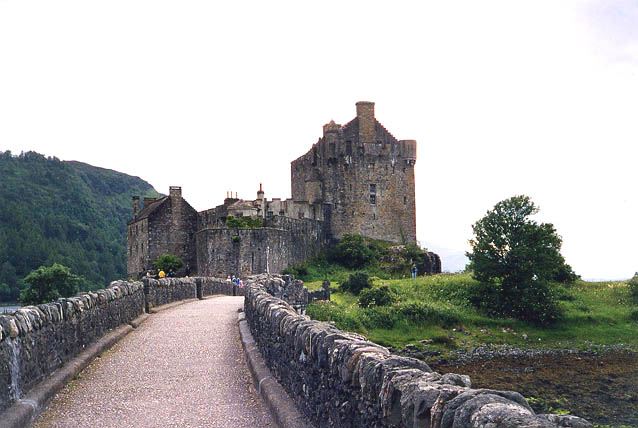
Information boards displayed at the castle recount
the following story:
One day a wealthy chief of the race of Mathesons had a son who was given
his first drink from a raven's skull. This gave him the power to understand
the language of the birds. When the boy was still young, his father asked
him what the birds were saying. The boy told him that they said one day
his father would wait upon him as a servant. Greatly displeased, his father
turned his son out of the house to make his own. Offering his special talents
he was able to discover that the birds were having a dispute which, with
the king, he was able to resolve. The king was so pleased that peace and
quiet had been restored that he presented the boy with a fully manned ship
in which to continue his journey.
On one of the voyages he was invited to dine with the ruler of a distant
country, only to discover that the palace was so infested with rats that
they even invaded the dining table. The next evening he returned with a
cat under his cloak and when the rats gathered around the dining table,
he let the cat loose and it killed all the rats. The ruler was so pleased
to be rid of the vermin at last, that he gave the boy a barrel of gold.
Eventually after many adventures, a fine ship with a young man aboard anchored
off Totaig. The sight of such a royal vessel caused a stir in the district
and all wondered who this richly dressed young man might be. The youth
was received by the old chief with great courtesy and invited to stay for
dinner. Sitting him at the table, the grey haired old man waited upon the
young stranger himself thereby fulfilling the prophecy of the birds. The
youth then revealed who he was and the father was reconciled to the boy
whom he acknowledged as his heir. His son's abilities and knowledge of
the world brought him into the favour of Alexander II (1214-1250) who commissioned
him to build Eilean Donan and protect his subjects against the Norwegians.
The castle information boards go on to say that:
In 1263 a vast fleet led by King Haakon IV of Norway made its way southwards
down Kyle of Lochalsh and past Eilean Donan on its way to do battle with
Alexander III of Scotland at Largs. Resoundingly defeated, the broken remnants
of the Norwegian fleet limped back home, stopping here only to revictual
their vessels. This marked the end of almost four and a half centuries
of Scandinavian control for, by the Treaty of Perth in 1266, the northern
mainland and the isles passed nominally at least into the hands of the
Scottish Crown. In return for his assistance during the fighting, the Earl
of Ross was granted vast territories in the north including the Isle of
Skye and much of the mainland opposite.
In 1263, Alexander III gave the castle to Colin Fitzgerald,
son of the Earl of Desmond and Kildare (later to become MacKenzies)
as a reward for his services in the Battle of Largs. Only excavation
can now determine whether 'Scandinavian' defences underlie the stone
keep and its outer enclosing wall as none of the visible remains appear
to date earlier than the later 13th century at the earliest and most
likely do not predate the 14th century. At the close of the 13th century
it was firmly in the hands of Kenneth Mackenzie despite attempts by
the Earl of Ross to wrest it from him.
The castle at this time may well be that whose outer defences are
now only faintly visible in part around the island well beyond the
contracted defences of its successor. Traditionally, it is believed
that in the early part of the 14th century, Robert the Bruce, out
of favour with many of the clan chiefs as well as being hunted by
the English, was given refuge in Eilean Donan Castle by John MacKenzie,
Second of Kintail. Later in 1331 the fortunes of Robert the Bruce
had changed. He had defeated his enemies and established his position
as King of Scotland. He sent his nephew Randolph, Earl of Moray and
Warden of Scotland, to Kintail.