

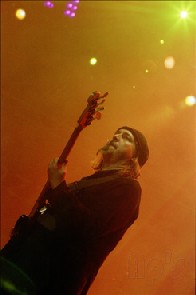
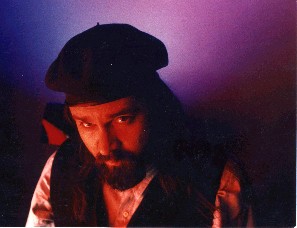
Click photo for a larger version
Recent productions:
HERBIE HANCOCK "Future to Future" 2001 - Transparent Music
GIGI "Gigi" 2001 - Palm Pictures
ANGELIQUE KIDJO "Black Ivory Soul" 2002 - Sony
BOB MARLEY "Dreams of Freedom" remix concept album by BILL LASWELL 1997
- Polygram - Axiom
MILES DAVIS 69-74 "Panthalassa" remix concept album by BILL LASWELL 1998
- Sony
Other remix works by Bill Laswell were recently made and released like:
SANTANA "Divine Light" - Sony Legacy,
STING "A Thousand Years", SONY classical, countless traditional & ethnic
repertoires or catalogues …
LUCKY PETERSON "Black Midnight Sun" 2003 - Birdology/Dreyfus Jazz/Koch
US
2003
Upcoming releases:
LILI HAYDN
- RCA Victor
Classical remix project - Sony Columbia (including music from Yo-Yo Ma,
Philip Glass, Michael Nyman, Andres Wollenweider, Gregorian chants, Hariprasad
Chaurasia, Riuchi Sakamoto...).
SLY & ROBBIE "Version Born" (feat. Tricky, Black Thought from The Roots,
Killah Priest …).
HERBIE HANCOCK electronic
period remix project including
"Rock It" with strings.
List of selected artists/projects produced:
GEORGE CLINTON , BOOTSY COLLINS ,MILES DAVIS , MANU DIBANGO , BRIAN ENO
, FADELA & SAHRAWI , PETER GABRIEL , HERBIE HANCOCK , WHITNEY HOUSTON
, MICK JAGGER , ANGELIQUE KIDJO , FELA ANIKULAPO KUTI , BOB MARLEY , MATERIAL
, MOTORHEAD , YOKO ONO , MACEO PARKER ,IGGY POP , RYUICHI SAKAMOTO , PHAROAH
SANDERS , SIMON SHAHEEN , SLY & ROBBIE , STING , TOURE KUNDA , JAH WOBBLE
, HECTOR ZAZOU …
BILL LASWELL
With over 20 years' experience as a touring musician and composer and
nearly 300 albums to his credit, producer and bassist Bill Laswell has
collaborated with some of the most illustrious names in music across
all genres and boundaries, including Herbie Hancock, Mick Jagger, Laurie
Anderson, Pharoah Sanders, Yoko Ono, Iggy Pop, The Last Poets, Buddy
Miles, George Clinton, Bootsy Collins, Afrika Bambaataa, Tony Williams,
Public Image Ltd., Peter Gabriel and countless others. He has also organized
and produced recordings with master musicians from around the world,
having logged extensive travel in Morocco and West Africa, India, Japan,
Cuba, Australia, Brazil, and numerous other locations throughout Asia,
Africa and South America. In the United States and abroad, his name
has become synonymous with a commitment to creativity, integrity and
daring -- whether in the recording studio or on stage -- that has earned
him the respect (and often lifelong friendship) of all the artists with
whom he has worked.
Laswell eventually landed in New York in 1979 and almost immediately
set out to change the climate of live and recorded music. He became
an integral fixture in the growing downtown avant garde scene (dubbed
'no wave' music by the press) with John Zorn, James Blood Ulmer, Fred
Frith, Olu Dara, Billy Bang and many others, and launched a recording
career that began with Brian Eno's On Land and continued with the Material
collective he co-founded with keyboardist Michael Beinhorn and drummer
Fred Maher, as well as other groups such as Massacre (with Fred Frith)
and Daevid Allen's 'avant-fusion' band Gong. By 1984, after only five
years in New York, Laswell had reached the first of many pinnacles in
his career by producing the first two of three revolutionary electronic
albums for Herbie Hancock -- the hip-hop fusion classic Future Shock,
which yielded the worldwide dancefloor and MTV hit 'Rockit,' and the
Grammy-winning follow-up Sound System. (Perfect Machine, the third of
the triumvirate, would follow in 1988).
Future Shock was a monumental foray into hip-hop, which in 1983 was
for the most part a self-contained and even consciously guarded movement.
The album featured turntable improvisations by Grandmixer D.ST, who
was in on the ground floor of the founding of Afrika Bambaataa's Universal
Zulu Nation in the Bronx, and who later that year would perform live
with Laswell's group Material at the Montreux Jazz Festival.
Laswell quickly became the most sought-after producer of the moment,
but after a string of high-profile albums that included Mick Jagger's
She's The Boss, Public Image Ltd's Album and production or mixing work
for Yoko Ono, Laurie Anderson, Peter Gabriel, Iggy Pop, Motorhead and
many others, he began to move away from 'the business' and the corporate
constrictions that come with success in order to explore entirely new
musical directions. His work with African musicians for the Celluloid
label was one path in evidence here, as was his immersion in reggae
rhythms on Sly & Robbie's post-Black Uhuru releases (which include Language
Barrier in 1985 and the punk-funk classic Rhythm Killers in 1987) and
Yellowman's breakthrough King Yellowman. For projects like these, Laswell
was vilified by critics as a 'cultural bandit' and a 'destroyer' of
African musical traditions; it was never even acknowledged that artists
like Fela Kuti and Manu Dibango wanted to make the leap into Western
technologies, and that Laswell was the only producer equipped to provide
this access. Years later, computers and drum machines inevitably made
their way into numerous African, Jamaican, Middle Eastern and Asian
styles like dancehall, soukous, rai and bhangra -- thus answering the
'purist' argument.
In
1990, in a partnership with Island Records founder Chris Blackwell,
Laswell created the Axiom label and opened his Greenpoint Studio in
Brooklyn (now relocated to Orange Music Sound Studios in New Jersey).
Both the imprint and the studio itself have been a magnet for some of
the most innovative artists on the planet, including composer/arranger
Henry Threadgill, jazz giants and Coltrane acolytes Pharoah Sanders
and Elvin Jones, beat godfather William S. Burroughs, Miles Davis alumni
Tony Williams, Wayne Shorter and Herbie Hancock, ex-Cream drummer Ginger
Baker, and some of the more illustrious emissaries of funk and hip-hop
such as George Clinton, Bootsy Collins, Buddy Miles, Bernie Worrell,
the Jungle Brothers, the Bomb Squad (Hank and Keith Shocklee, the production
team behind Public Enemy), and Umar Bin Hassan and Abiodun Oyewole of
the original Last Poets.
Numerous Axiom projects have been realized with musicians from around
the world, including the Master Musicians of Jajouka (Morocco), the
Mandinka and Fulani drummers of Gambia, the Gnawa musicians of Essaouira
and Marrakesh (Morocco), Carlinhos Brown, the Olodum drumming ensemble
(Brazil), and solo artists such as tabla master Zakir Hussain (India),
vocalist and composer Liu Sola (China), violinists L. Shankar (India)
and Simon Shaheen (Palestine), kora player Foday Musa Suso (Gambia),
percussionist Aiyb Dieng (Senegal), and many more. While Laswell has
always maintained a keen interest in working with musicians in their
own environment -- particularly in Morocco and West Africa -- these
are more than mere 'field recordings'. Using state-of-the-art multi-tracking
techniques, Laswell is able to capture the live energy of a location
and translate it into an even larger sonic experience from behind the
mixing board.
In 1997 Laswell furthered his reputation for innovation (and alleged
controversy) by exploring the tape vaults of two icons of modern music
-- Miles Davis and Bob Marley. Emerging with original source material
-- some of it previously unreleased -- he essentially uses the recording
studio as an instrument of improvisation to construct radically different
remixes of selections from Miles Davis' electric work (originally recorded
from 1969 to 1974), and Bob Marley's studio work with the Wailers (from
1973 to 1979). The resulting albums, Panthalassa (Sony/Columbia) and
Dreams Of Freedom (Axiom/Island), bring not only a fresh and futuristic
perspective to the music of two very important artists, but also represent
a new way of experiencing recorded sound in an ambient and almost sanctified
environment. Similar remix projects are already planned for the music
of Carlos Santana and Tony Williams Lifetime.
The range of Bill Laswell's music has demanded a new openness from musician
and listener alike, and through his work points of congruence between
genres have become clearer and we now have new hybrid forms to reckon
with. Once described as a 'radical' influence in music by the UK journal
International Musician and Recording World, the often circumspect producer
felt obliged to define the term for them: 'Radical means hitting people
on a real level and trying to lift their awareness up a notch or two,
to get them to think beyond the conventionally held beliefs that certain
musics only work in certain ways. That's the driving force behind most
of what I do, and if it means sacrificing notoriety and acceptance for
freedom, creativity and integrity, I'll do it every time.'