 |
|
 |
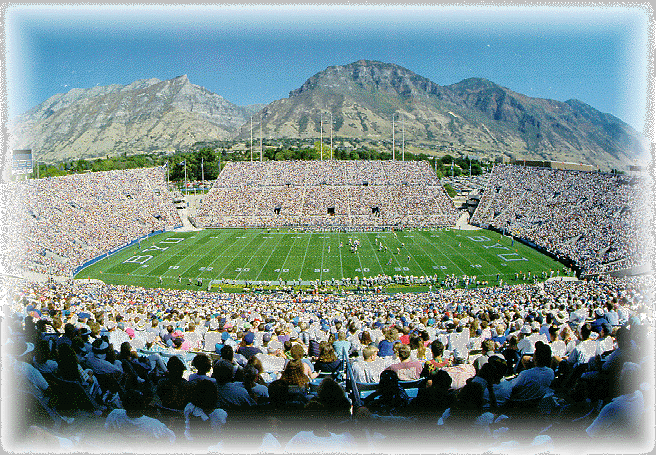
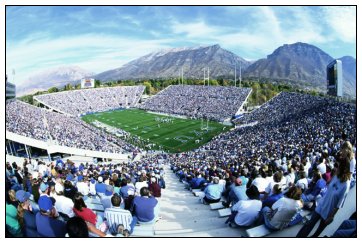
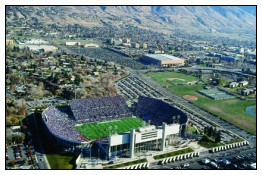
Cougar Stadium, with its 65,000-seat capacity, huge video scoreboards, and immaculate press boxes, is home to legendary BYU football. Since its expansion in 1982, the stadium has consistently ranked among the nation's top 25 in attendance every year. Some of the stadium's well-known features include a box-bowl seating configuration, a grass playing surface and a four-level press box. The Field The field is covered with a sand-based natural turf capable of draining eight inches of rain per hour. The well-kept grass field is consistently deemed one of the best in the country. Press Box In 1982, 1988 and 1997 the Football Writers Association of America cited BYU for its "outstanding press box working area." The Cougar Stadium press box has been named the "Provo Marriott" by the media who cover BYU football. Rising over 10 stories high, the four-level press box is located on the west side of the stadium and runs the entire length of the stands. Levels one and two of the press box contain 42 private loges, each one equipped with 12 padded chairs, a television, radio, telephone, refrigerator, sink and game programs. The BYU President's box, which includes 163 padded chairs, five television sets and a buffet area, is also located on the first floor. Level three is reserved for the print and electronic media along with all the game operators. The statistics, public address, sound and scoreboard controls are all located on the third level. Altogether, approximately 300 people work on the third level during games. Level four is primarily used for television game filming. The Early Years BYU football hasn't always had the luxury of Cougar Stadium. When BYU began its football program in 1896, pasture lands and city parks were the playing fields. In the early 1900's, a rocky field was cleared and a grandstand erected where the Joseph Smith Building now stands. In 1928, the next Cougar playing field was built where the Stephen L. Richards Building now stands. By using the hillside for seating, the spectator accommodation was increased from a few hundred to five thousand. As BYU football increased in popularity, the university was forced to find yet another location for a new stadium. Groundbreaking for the current Cougar Stadium commenced in October, 1963. The initial seating capacity was set at 28,812 but soon increased to 35,000. Last Expansion As a result of increased seating demands, BYU made yet another renovation in 1982, adding stands to the north and south end zones, lowering the field eight feet and removing the track surrounding the field (which hosted the 1967 and 1975 NCAA Track and Field Championships). The stadium expansions increased the seating capacity to over 65,000. The crowd of 64,253 that gathered for BYU's first game in the expanded stadium on September 25, 1982 was reported at the time as "the largest gathering ever in Utah history." |
 |
 |
 |
 |
 |
|
|
|
|
|
|
|
|||||