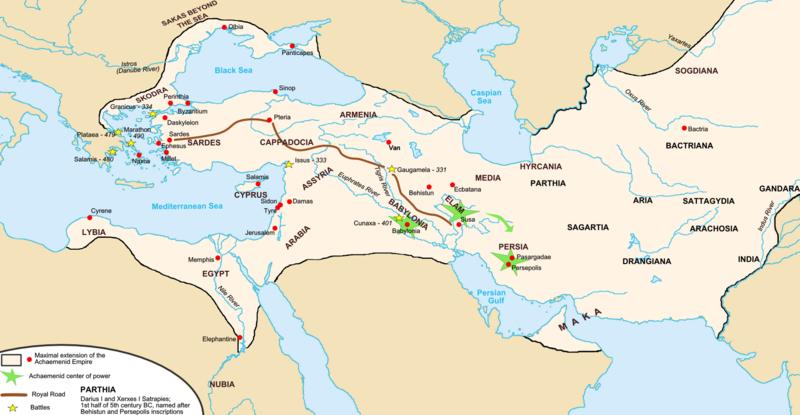
The Achaemenian Empire (559–330 BCE) at its greatest extent.Main articles: Zayandeh Rud civilization, Jiroft civilization, Elam, Median Empire, and Achaemenid Empire Dozens of pre-historic sites across the Iranian plateau point to the existence of ancient cultures and urban settlements, centuries before the earliest civilizations arose in nearby Mesopotamia. The written history of Persia (Iran) begins around 3200 BCE with the Proto-Iranian civilization, followed by the Elamites. The arrival of the Aryans (Indo-Iranians) in the third and second millennium BCE and the establishing of the Median dynasty (728–550 BCE) culminated in the first Iranian Empire. The Medes are credited with the foundation of Iran as a nation and empire, the largest of its day, until Cyrus the Great established a unified empire of the Medes and Persians leading to the Achaemenid Empire (648–330 BCE), founded by Cyrus the Great.
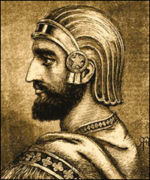
 After Cyrus's death, his son Cambyses continued his father's work of conquest, making significant gains in Egypt. A power struggle followed Cambyses' death and, despite his tenuous connection to the royal line, Darius was declared king (ruled 522-486 BCE). He was to be arguably the greatest of the ancient Persian rulers.
While Darius's first capital was at Susa, he also initiated the construction of Persepolis. He then built a canal between the Nile and the Red Sea, a forerunner of the modern Suez Canal. It is during his reign that mention is first made of the Royal Road (shown on map), a great highway stretching all the way from Susa to Sardis with posting stations at regular intervals.
Under Cyrus the Great and Darius the Great, the Persian Empire eventually became the largest and most powerful empire in human history up until that point, ruling over most of the known world. Their greatest achievement was the empire itself. The Persian Empire represented the world's first global superpower.
The Arg-e Bam citadel, built before 500 BC.The borders of the Persian empire stretched from the Indus and Oxus Rivers in the East to the Mediterranean Sea in the West, extending through Anatolia (modern day Turkey) and Egypt. But in 499 BCE, one of the cities along the cost of Anatolia, Miletus, ruled by a Greek tyrant named Aristagoras, staged a revolt and turned to the Athenians for aid. Until then the Persians had no plan or desire to go into Europe. Subsequently, an Athenian assault on a major Persian province culminated in the sacking and burning of the city of Sardis. It is this event that escalated into what is known as the Greco-Persian Wars, which included encounters such as the Battle of Thermopylae. In 494 BCE the Persians defeated the Greeks at the Battle of Lade, and the coast of Anatolia was once again peaceful.
Alexander of Macedon - referred to as "the accursed" in the Zoroastrian Middle Persian Book of Arda Viraz - invaded Achaemenid territory in 334 BCE, conclusively defeating the last Achaemenid Emperor Darius III at the Battle of Issus in 333 BCE. In 330 BCE, Alexander occupied Persepolis (and according to legend, had it destroyed) and Pasargadae, leaving them and the rest of the Pars province in control of one of his officers before moving on northwards. In the same year, Alexander occupied in quick succession Aspardana (present day Isfahan), Ecbatana in Media (present day Hamadan), Hecatompylos in Hyrancia (present day Mazandaran), Susia in Parthia (in present day North Khorasan). He then turned southwards and occupied Prophtasia in Drangiana (present day Sistan). The next year, in 329 BCE, Alexander took the satrapy capitals at Kandahar in Arachosia, Kabura (Kabul), Bactra (Balkh) in Bactria, and finally Maracanda (Samarkand) in Sogdiana before leaving imperial territory in 328-327. In each of the former Achaemenid territories he installed his own officers as caretakers, which led to friction and ultimately to the partitioning of the former empire after Alexander's death. A reunification would not occur until 700 years later, under the Sassanids (see below). Unlike the diadochic Seleucids and the succeeding Arsacids, who used a vassalary system, the Sassanids - like the Achaemenids - had a system of governors (MP: shahrab) personally appointed by the Emperor and directed by the central government.
After Cyrus's death, his son Cambyses continued his father's work of conquest, making significant gains in Egypt. A power struggle followed Cambyses' death and, despite his tenuous connection to the royal line, Darius was declared king (ruled 522-486 BCE). He was to be arguably the greatest of the ancient Persian rulers.
While Darius's first capital was at Susa, he also initiated the construction of Persepolis. He then built a canal between the Nile and the Red Sea, a forerunner of the modern Suez Canal. It is during his reign that mention is first made of the Royal Road (shown on map), a great highway stretching all the way from Susa to Sardis with posting stations at regular intervals.
Under Cyrus the Great and Darius the Great, the Persian Empire eventually became the largest and most powerful empire in human history up until that point, ruling over most of the known world. Their greatest achievement was the empire itself. The Persian Empire represented the world's first global superpower.
The Arg-e Bam citadel, built before 500 BC.The borders of the Persian empire stretched from the Indus and Oxus Rivers in the East to the Mediterranean Sea in the West, extending through Anatolia (modern day Turkey) and Egypt. But in 499 BCE, one of the cities along the cost of Anatolia, Miletus, ruled by a Greek tyrant named Aristagoras, staged a revolt and turned to the Athenians for aid. Until then the Persians had no plan or desire to go into Europe. Subsequently, an Athenian assault on a major Persian province culminated in the sacking and burning of the city of Sardis. It is this event that escalated into what is known as the Greco-Persian Wars, which included encounters such as the Battle of Thermopylae. In 494 BCE the Persians defeated the Greeks at the Battle of Lade, and the coast of Anatolia was once again peaceful.
Alexander of Macedon - referred to as "the accursed" in the Zoroastrian Middle Persian Book of Arda Viraz - invaded Achaemenid territory in 334 BCE, conclusively defeating the last Achaemenid Emperor Darius III at the Battle of Issus in 333 BCE. In 330 BCE, Alexander occupied Persepolis (and according to legend, had it destroyed) and Pasargadae, leaving them and the rest of the Pars province in control of one of his officers before moving on northwards. In the same year, Alexander occupied in quick succession Aspardana (present day Isfahan), Ecbatana in Media (present day Hamadan), Hecatompylos in Hyrancia (present day Mazandaran), Susia in Parthia (in present day North Khorasan). He then turned southwards and occupied Prophtasia in Drangiana (present day Sistan). The next year, in 329 BCE, Alexander took the satrapy capitals at Kandahar in Arachosia, Kabura (Kabul), Bactra (Balkh) in Bactria, and finally Maracanda (Samarkand) in Sogdiana before leaving imperial territory in 328-327. In each of the former Achaemenid territories he installed his own officers as caretakers, which led to friction and ultimately to the partitioning of the former empire after Alexander's death. A reunification would not occur until 700 years later, under the Sassanids (see below). Unlike the diadochic Seleucids and the succeeding Arsacids, who used a vassalary system, the Sassanids - like the Achaemenids - had a system of governors (MP: shahrab) personally appointed by the Emperor and directed by the central government.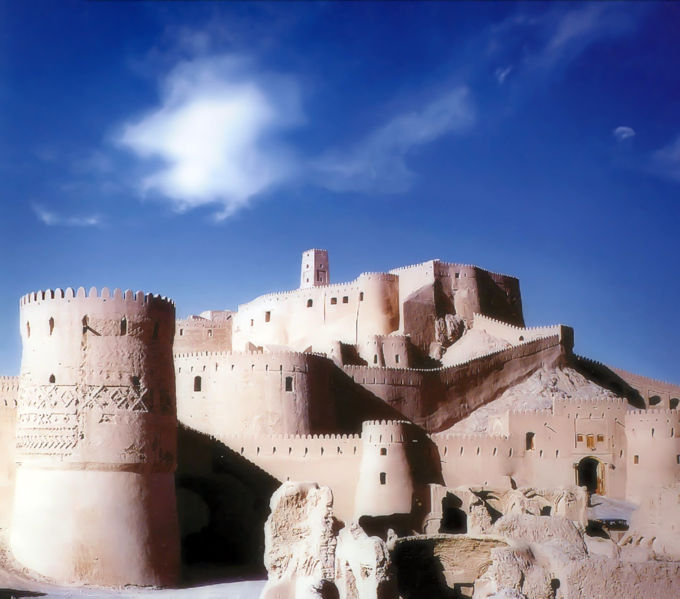
 Main articles: Parthian Empire and Seleucid Empire
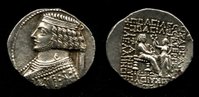
Parthia was led by the Arsacid dynasty, who reunited and ruled over the Iranian plateau, after defeating the Greek Seleucid Empire, beginning in the late third century BCE, and intermittently controlled Mesopotamia between ca 150 BCE and 224 CE. These were the third native dynasty of ancient Iran (Persia) and lasted five centuries.
Parthia was the arch-enemy of the Roman Empire in the east, limiting Rome's expansion beyond Cappadocia (central Anatolia). By using a heavily-armed and armored cataphract cavalry, and lightly armed but highly-mobile mounted archers, the Parthians "held their own against Rome for almost 300 years".[17] Rome's acclaimed general Mark Antony led a disastrous campaign against the Parthians in 36 BCE in which he lost 32,000 men. By the time of Roman emperor Augustus, Rome and Parthia were settling some of their differences through diplomacy. By this time, Parthia had acquired an assortment of golden eagles, the cherished standards of Rome's legions, captured from Mark Antony, and Crassus, who suffered "a disastrous defeat" at Carrhae in 53 BCE.
Parthian remains display classically Greek influences in some instances and retain their oriental mode in others, a clear expression of "the cultural diversity that characterized Parthian art and life". The Parthians were innovators of many architecture designs such as that of Ctesiphon, which later on "influenced European Romanesque architecture".
Main articles: Parthian Empire and Seleucid Empire
Parthia was led by the Arsacid dynasty, who reunited and ruled over the Iranian plateau, after defeating the Greek Seleucid Empire, beginning in the late third century BCE, and intermittently controlled Mesopotamia between ca 150 BCE and 224 CE. These were the third native dynasty of ancient Iran (Persia) and lasted five centuries.
Parthia was the arch-enemy of the Roman Empire in the east, limiting Rome's expansion beyond Cappadocia (central Anatolia). By using a heavily-armed and armored cataphract cavalry, and lightly armed but highly-mobile mounted archers, the Parthians "held their own against Rome for almost 300 years".[17] Rome's acclaimed general Mark Antony led a disastrous campaign against the Parthians in 36 BCE in which he lost 32,000 men. By the time of Roman emperor Augustus, Rome and Parthia were settling some of their differences through diplomacy. By this time, Parthia had acquired an assortment of golden eagles, the cherished standards of Rome's legions, captured from Mark Antony, and Crassus, who suffered "a disastrous defeat" at Carrhae in 53 BCE.
Parthian remains display classically Greek influences in some instances and retain their oriental mode in others, a clear expression of "the cultural diversity that characterized Parthian art and life". The Parthians were innovators of many architecture designs such as that of Ctesiphon, which later on "influenced European Romanesque architecture".
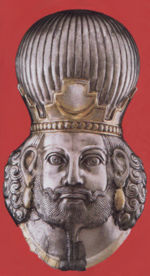 The end of the Parthian Empire came in 224 CE, when the empire was loosely organized and the last king was defeated by Ardashir I, one of the empire's vassals. Ardashir I then went on to create the Sassanid Empire. Soon he started reforming the country both economically and militarily.
\The Sassanids established an empire roughly within the frontiers achieved by the Achaemenids, with their capital at Ctesiphon, and called their empire Erânshahr (or Iranshahr, "Dominion of the Aryans", i.e. of Iranians).
The end of the Parthian Empire came in 224 CE, when the empire was loosely organized and the last king was defeated by Ardashir I, one of the empire's vassals. Ardashir I then went on to create the Sassanid Empire. Soon he started reforming the country both economically and militarily.
\The Sassanids established an empire roughly within the frontiers achieved by the Achaemenids, with their capital at Ctesiphon, and called their empire Erânshahr (or Iranshahr, "Dominion of the Aryans", i.e. of Iranians). During their reign, Sassanid battles with the Roman Empire caused such pessimism in Rome that the historian Cassius Dio wrote:
“ Here was a source of great fear to us. So formidable does the Sassanid king seem to our eastern legions, that some are liable to go over to him, and others are unwilling to fight at all."
”
The Romans suffered repeated losses particularly by Ardashir I, Shapur I, and Shapur II. During this period the religion of Mithraism as restructured by Prophet Zoroaster, was practiced throughout the Roman Empire and became particularly popular among Roman Soldiers.
Under the Sassanids, Persia expanded relations with China, the arts, music, and architecture greatly flourished, and centers such as the School of Nisibis and Academy of Gundishapur became world renowned centers of science and scholarship.
After roughly six hundred years of confrontation and rivalry with the Roman Empire, raids from the Arab peninsula began attacking the Sassanin and Byzantine frontiers in which a war-exhausted Persia was defeated in the Battle of al-Qâdisiyah, paving way for the Islamic conquest of Persia.
During their reign, Sassanid battles with the Roman Empire caused such pessimism in Rome that the historian Cassius Dio wrote:
“ Here was a source of great fear to us. So formidable does the Sassanid king seem to our eastern legions, that some are liable to go over to him, and others are unwilling to fight at all."
”
The Romans suffered repeated losses particularly by Ardashir I, Shapur I, and Shapur II. During this period the religion of Mithraism as restructured by Prophet Zoroaster, was practiced throughout the Roman Empire and became particularly popular among Roman Soldiers.
Under the Sassanids, Persia expanded relations with China, the arts, music, and architecture greatly flourished, and centers such as the School of Nisibis and Academy of Gundishapur became world renowned centers of science and scholarship.
After roughly six hundred years of confrontation and rivalry with the Roman Empire, raids from the Arab peninsula began attacking the Sassanin and Byzantine frontiers in which a war-exhausted Persia was defeated in the Battle of al-Qâdisiyah, paving way for the Islamic conquest of Persia.
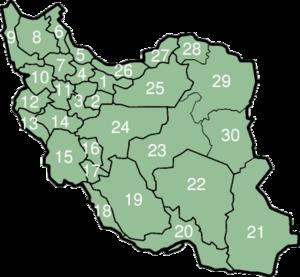 4. Qazvin