It has been six months since your death and still I feel as if it happened only yesterday. If only you could have known how much pain your passing could inflict on a family now reduced to two. If only God could have spared you. Your passing seems to have affected Father the most, though I miss you dearly. His eyes have lost their cheerful twinkle, the bright blue fading into solemn grey. He walks alone most days, mumbling to himself about something or another, speaking only if he is spoken to or if he has to address the workers. He carries about him the air of a rainy day. Even the tumbling street performers that wander through our part of town can?t cheer him up1. It pains me to see him so helpless, so confused, and so distraught.
I find it amazing that so many emotions could be crammed into the mind of one depressed, middle-aged man. Kara once said to me, on one of those long and dull days when father addresses the workers, that ?if you don?t empty your mind onto paper or some other substance, your head will be so tightly crammed with thoughts that it will explode into a million pieces?. Naturally that would be something that Kara would say, as she is a 14-year-old ignorant immigrant worker that works for father in the factory, but I do feel that she has a point. One should have an outlet into which to pour out one?s thoughts. That is perhaps one of the reasons I started this typed diary. Using my shining metal typewriter to write to you2 seems to calm me in these unstable times. Sometimes I wish I could just sit and write to you forever, but I know that I cannot. Life must go on and people must learn to deal with these things, though I don?t see how I will ever be the same person that I was in my early childhood.
Your loving daughter,
Elizabeth
Dear Mother, February 27, 1911
Have you heard of Henry Longfellow? Oh of course you have, you having read every book in father?s library. Isn?t he an enchanting poet3? On gloomy days when the sun refuses to show its cheerful face, I love to sit on my window seat and read his works for hours and hours4. Father thinks it is a waste of my time, but what else am I to do? My favorite poem of his is the one about the Indian hero, ?Song of Hiawatha?5. The courageous deeds of the brave warrior truly fascinate me. I wonder if Hiawatha ever did exist. Longfellow speaks so knowledgably about his life that it almost confirms the fact6.
Longfellow has deeply inspired me to find a new passion: writing. I love pouring ideas onto paper, creating a whole new world of fantasies. What I do not understand is why Father ignores the fact that I love writing and refuses to even look at my new pieces. Every time I try to go to him for suggestions and revisions, he dons an angry face that comes out of nowhere and starts lecturing me on how women of our class shouldn?t be doing things like reading and writing, or working for that matter. Has he forgotten that you were a suffragette?
Your loving daughter,
Elizabeth
Dear Mother, March 3, 1911
Today Father made a speech to all the workers out in the glaring sun. He wanted to explain to them why he wasn?t investing in this new invention that could keep people cool indoors on a hot day. Some of the overseers had approached Father about installing ?air conditioning?7 to make the working conditions bearable in the hot, blistering summers of New York City. Father refused this plea, privately saying that it wouldn?t last like many of the new inventions in the time, and that it would most likely break down in two days, costing him an outrageous price for a worthless piece of trash. Father can be so stubborn about accepting new things sometimes! It drives Max Blanck, Father?s co-worker and co-owner8, insane!
I haven?t the slightest idea why Father made me come along to hear his speech. It was very dull, for the most part, but I had a stroke of luck. Mary Blanck was there; her father had dragged her along as well. Poor Mary! The powerful wind decided to play a practical joke on her and blew her hat into the river. Now the sun burned her skin as red as an Indian. She is so ashamed!9 I asked her to attend brunch with me tomorrow but she said that she doesn?t want to be seen in public; she doesn?t want to look like a worker of our fathers?. I tried to tell her that not all the workers are dark and dirty. Some of them are alright, for immigrants.
Take the Irish Kara for instance. She may have some ridiculous ideas, a big mouth, and an annoying habit of nagging people until they finally give in just to silence her, but she can be pleasant and humorous. She is convinced that I am Irish just because I have brilliant green eyes like her (but blond hair, not red). Despite the fact that she keeps reminding me about looking Irish every time I see her, she can be polite and is she easy to talk to. I feel as if Kara is starting to grow on me. One day she was just another one of the gloomy, complaining immigrants, and now, she is a bright and energetic teenager with whom I can converse freely. Maybe the reason why I so easily befriended her was that she had read a few of Henry Longfellow?s poems including ?Song of Hiawatha? and ?Evangeline?.10 I knew from that moment that we would be great friends. She said she wants to die a heroine, like Hiawatha, except he was a hero. I don?t know why. It?s probably another one of her ridiculous fantasies. I wish you could meet Kara. You might enjoy her company, but of course you can?t because you are gone.
Your loving daughter,
Elizabeth
Dear Mother, March 19, 1911
I feel I must address this issue with you now that it is at the top of my mind and has been so for a while. As I have told you before, Father strongly opposes the idea of me writing. It never has been clear to me, but was father against you being a suffragette11? Whenever I was around him it didn?t seem like he had much of a problem with it, but could I be wrong?
Kara told me yesterday that she had heard one of the overseers talking about that dreadful disease that claimed your life, tuberculosis. He had said that it spreads easily through large groups of people13. Could going to that women?s rights convention have exposed you to tuberculosis? If that was the case, would that make father angry at the women?s rights movement for causing the disease that led to your death and to so much pain in the family? Could that be the reason he is all of a sudden saying women shouldn?t be doing things like reading and writing12? I just don?t understand! I wish so hard that he would acknowledge the fact that I am eager to learn and write, but he turns a blind eye! I want so much to be like Henry Longfellow, or another famous author, with my works widely known, but I feel as if there is a large barrier blocking my way! Oh Mother, please help me! Please help Father see reason!
Your loving daughter,
Elizabeth
Dear Mother, March 24, 1911
When I expressed my feelings to Kara about Father not wanting me to write, she gave me an indescribable look and launched into telling the tale of her life. It impacted me so that I feel I must share it with you.
Kara grew up in the Irish part of town on the sooty streets of New York. She started working in the factory at age 11, making no more than $1.50 a week14. I had no idea that Father paid his workers so little! She described the long laborious hours in the crowded factory rooms that were strewn with mountains of fabric scraps, the sounds of rumbling, hungry bellies, and the smells of sweat and grime, poisoning the air15. It shocked me to hear this, as Father had always bragged about his clean, flawless factory.
Kara?s mother died of tuberculosis when she was twelve. Being one of the oldest, she had to take care of the family and make enough money for them to live on16. She told me of all her struggles trying to take care of her family. Like many other workers, Kara did not attend school because she had to work17.
It is hard to describe the horrible feeling that built up inside me when I listened to her tales. A twisted knot of guilt sat heavily on my heart as I thought of all the wonderful things you and father have given me and done for me. I felt so ashamed to think that I had ever complained about the smallest things, like Father ignoring my writing, or my having to go with Father to a speech he made, when here, thousands of people were living miserable lives. She challenged me to look at every single one of the workers and see them as a respectable human being. She left me there, in my own little world, full of remorse and thinking about what she had just asked me to do. I swear on my honor that I will try and do as she requested.
Your loving daughter,
Elizabeth
Dear Mother, March 25, 1911
My hand shakes as I write to you this evening, for the horror from the days events still fill me. I will not be surprised if this news is plastered all over the front page of the New York Times tomorrow18; heaven knows it was a day to remember in that sorrowful way.
I woke up this morning to find the sun looking troubled. Instead of smiling down on the city as it normally does, it seemed to have a weary, foreboding shine. I felt the same way as I did the day you died. I felt death in the air. Death is hard to describe and yet its presence is very real.
The morning air felt thick and still. There seemed to be less noise coming from the city. The birds didn?t sing, the wind didn?t rustle the leaves, and there seemed to be hardly any of the new, beautiful, gleaming Model T cars19 honking about the streets, perhaps a foreshadowing of what would happen later that day.
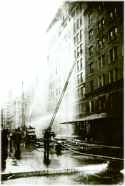
Then I heard it. The shrill panicked scream of ?FIRE!? emerged from the factory across the street, Father?s factory, The Triangle Shirtwaist Factory20! I didn?t believe there really could be a fire, for Father had paid a lot of money to ensure that the building was made out of a new fire proof material21. However, here it was glowing bright and orange right in front of my eyes. Thick black smoke streamed out of the windows as bundles of cloth came hurtling to the ground22. With horror, I realized that they were not bundles of cloth but factory girls, desperately choosing to jump to their deaths instead of being swallowed by the swiftly moving Fire.23 The flames licked out the windows, groping for another girl dressed in a simple shirtwaist and long flowing skirt24, another innocent soul.
Sounds of sirens could be heard as the fire truck went racing around the corner of Greene Street and Washington Place25. To the dismay of the quickly gathering crowd, the ladders on the fire truck only reached the 6th floor of the building and the fire was on the 8th and 9th!26 More bodies plunged to the ground, falling for a brief moment, and then hitting the ground, suddenly lifeless.
Some people tried running down the fire escape, but the heat from the fire and the pressure and weight of the people was too much for the weak metal stairs. They crumpled and crashed to the ground, carrying the people down with them27.
Some were trapped in the building; others jumped to their death or died on the falling fire escape28. I witnessed the whole incident from my safe and cozy little window seat. It was the most horrifying thing I have ever seen! I can?t describe the feeling of shock and horror that still remains inside me, or the waking nightmares that already haunt me. I feel like crying out the words of Longfellow in his poem ?Day is Done?, ?Come read to me some poem, some simple heartfelt lay that shall soothe this restless feeling and banish the thoughts of the day?.29
Outside police and fireman are still searching for more bodies; I can only pray that Kara is not dead. I don?t know if I could stand one more death in my life.
Your loving daughter,
Elizabeth
Dear Mother, March 27, 1911
Once again, grief has captured me in its grasping arms. My worst fears have been confirmed; Kara was found dead near one of the windows on the top floor. According to one of the girls that escaped through that window and lived, Kara had been helping people climb up onto the roof to jump across the rooftops of buildings to safety.30 I guess she got her wish, for she certainly died a heroine.
As I look out the window to the devastated building, I think of all those workers who perished. I think of what Kara recounted to me that day before the fire. Everything flashes before me like a silent motion picture31, black and white, black and white, flashing, flashing?
Your loving daughter,
Elizabeth
Dear Mother, March 28, 1911
Today I attended one of the many funerals for all the 146 workers that died in the fire32. So many families and friends were there, gathered in respect for their lost loved ones. A lone rose lay mournfully in the debris of the building, my rose, for Kara. On a tag tied to the rose I wrote, ?To the greatest heroine I ever knew?. In her honor, I stood alone at the edge of the still smothering site, and read ?Song of Hiawatha?, her favorite poem, to the empty, blackened building.
Your loving daughter,
Elizabeth
Dear Mother, April 10, 1911
Poor Father is in mountains of trouble. People think that he is responsible for the fire and he is being charged with manslaughter in the first and second degree. He might have to go to jail!33 Although I feel badly for him for having to take all this blame, there is a part of me that feels that he is somehow responsible for Kara?s death. I know it is silly of me, and I know that Father couldn?t have done anything to prevent the fire. Nevertheless, it is natural to look for a scapegoat.
Why do so many bad things have to happen all at once? Why do I have to feel so confused? Why can?t I just be like one of Henry Longfellow?s peaceful characters without a problematic life34? I am still having trouble forgiving Father for opposing my desire to write and also for being somehow responsible for Kara?s death, but I know that I must because I am the only person he has left for support and he is all that I have too! What am I to do Mother? What am I to do?
Your loving daughter,
Elizabeth
Dear Mother, April 29, 1911
Some good news has lit a lamp in these dark times; Father will not have to go to jail after all. The best legal minds of our time defended the right of shop owners to resist government safety regulation35. Although the trials were long and stressful, Father and Mr. Blanck have been acquitted of all charges36.
Lately Father has been digging through some of your old things. Maybe he finds comfort in them, I don?t know. He seems to be clearing other things out too, not just your things, but all of ours. I wonder if he is trying to purge the house of sad memories. Who knows?
Your loving daughter,
Elizabeth
Dear Mother, May 1, 1911
On one of his mad attempts to cleanse the house of clutter, Father came across an unopened letter from you to him. I snuck a peek at the envelope before Father shooed me out of the room - it said it was to be opened after your death. I didn?t get a chance to look at the letter, but something you said in there must have touched Father?s heart and made him see reason. He took me aside and apologized for being so arrogant and for ignoring my passion for writing. He even offered to take a look at some of my works and give me some suggestions! Thank you so much Mother!
Another satisfying little joy has happened, though I feel guilty to admit that I am pleased about it- Father probably will have to pay a 75 dollar fine to each of the 23 families that are suing him37. I know it is wrong of me to celebrate this occurrence, but now I finally feel that Kara?s death has been vindicated.
I think about my last conversation with Kara a lot these days. After experiencing so much tragedy in my life, I am learning to look through the eyes of others. I can see how difficult the worker?s lives must have been, how hard they toiled, how much they tried. Out of respect to them and to Kara, I have resolved to dedicate my abilities with the pen to writing about their lives, proclaiming to the world their story. Maybe I can?t do much, but maybe I can make a small difference to better the lives of future immigrant workers, to prevent them from having to deal with the same tragic life as those before them.
Your loving daughter,
Elizabeth