
My Daugther
Dying To Be Thin
Her Eating Disorder
I made this Page to Help others Like Myself to Understand
What may be going on in your childs Life or a family or even maybe a friend
Like Myself my Daughter is a Belimic
She was 13 yrs old
She started losing weight fast in 7 weeks
she had lost about 50lbs
she weight 160 lbs and kids at school started making fun of her
so she decide to do something about it
She would eat everything in sight then would go and stick
her fingers down her throat to bring everything back
Shortly after that she didn't need her fingers anymore she just couldn't keep food down
Just before her 14 birthday she weighed about 80 lbs and
stayed there for a long time
Finally the Doctor Placed her in great hospital & program and she
started to gain weight and getting better she now weight 110 lbs and trying to not lose weight
But she will battle this all her life
So I want people to know what to look for and to understand it a
bit. If you know someone that is going through this
Please don't look the other way and think this will go away
Because it won't without Professional Help
This is Very Serious and it can be Fatal
If you don't get help.

Bulimia Nervosa

�
The Bulimic eats compulsively and then purges through self
induced vomiting, use of laxatives, diuretics, strict diets,
fasts, vigorous exercise, or a combination of the above to
prevent weight gain. The addictive binge purge cycle is
often done in secret and progresses from once or twice a
week to multiple times a day. Without treatment, Bulimia
Nervosa can be fatal.
�
Eating Disorders Warning Signs
�
Exhibit concern about their weight and make attempts to
control weight by diet, vomiting or laxative and diuretic abuse.
Eating pattern may alternate between binges and fasts
Most are secretive about binges and vomiting
Food consumed during a binge has a high caloric content
Majority of individuals are within a normal weight some may be slightly underweight or overweight
Depressive moods and self-deprecating thoughts following a binge
Anorexia Nervosa
�
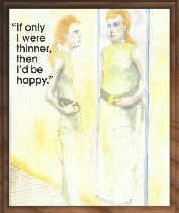
In the obsessive pursuit of thinness, Anorexics starve
themselves and often become malnourished. Restrictive
dieting, body image distortion, compulsive exercise,
laxative and diuretic abuse are some of the characteristics of the disease.
Anorexia Nervosa is left untreated, it can be fatal.
�
Eating Disorders Warning Signs
Abnormal weight loss of 25% of more with no know medical illness accounting for the loss.
Reduction in food intake, denial of hunger and decrease in
consumption of high carbohydrate and fat-containing foods.
Prolonged exercising despite fatigue and weakness.
Intense fear of gaining weight.
Peculiar patterns of handling food.
Amenorrhea in women.
Some exhibit bulimic episodes of binge-eating followed by
vomiting and/or laxative and diuretic abuse.
How to help someone you care about
Your biggest problem will be convincing the person to get
help. At first s/he will deny there is a problem. S/he will
fear weight gain and resist it mightily. S/he will be
ashamed and not want to admit what s/he is doing. S/he has
used the eating disorder to protect, comfort, and empower
her/himself. In the beginning, at least, s/he will not want to give it up
Tell the person you are concerned, that you care and would
like to help. Suggest that the person seek professional
help from a physician and/or a therapist.
If the person refuses to seek professional help, encourage
reaching out to an adult such as a teacher, school nurse or counselor.
DO NOT discuss weight, the number of calories being
consumed, or particular eating habits. Do try to talk about
things other than food, weight, counting calories and exercise.
Avoid making comments about a person's appearance. Concern
about weight loss may be interpreted as a compliment,
comments regarding weight gain may be felt as criticism.
It won't help to become involved in a power struggle. You
can't force the person to eat.
You can offer support. Ultimately, however, the
responsibility and the decision to accept help and to change
rests with the person
If your child is younger than eighteen
Get professional help immediately. You have a legal and moral
responsibility to get your child the care s/he needs. Don't
let tears, tantrums, or promises to do better stop you.
Begin with a physical exam and psychological evaluation.
If the physician recommends hospitalization, do it. People die
from these disorders, and sometimes they need a
structured
time out to break entrenched patterns.
If the counselor asks you to participate in family sessions,
do so. Children spend only one or two hours a week with
their counselors. The rest of the time they live with their
families. You need as many tools as you can get to help your
child learn new ways of coping with life.
Index
�
�
|
|