| By Patrick Burns |
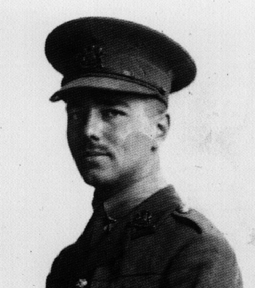
The great British poet Wilfred Owen was born on the 18th of March 1893, in Owestry, England. As his parents were both of Welsh origin, Owen was well aware of his Celtic ancestry, and once wrote that Celtic blood "makes poets sing and prophets see." An apt pupil, young Wilfred enjoyed studying the earth sciences as much as he loved literature, becoming a keen amateur botanist, astronomer, and geologist. After leaving school, Owen made an unsuccessful attempt to get into university, so as a temporary measure before trying again, he found a vicar willing to tutor him in return for unpaid work. Although it pleased his very religious mother, Owen was eager to earn tuition and leave the vicarage, and when the money failed to materialize, he left. Owen did some psychological wandering for a while, tutored in England and France, and by 1915 had found himself at a crossroads; he knew poetry was his true calling, but more grounded matters became immediately pertinent, such as money. In October 1915, due to the pressures of his parents, encouraged by propaganda posters and a quote he encountered in an essay by Hillaire Belloc ("If any man despairs of becoming a poet, let him carry his pack and march in the ranks") and Flaubert’s gruesome war novel Salammbo, a highly gruesome and vivid novel which would inspire the great poems of Owen that were yet to come (Hibberd, pp.443-460). Owen would write poetry throughout his war years, using his experiences in battle and its aftermath as inspiration for his poems. In January 1917, Officer Owen was concussed badly at the Somme region of France after a shell hit just two yards away; after spending seven days in the crater with a fellow officer’s mangled corpse, he was transported to Craiglockhart War Hospital, where he met a major supporter of his work, poet Siegfred Sassoon. Another writer also met Owen at this Craiglockhart hospital: Robert Graves, who suggested Owen write in a more direct and colloquial style. In the next few months, Owen would write four poems that are likely to be his most powerful and famous: Anthem for Doomed Youth, Dulce et Decorum Est, Disabled and Strange Meeting. In the second week of March 1918, Owen was declared fit for active duty and returned to lead a company in France. Owen would survive the great German offensive that occurred after the imperial troops secured their eastern front; however, Wilfred Owen failed to survive a direct artillery fire as his company crossed the Sambre Canal in France, only two weeks before the armistice would be signed between the sides. Sassoon would be a major player in the effort to get Owen’s poetry published after his death.
Anthem for Doomed Youth
What passing bells for those who die as cattle?
Only the monstrous anger of the guns.
On the stuttering rifles’ rapid rattle
Can patter out their hasty orisons.
No mockeries for them from prayers or bells,
Nor any voice of mourning save the choirs,
The shrill, demented choirs of wailing shells;
And bugles calling for them from sad shires.
What candles may be held to speed them all?
Not in the hanks of boys, but in the eyes
Shall shine the holy glimmers of good-byes.
The pallor of girls’ brows shall be their pall;
Their flowers the tenderness of patient minds,
And each slow dusk a drawing-down of blinds.
from www.spartacus.schoolnet.co.uk/Jowen.htm
Critic Dominic Hibberd writes that Owen had a female fatalist view to the effect that he blames them as a major cause of young men’s drive to go to war
Another aspect of Anthem that makes the poem stand out from many of Owen's others is the fact that there is a definite rhyme scheme. Owen is known for more incomplete rhymes such pararhyme, which are pairs of words with similar consonant sounds before and after unlike vowels, such as "braid/brood" or "leaves/lives". Anthem’s definite rhyme scheme leads to the fact that it’s a sonnet; the form adds to the ode-ness of the poem and gives it much more of a sad eulogic feeling.
Anthem is indeed what it is stated to be; Owen, as an officer in the British Army, has seen how low and dismal deaths young men meet at war, and what brought them to these deaths. As the above critics have stated, Owen has performed a very good median between poetry and editorial and elegy; the poem is masterful in its simplicity and impact.

Let the boy try along this bayonet-blade
How cold steel is, and keen with hunger of blood;
Blue with all malice, like a madman’s flash;
And thinly drawn with famishing for flesh.
Lend him to stroke these blind, blunt bullet-heads
Which long to nuzzle in the hearts of lads,
Or give him cartridges of fine zinc teeth
Sharp with the sharpness of grief and death.
For his teeth seem for laughing round an apple
there lurk no claws behind his fingers supple;
And God will grow no talons at his heels,
Nor antlers through the thickness of his curls.
from The Riverside Anthology of Literature
One aspect of Arms that is a bit startling is the sexuality or at least the intimacy of the tone of the poem; Hibberd in his critique of Owen states that Owen had "innocent" intimate contact with boys during his internship at the vicarage and remained at least emotionally attached to homosexuality throughout his life. However, the main point seems to be the fascination with weapons and destruction he sees in the young men coming to war; the words Owen uses such as "nuzzle" and "stroke" and the phrases such as "thickness of his curls" and "fine zinc teeth" and "hunger of blood" all show this. Although Owen makes the point in the first two quatrains of Arms that these objects that the young men going to war are so intimate with are indeed objects of destruction and death, the last quatrain seems to be the strongest point he tries to make: That men do not seem to be made for the death and destruction that the weapons they are fascinated with represent; God has made them to enjoy the fruits of life and be beautiful, not destroy life and everything that surrounds it.
The alliteration is quite noticeable in Arms. "Famishing for flesh." emphasizes the hunger for action that Owen attempts to get across in the poem; "blind, blunt bullet-heads" uses the repetition of the hard b’s to make the reader realize the harsh, simple reality of the subject; "sharp with the sharpness" is emphasis on what kind of deathly sharpness the bayonet really represents.
Hibberd, Dominic. "Wilfred Owen." British Writers. 2nd ed., Vol6. Newark: Huntington Press, 1983, 443-460.
"Wilfred Owen." Online. Internet Explorer. June, 2001. Available: http://www.spartacus.schoolnet.co.uk/Jowen.htm
"Owen, Wilfred." The Columbia Electronic Encyclopedia. Columbia University Press, 2000.
