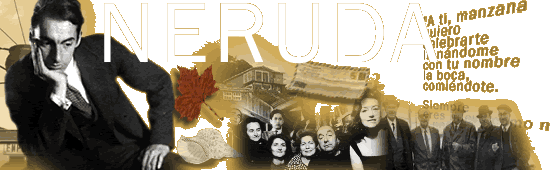
Sus
obras y su
vida
Page by
Allison Hundstad
2001

v Pablo
Neruda is one of the most famous Latin American poets of all time. It is
remarkably difficult to pin down exactly how Neruda writes, because with each
major change in his life, his poetry changed with him. A study of Neruda’s works can only be
complete after connecting his works with the time in his life in which he wrote
them.

v Pablo
Neruda was born on July 12, 1904 in Parral, Chile (Pablo Neruda), as Ricardo
Eliecer Neftali Reyes y Basoalto (Goforth). He was born to don José del Carmen
Reyes Morales, a railway worker, and Posa Basoalto de Reyes, a schoolteacher
that died of tuberculosis shortly after Neruda was born (1904-1973). Neruda took
his pseudonym to keep his literary efforts a secret from his critical family
(Goforth). He took the last name of Neruda to honor Czechoslovak poet Jan Neruda
(1834-1891) (Pablo Neruda).

v Neruda
represented Chile by holding consul positions in many different locations from
Asia to Mexico. He took the consul appointments because he could not afford to work only on his poetry. The Spanish revolutions disillusioned Neruda, and he
became a communist and spoke out against fascist governments (Schade).
v In 1969 and 1970 he
campaigned as the communist choice for president of Chile, but he pulled out of
the race. He put his support behind his friend, the socialist candidate Salvador
Allende (Schade). President Allende appointed Neruda as ambassador to France
(1970-1972). On September 23, 1973, Neruda died in Santiago of leukemia. His
death was probably accelerated by the assassination of President Allende during
the Pinochet coup (1904-1973). In his life he received the Stalin Peace Prize of
1953, a honorary degree from Oxford University in London in 1965, and the Nobel
Prize for Literature in 1971.

v In
Neruda’s life, his poetry went in four main directions, with each direction
matching an aspect of his personality. The first direction, shown in his work
Twenty Love Poems and a Song of Despair (1924), was the tender,
melancholy, sensuous, and emotional love poetry about his passionate love live.
The next course, as seen in Residence on Earth (1925-1935), was material
poetry in which “loneliness and depression immerse the author in a subterranean
world of dark, demonic forces”; these demonic forces came out of Neruda’s
nightmares and his depression that was caused by feelings of isolation in Asia. The
third route was epic poetry, such as the poetry in Canto General (1950),
that sprung from Neruda’s wish to express the grievances of the tyrannized and
the feeble people of the world and to analyze both past and present times Latin
America. His last path took him to poetry of the common, like the odes in
Odas Elemenales (1954), where his “ever-present attention to details of
daily life, his love of things made or grown by human hands” helped him express
the wonder of everyday objects, plants and animals (Assessment).

From
Twenty Love Poems and a Song of Despair
¤ Tonight I Can Write. . .
Tonight
I can write the saddest lines.
Write,
for example, "The night is shattered
and
the blue stars shiver in the distance.'
The
night wind revolves in the sky and sings.
Tonight
I can write the saddest lines.
I
loved her, and sometimes she loved me too.
Through
nights like this one I held her in my arms.
I
kissed her again and again under the endless sky.
She
loved me, sometimes I loved her too.
How
could one not have loved her great still eyes.
Tonight
I can write the saddest lines.
To
think that I do not have her. To feel that I have lost
her.
To
hear the immense night, still more immense without her.
And
the verse falls to the soul like dew to the pasture.
What
does it matter that my love could not keep her.
The
night is shattered and she is not with me.
This
is all. In the distance someone is singing. In the
distance.
My
soul is not satisfied that it has lost her.
My
sight searches for her as though to go to her.
My
heart looks for her, and she is not with me.
The
same night whitening the same trees.
We,
of that time, are no longer the same.
I
no longer love her, that's certain, but how I loved her.
My
voice tried to find the wind to touch her hearing.
Another's.
She will be another's. Like my kisses before.
Her
voice. Her bright body. Her infinite eyes.
I
no longer love her, that's certain, but maybe I love her.
Love
is so short, forgetting is so long.
Because
through nights like this one I held her in my arms
my
soul is not satisfied that it lost her.
Though
this be the last pain that she makes me suffer
and
these the last verses that I write for her.
¤ Neruda, Pablo. Selected Poems.
Boston: Houghton Mifflin/
Seymour Lawrence,
1970.
v Twenty
Love. . .
takes the reader through one of Neruda’s relationships: the first physical
attraction, the confusion about what to do, the lust for the person, the gentle
love once with the person, and the end of the relationship when the narrator is
alone. “Tonight I Can Write. . .” (“Puedo Escribir. . .”) comes at the end of a
relationship when Neruda is recalling the passionate moments he shared with a
woman and the love that he is missing now that she is out of his life and he has
fallen into the consequential loneliness that follows a relationship. One of the
main elements to Neruda’s love poetry is that his beloved is absent in the poem.
It is obvious that the woman is not present in “Tonight I Can Write. . .”
because he speaks of his love in the third person instead of the second person.
Neruda’s verse is written in iambic hexameter. Every stanza except for the two
one-line stanzas (ln1 and ln 4) is a couplet without rhyme. Both consonance and
assonance are seen. Consonance can be found in the line “Tonight I
can write the saddest lines,” and assonance is in line
seventeen: “In the distance someone is
singing.” Alliteration is present throughout the poem: line three
“stars shiver” and line twenty-three “longer love.” The enjambment in lines two
and three stresses the word “shattered” because of where the lines split. Short
simple sentences that repeat a though in the before or after it, such as in line
twenty-five “Another’s. She will be another’s,” and caesura do to short
sentences and end-stopped lines create emphasis. Neruda also formulates emphasis
by repeating lines. He repeats the first line, “Tonight I can write the saddest
lines,” in lines five and eleven. Neruda is able to appeal to the simple reader
by using emotional, realistic diction. Lines such as line twelve “To think that
I do not have her. To feel that I have lost her,” are not cloaked in eloquent,
hard-to-understand language (Schade).

From
Odas Elementales
¤
Ode to the Clothes
Every
morning you wait,
clothes,
over a chair,
for
my vanity,
my
love,
my
hope, my body
to
fill you,
I
have scarcely
left
sleep,
I
say good-bye to the water
and
enter you sleeves,
my
legs look for
the
hollow of your legs,
and
thus embraced
by
your unwearying fidelity
I
go out to tread the fodder,
I
move into poetry,
I
look through windows,
at
things,
men,
women,
actions
and struggles
keep
making me what I am,
opposing
me,
employing
my hands,
opening
my eyes,
putting
taste in my mouth,
and
thus,
clothes,
I
make you what you are,
pushing
out your elbows,
bursting
the seams,
and
so your life swells
the
image of my life.
You
billow
and
resound in the wind
as
though you were my soul,
at
bad moments
you
cling
to
my bones
empty,
at night
the
dark, sleep,
people
with their phantoms
your
wings and mine.
I
ask
whether
one day
a
bullet
from
the enemy
will
stain you with my blood
and
then
you
will die with me
or
perhaps
it
may not be
so
dramatic
but
simple,
and
you will sicken gradually,
clothes,
with
me, with my body
and
together
we
will enter
the
earth.
At
the thought of this
every
day
I
greet you
with
reverence, and then
you
embrace me and I forget you
because
we are one
and
will go on facing
the
wind together, at night,
the
streets or the struggle,
one
body,
maybe,
maybe, one day motionless.
¤ Neruda, Pablo. Selected Poems.
Boston: Houghton Mifflin/ Seymour
Lawrence, 1970.
v In
“Odas Elementales” (1954) he showed the “simplicity and joy in elemental things”
while paying “special homage to things, inanimate objects as well as living
things and a few abstractions and criticisms.” His odes are an optimistic look
at things that are “humble in nature” in order to “spring them to life.” The
odes seem to have been written in the moment of inspiration with a “mixture of
the calculated and the impromptu.” While the odes seem to lack substance or
poetic competency to the untrained reader, in reality “they are attractive to
look at in their short, broken-line typographical disarray, as well as
satisfying in what they have to say to us.” In “Ode to Clothes,” as in the other
odes, Neruda’s tone is light and almost comical at some points, but his subject
is deep and meaningful. In this poem, Neruda is searching for answers about
death by considering what will happen to his clothing when he dies. He
personifies the clothing as a part of him, a piece of his physical self that
feels as he feels. In his odes, Neruda seems to be “searching for metaphysical
answers in the concrete, we find him placing much significance on objects and
things” (Schade).
v

From
Cien sonetos de amor
¤
XLV
Don’t
go far off, not even for a day, because—
because—I
don’t know how to say it: a day is long
and
I will be waiting for you, as in an empty station
when
the trains are parked off somewhere else, asleep.
Don’t
leave me, even for an hour, because
the
little drops of anguish will all run together,
the
smoke that roams looking for a home will drift
into
me, choking my lost heart.
Oh,
may your silhouette never dissolve on the beach;
may
your eyelids never flutter into the empty distance.
Don’t
leave me for a second, my dearest.
because
in that moment you’ll have gone so far
I’ll
wander mazily over all the earth, asking,
Will
you come back? Will you leave me here, dying?
¤
Neruda, Pablo. Cien Sonetos de Amor. Austin:
University
of Texas Press, 1986.
v In
Cien Sonetos. . . Neruda’s sonnets range from those in free verse to
those that are strict iambic pentameter. Unlike many sonnets, Neruda’s are
completely devoid of rhyme, even in the Spanish. XLV has a tone of melancholy,
as the narrator is afraid to be left to die alone. Neruda uses visual imagery to
express his fear of loneliness. He compares himself without Matilde (his wife to
whom he wrote Cien Sonetos. . .) to an image of an empty train station in
lines three and four: “as in an empty station/ when the trains are parked off
somewhere else, asleep.” He is saying that without her he will feel emotionally
drained and he will be as useless as a train that is not running. Stephen
Tapscott, the translator, said, “We don’t have much of a tradition of love
poetry in North America, and these poems seem to introduce attitudes of sensual
joy of a sort that we--Anglophobes, at least--have never been very comfortable
with, nor very adept at expressing.” So, Neruda becomes “a voice of intelligent
sensual joy” (Tapscott).
Works Cited
v
“Assessment.” Encyclopedia
Britannica. On-line. Internet. 14 May 2001.
Availiable:wysiwyg://45/http://www.britannica.com/eb/article?eu=567
5&tocid=5186. (See also: http://www.britannica.com/)
v Goforth, Ray. “Some Thoughts
on Pablo Neruda’s Epic Poem ‘The Heights of
Manchu Picchu.’” On-line.
Internet. 16 May 2001. Available: http://www.wco.com/~altaf/pablo.txt
v “Pablo Neruda.” On-line.
Internet. 12 May 2001. Available:
http://www.nobel.se/literature/laureates/1971/neruda-bio.html
v “Pablo Neruda
(1904-1973).” On-line. Internet. 16 May 2001. Available:
http://www.kirjasto.sci.fi/neruda.htm
v Schade, George D. “Pablo
Neruda.” Scribners. CD-ROM. Vol. 3.: Latin
AmericanWriters, 1989. P.p.
1001-1018.
v Tapscott, Stephen.
Translator’s note. Cien Sonetos de Amor. By Pablo
Neruda.
Austin: University of Texas
Press, 1986. vii-x.
Pictures gathered
from:
v http://www.uchile.cl/neruda/
v http://boppin.com/neruda.html