Ceremony (1950)
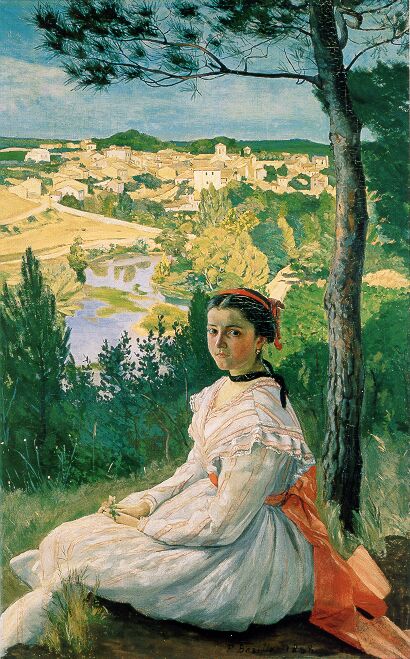 A striped blouse in a clearing by Bazille
Is, you may say, a patroness of
boughs
Too queenly kind toward nature to
be kin.
But ceremony never did conceal,
Save to the silly eye, which all
allows,
How much we are the woods we
wander in.
Let her be some Sabrina fresh
from stream,
Lucent as shallows slowed by
wading sun,
Bedden on fern, the flowers’
cynosure:
Then nymph and wood must nod and
strive to dream
That she is airy earth, the
trees, undone,
Must ape her languor natural and
pure.
Ho-hum. I am for wit and wakefulness,
And love this feigning lady by
Bazille.
What’s lightly hid is deepest
understood,
And when with social smile and
formal dress
She teaches leaves to curtsey and
quadrille,
I think there are most tigers in
the wood.
In this poem, Wilbur emphasizes the importance of ceremonial forms in art and justified his own use of such forms in poetry. The poem itself is written in a very traditional structure, using iambic pentameter and an ABCABC rhyme scheme similar to the concluding sestet of a Petrarchan sonnet. Wilbur uses these styles to reflect his theme.
In the first stanza Wilbur introduces the largely twentieth-century idea of formality being severed from reality and therefore being untrue. However, he swiftly rejects the idea by claiming that formality can never truly separate an object from its natural origin, and that anyone with reasonable intellect should still be able to see the connection, ie that we “are the woods we wander in.”
He goes on to present the alternative to formality, a perfectly accurate representation of nature. However, he points out that such a representation often does not present enough contrast to be of interest, forcing us to “nod and strive to dream” the symbolism of an object meant to represent its origins, when the object is indistinguishable from the origins themselves.
Therefore, he concludes in the third stanza that a formal interpretation is more valuable than a perfectly natural one in that it provides enough contrast to evoke the intellect and also separates an object enough from its origins that it may come to symbolize them. The interest such a “lightly hid” connection provokes creates more “tigers in the wood,” by comparison making the reader or viewer more conscious of both the individual object and its origins.