Biography
Richard
Wilbur was born in 1921, the son of a mother whose family worked in newspaper
editing and a father who was a portrait painter. He grew up in a rental house on the New England estate of an
English millionaire. It was there that
he gained both the intellectual refinement characteristic of much of his poetry
and the love of nature that would serve as the focus for many of his ideas.
In 1938, at the age of 17, Wilbur began
attending Amherst College, where he essentially began his career as a literary
scholar. He studied seventeenth century
metaphysical English poetry and gained an appreciation for finely structured
verse.
He graduated in 1942, after which he enlisted in the US army and
took part in the final days of World War II, including the invasion of southern
France. The tension and uncertainty of
the war was what ultimately caused Wilbur to turn to writing poetry as a means
of security. He used it to make order
of the confusion induced by the war.
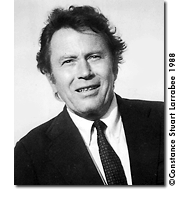 Upon returning to
the US following the war, Wilbur began studies at Harvard College, where he
obtained his MA in 1950. During this
time also his first collection of poetry, Beautiful Changes and Other Poems,
was published. Following his degree he
became an associate professor at Harvard for four years, and after which taught
English at Wellesley and Wesleyan Colleges and worked as a writer-in-residence
at Smith College. During this time he
published several more works of poetry, including Things of This World,
for which he received the Pulitzer Prize.
Upon returning to
the US following the war, Wilbur began studies at Harvard College, where he
obtained his MA in 1950. During this
time also his first collection of poetry, Beautiful Changes and Other Poems,
was published. Following his degree he
became an associate professor at Harvard for four years, and after which taught
English at Wellesley and Wesleyan Colleges and worked as a writer-in-residence
at Smith College. During this time he
published several more works of poetry, including Things of This World,
for which he received the Pulitzer Prize.
In 1987 Wilbur was named the second poet laureate of the United
States by President Reagan, to be followed by Stanley Kunitz. He currently resides in the Berkshire
Mountains in Massachusetts, where he is taking in silence so that he may return
to words with more force.