SOCIAL STUDIES
Unit of Study:
Building a classroom community
Date: Summer 2007
Standard: __
__Government/Civics _X_
Culture/Societies ____Economics ____Geography ____Historical Perspectives
|
Demonstrator(s)
(What I want the students to learn): SS-P-CS-U-2 Students will
understand that cultures develop social institutions (e.g., government,
economy, education, religion, family) to structure society, influence
behavior, and respond to human needs. PL-P-PW-U-3 Students will understand that responsibility to others enhances social interactions skills. |
ESSENTIAL QUESTION & GUIDING QUESTIONS
|
Essential Question: What is your role in
our classroom community? |
|
Guiding Questions: · What is a group? · What is a community? · Why do we need to work together? · Why do we need a community? · How is a group like a community? · What are some jobs people have in a community? · What are some jobs we have in our classroom? · How can you belong to more than one group? · What groups do we belong to? · How is our classroom a group? A community? |
VOCABULARY
|
Community – a
group of people living in a particular area Group – two or more
people gathered together because of common characteristics or interests Jobs People Neighborhood |
RESOURCES AND MATERIALS
|
Items: · Computer with Internet/Ethernet access · Projector hooked up to computer · Projection screen · Printer · Remote tablet connected to computer · Writing/drawing materials such as: paper, construction paper, crayons, markers, pencils · White board or poster paper for teacher to write on · Tennis balls · Poster board, markers, pictures (from magazines) for student posters. · Classroom job signs materials: index cards, sentence strips, or other such material, makers, crayons, etc. · Individual computers for student use with Internet/Ethernet connection and printer access · Hollywood Squares PowerPoint game |
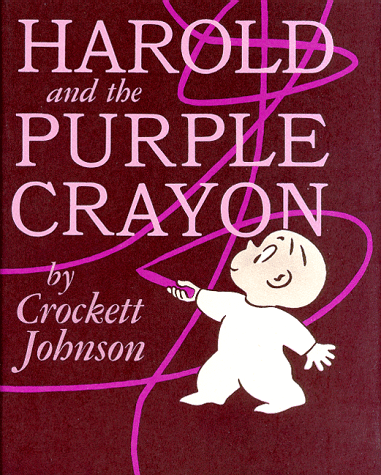
Pint Materials: · Harold and the Purple Crayon by Crockett Johnson (image from http://www.k-state.edu/english/nelp/images/johnson.books/haroldandpurple.gif)
(image from http://www.amazon.com) Your school handout from: http://www.nationalgeographic.com/xpeditions/lessons/01/gk2/gpafrica1.html · Your classroom handout from: http://www.nationalgeographic.com/xpeditions/lessons/01/gk2/gpafrica1.html |
Websites: Activity based: · http://www.readwritethink.org/student_mat/student_material.asp?id=56 · http://www.econedlink.org/cyberteach/tools.cfm ·
Teacher references: · http://www.nationalgeographic.com/xpeditions/lessons/01/gk2/gpafrica1.html · http://www.sciencenetlinks.com/lessons.cfm?BenchmarkID=7&DocID=341 · http://artsedge.kennedy-center.org/content/2373/ · http://www.geocities.com/maryafton/ - click on movie |

ACTIVITIES
#/Date |
Activity |
|
1 |
· Introduce essential question and post in classroom. · Guiding question: What is a group? · In large group define the word group using student ideas. Once definition in formed, post under the essential and guiding questions. · Take virtual field (http://www.geocities.com/maryafton). · After virtual field trip discuss groups we are born into (family, gender, and race) and discuss what a group like this might have in common and groups we join (religion, interest based, and friends) and discuss what a group like this might have in common. · Activity: have all students sit on the carpet and ask them to stand when you say a characteristic (i.e., girls, boys, light hair, dark hair, have a pet, have a brother or sister, like to read, like to play outside, etc.) and with each characteristic as the students if this is a group they were born into or a group that they joined. End with asking all students to stand who go to ___________ elementary school and who are in Ms. Keeton’s class. This emphasizes that we are a group. · For more information go to: http://www.sciencenetlinks.com/lessons.cfm?BenchmarkID=7&DocID=341 |
|
2 |
· Revisit essential question by reviewing previous activities. ·
Guiding question(s): What groups do we belong
to? How can you belong to more than
one group? · Review what the word group means. · As a large group, ask the students to help create a list of different groups that they belong to (teacher writes). Put this list on a T chart with one side being groups we are born into and groups that we join. · Start a discussion about being in more than one group. · Ask students how they can join certain groups. · For more information go to: http://www.sciencenetlinks.com/lessons.cfm?BenchmarkID=7&DocID=341 |
|
3 |
· Revisit essential question by reviewing previous activities. ·
Guiding question(s): What is a group? What groups do we belong to? ·
Review definition of group and discuss how group
members have common characteristics. · Formative assessment: Students draw a picture of a group that they belong to. They should be able to answer the following questions: o What group is this? o Where you born into this group or did you join it? o About how many people are in this group? o What do you have in common with the other members in your group? · For more information go to: http://www.sciencenetlinks.com/lessons.cfm?BenchmarkID=7&DocID=341 |
|
4 |
· Revisit essential question by reviewing previous activities. ·
Guiding question(s): What is a community? · Begin lesson by watching Community video (http://www.geocities.com/maryafton/ - click on movie) and discuss characteristics of a community. · Next watch Brain Pop Jr. video: http://www.brainpopjr.com/socialstudies/communities/ruralsuburbanandurban/ · List characteristics of a community (teacher writes) · Read Harold and the Purple Crayon aloud and ask discussion questions: o What were some of the things that Harold drew? o What adventures did Harold have on his journey? o Did Harold draw a neighborhood? o What is a neighborhood? o How is a neighborhood part of a community? · Revisit list of community characteristics and add to if possible. · For more information go to: http://artsedge.kennedy-center.org/content/2373/ |
|
5 |
· Revisit essential question by reviewing previous activities. · Guiding question(s): How is a group like a community? How is our classroom like a community? · Begin lesson by watching Brain Pop Jr. video: http://www.brainpopjr.com/socialstudies/communities/school/ · Add to list of characteristics of a community by highlighting ways that the classroom is a community (circle common factors or make a T chart. · Work through questions on Your School handout as a whole group on the projection using the tablet to take notes. · For more information go to: http://www.nationalgeographic.com/xpeditions/lessons/01/gk2/gpafrica1.html |
|
6 |
· Revisit essential question by reviewing previous activities. ·
Guiding question(s): What are jobs in the community?
(What would happen if we didn’t have certain jobs in the community?) · Activity: build a community and match jobs in a community at http://www.econedlink.org/cyberteach/tools.cfm · List jobs in the community and discuss why that job is important as a whole group. · Have the students work in small groups to build their own community, describe the jobs in the community and why they chose them. Have them print this out and share explanation with the class. Use activity on http://www.econedlink.org/cyberteach/tools.cfm · Alternate activity (if not all students can be on a computer at the same time) read aloud Jobs Around My Neighborhood/Oficios en mi vecindario |
|
7 |
· Revisit essential question by reviewing previous activities. ·
Guiding question(s): What are some jobs in our
classroom? (What would happen if we
didn’t have certain jobs in the classroom?) · Create a list of jobs for students in the classroom (teacher writes) and discuss why that job is important. Have students create signs for classroom jobs on sentence strips, index cards, or other such material. This activity should be completed in pairs. ·
Formative assessment: · Begin work on summative project. |
|
8 |
· Revisit essential question by reviewing previous activities. ·
Guiding question(s): Why do we need to work
together? ·
Play the student juggling game: o
Have students stand in circle. o
Explain that the students will be tossing (not
throwing) the tennis ball to one student across from them by saying their
name, making sure they are looking and then tossing the ball. Go over rules of safe play. o
Teacher starts with one tennis ball and says a
student’s name across from him/her and tosses the ball to the student. o
Teacher leads the students through choosing a
person across from them, tossing the ball, and keep
it moving so that every person catches and throws the ball once. The ball should create a complete circuit
through all of the students and then return to the teacher. o
Now the teacher starts the ball around again
and monitors the progress of the students.
As the students become more confident the teacher adds in additional
balls. o
Let the students continue on in the game. o
Once the teacher collects all the balls ask
discussion questions: o
Could we have done this activity individually? o
What would have happened if one person did not
do their job? o
What would have happened if one person dropped
a ball? Could we have helped him/her
to do the job? o
How is this game like our classroom? What happens if some one does not do their
job? How can we help if someone makes
a mistake on their job? · Provide work time for summative project. |
|
9 |
· Revisit essential question by reviewing previous activities. ·
Guiding question(s): How is our classroom a
community/group? ·
Discuss the school as a community. o
Where: Where is the classroom located
in the school? Is it close to the cafeteria? Or gym? Or exit doors? Does that
make it noisy? Does it mean students get to lunch, P.E., or recess first? Is
the classroom on the ground floor or second floor? o
What: What is the classroom like? What
goes on in the classroom? What subjects are taught? What events happen? What
do you personally like best about the classroom? Why? o
Who: Who belongs to this class? Why is
each person (student, teacher, aide, etc.) important? o
When: When do students in your class
get dismissed relative to the rest of the school? Is yours the first or last
class to get dismissed because of its location? o How: How is the classroom arranged? Is it large enough for the entire class? How are desks and learning centers arranged? How do students use the different spaces within the classroom? How is it decorated? Why? Is the school itself old or new? Does everything work well in it? How do things like the condition of the heating or air conditioning or having computers in the classrooms affect the students and their learning? o Why: Why is your classroom special? What makes it different from other classrooms? · For more information go to: http://www.nationalgeographic.com/xpeditions/lessons/01/gk2/gpafrica1.html |
|
10 |
·
Revisit essential question by reviewing
previous activities. · Summative assessment: present posters. · Using posters, students’ information, and guiding questions to answer essential question. |
SUMMATIVE EVALUATION
MAKING A POSTER:
Students will make a poster with a partner. The poster will include a title, information
about the classroom, and pictures (drawn or cut out) to support the
information. The information about the
classroom should include how the classroom is a community or group, how the
classroom is a community or group, and how the classroom works as a community
or groups with jobs.