|
Located in Peace Avenue of Shahr-e-Nau of Kabul city was a big building in which women's activities were regularly held. Branches of Women's Association used to organize their activities in this building years before the April Revolution 1978. After the April Revolution, the name of the institution was first changed into Central Women's Club, and finally into the Central Women's Association of Afghanistan. |
|
|
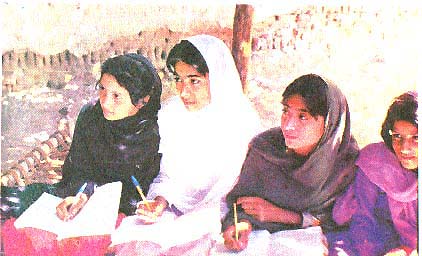
A large number of women, dressed in modern or traditional costumes and veils, came to this centre every day and engaged themselves in different cultural and social activities. They learnt various crafts and pursued social activities at this centre which helped develop their talents. As a majority of our women folk were still confined to their homes, this organisation provided them an opportunity to receive professional training in many spheres. It also provided conditions for the participation of housewives in outdoor activities for improving their socio-economic, political and cultural life. Sixty-nine other associations were functioning in late 1980s under the centre in the precincts of Kabul city and province as well as other provinces of the country, of which 44 were in the provinces, while 16 are in Kabul city and nine in the districts of Kabul Province. Regarding the housewives' participation in the activities of the Central women's club or the precinct and residential area associations, it should be noted that traditional festivals were organized every month in the capital and residential areas for Afghan women. By talking to housewives, instructors of the associations learnt and studied their problems. They also invited craftswomen and women workers to work at whatever craft they had access to. The association provided them raw materials and paid wages for their labour. For instance, the association supplied thread, paint and other equipment, needed by women carpet-weavers; fabrics, threads and even sewing machines were provided to women engaged in needle work and tailoring. Fixed wages were paid to women against the goods they produce, goods which were a part of the traditional handicrafts of the country. Artistic troupes staged concerts, and directives of health publicity groups on environmental and personal hygiene were read out and explained in traditional festivals for women. Another method, by which the women's association of Afghanistan attracted housewives to social activities, was by organising peace camps in different cities, towns, villages, districts and provinces. Apart from the instructors and publicists of the women's association, a number of physicians and nurses also attended peace camps set up in any part of the country. They examined and treated women and children free. Publicity groups of Public Health Ministry explained to women issues pertaining to the care of mothers and children, prevention of diseases, vaccination of children, breast feeding etc. Garments for mothers and their children were stitched free of charge by the Women's Association of Afghanistan and relief goods distributed to deserving women when a peace camp was held. The Women's Association of Afghanistan organized, through its central precinct residential area and district associations, discussion with women. In such functions, that were participated in by a large number of housewives, several women who excelled in productive and social activities were invited to talk about their work and contribution to social activities. To further attract the women to outdoor activities, the Central Women's Association and its other branches convened seminars on different subjects concerning health and environment to enlighten women. For instance, about 15,000 women took part in the seminars held in Kabul city in Afghan year 1987-1988. Poetry recitation and folklore story-reading functions by the association also attracted housewives, that narrated stories and folk tales to each other, and read poems. These functions concluded with the distribution of awards and gifts from the association to women. In addition, work emulation drives were also organized twice a year by the association among the workers engaged in productive activities of women's clubs. Women, who could produce better handicraft pieces in a comparatively short period, were honoured with awards and gifts. The number of women workers, who were organized in different productive sections like needle work, carpet-weaving, tailoring, etc., was 420 in 1987-1988. Over 110 women in the Central Association and 90 others in Kabul city precincts were permanently engaged in social and productive activities. The Central Women's Association of Afghanistan and its branches conducted, among other useful activities, free courses on house management, hair-dressing and typing for young women and girls. The term of hair-dressing course was nine months, while that of others is six. In 1987-1988 a total of 530 women were attending these courses; by the end of this Afghan year 230 had graduated. The Central Women's Association also ran literacy courses at its centre and branches in the precincts. In 1987-1988, 1,900 female literacy learners were admitted to these courses and 14.0 graduated. This way workers' complementary school was also set up under the Association for women workers who had completed literacy courses. The school conducted two-hour classes every day. There was a big museum of various local garments of women and needle work, many of which were unique from the qualitative point of view in the region and the world. Artistic, music, painting and sculpture courses trained interested women and girls through experienced art teachers. To enable its workers, who were mothers, to work peacefully and take care of their children, the Central Women's Association of Afghanistan also maintained a crèche. In addition to similar associations in the precincts, districts and provinces, the Central Women's Association extended its activities to peasant women in villages. Establishment of 15 chambers of peasant women in villages and towns of the districts of Kabul Province was a testimony to this claim. It prepared necessary equipment and means needed by the chambers of peasant women, which, as a matter of fact, were the centres for running social activities of women in villages. For creating such chambers, a peasant women had to put one or two rooms in her house at the disposal of the women's association. After assessing the activities of rural women in agriculture or handicrafts, the association sent the required equipment and materials to the chamber, and guided them. Such chambers were also used to run literacy courses for the illiterate and to establish small carpet-weaving, tailoring and needle work units for rural women. Z. Razban |
|