In Chinatown, a 5-th generation acupuncturist
The practice is ancient, the hope new
 By Meiyue Zhou
INQUIRER STAFF WRITER

Pain and the inability, to walk
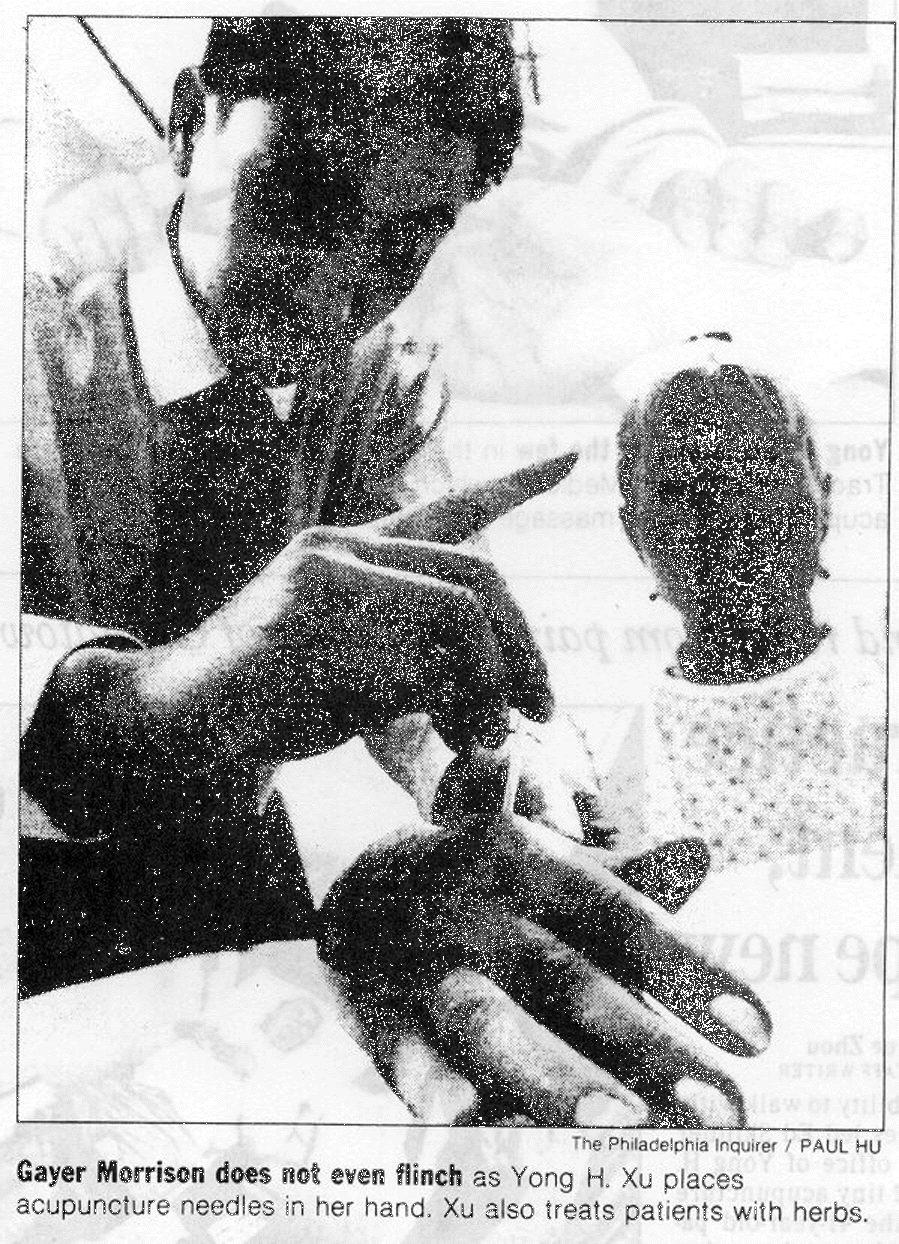
without using two canes led Ed Skinner to the Chinatown office of Yong H. Xu,
who pushed 12 tiny, acupuncture needles through the 41-year-old patient's skin
and did something that Western medicine had failed to do: Relieve
Skinner's pain and ease his walking.

The medical knowledge and tradition that benefited Skinner has passed through
five generations of a family and is now in Xu's hands.

Xu -  whose father, grandfather, great-grandfather and great- great-
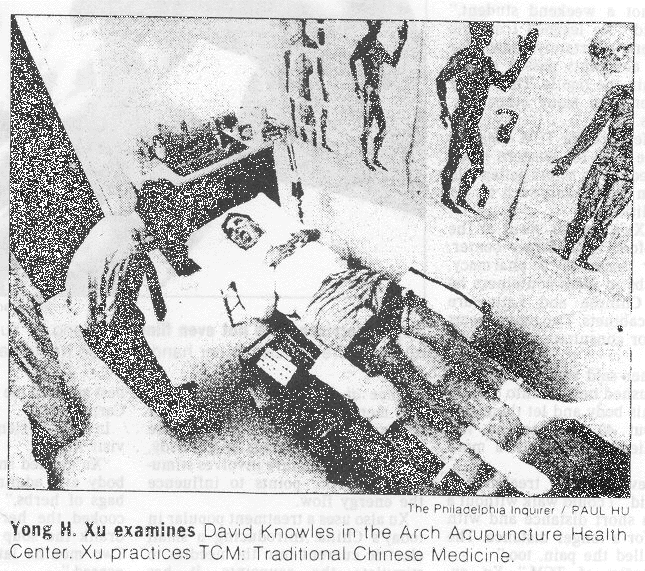
grandfather practiced Traditional Chinese Medicine (TCM) - uses
acupuncture, massage, herbs, heat, therapeutic exercises, dietary
therapies, and other methods to treat about 10 patients daily six
days a week at his Arch Acupuncture Health Center, at 931 Arch
St. Xu is one of the few Acupuncturists, here or in China, who
have been blessed by so many generations of family knowledge.

For many of his patients, treatment comes with a full dose of
education about TCM, which holds that the human body is
inseparable from the rest of nature."Every part of the body,
including the mind, is connected together."  Xu said recently.  "
For example, if a patient has back pain, sore knees and ringing in the ears,
he might be advised to see an orthopedist, a neurologist and an ear doctor by
his American physician. A traditional Chinese doctor, however,
would deem all that as symptoms of a single disease."

TCM practitioners do not treat single symptoms the way practitioners of Western
medicine do, say by prescribing aspirin for a headache. Instead,
they treat a pattern of symptoms, which they call symptom-
complexes. to rebalance the body and enable it to cure itself.

Most of Xu's clients are non-Asian. In fact, every Wednesday morning, he
performs acupuncture with Leon J. Weiner, a medical doctor, in
Weiner's clinic in the Northeast. Xu helps Weiner treat patients
suffering from the stiffness and aches that result from
Parkinson's disease or strokes.

"He is not a weekend student,"  Weiner said.  "He learned from
his family. There is certainly knowledge about the acupoints passed on secretly
within the family.  That's why he is better than many other acupuncturists."

Xu's preference for TCM does not exclude the need for Western
medicine. He frequently refers patients to mainstream physicians,
such as for heart conditions.

Most of Xu's time is spent at the 350-square-foot Arch Street center. The
outer room is a pharmacy, where herbs in glass containers labeled
in Chinese and Latin are aligned in cabinets. Two other rooms arer
used for consultation and treatment.

Ed Skinner said that immediately after Xu pushed needles into
certain points of his body and let them stay there about 40
minutes, he felt " much relieved"  and walked more
easily.

"After several more treatments,"  Skinner said, " I
could walk without a stick for a short distance and with only one
for a longer distance. The needles killed the pain, too."

" The theory of TCM,"  Xu explained, " is based on the concepts
of energy, named qi in Chinese, and change, that is, the yin-yang
theory. If qi is not excessive or deficient in any part of the body, a person
is well. Disease is the result of unbalanced qi."

Since qi flows through channels and meridians that form a two-way communication
system between the organs and the surface of the body, Xu said,
acupuncture involves stimulating specific points to influence the
energy flow.

Xu also uses a treatment popular in today's China: introducing a small electric
current into the needles to stimulate the acupoints. It has
proven effective in treating pain, he said.

Then there are the herbs.

For 29 years, Brian Carney, 38, of Philadelphia, suffered from seborrhea,
a chronic skin disease.

" My doctor said he had tried his best and told me to go back and rest,"
Carney said.

In 1992, a friend suggested that he visit Xu.

" Xu applied smashed herbs on my body and administered me several
bags of herbs,"  Carney recalled. " I cooked the herbs
with water and drank the soup three times a day. Two months
later, the rash disappeared."

Herbal therapy, Xu said, does not aim to kill bacteria, viruses, cells and so forth
 but to rebalance the body so that it can heal itself. A formula is
custom-designed for each patient according to his or her age, weight and medical condition.

Xu' s family has practiced TCM in China for more than a century. His great-great-grandfather
was medical practitioner, but Xu knows little else about him. His great-grandfather was a
doctor for the imperial family late in the Qing Dynasty  (1644-1911). When the dynasty ended,
the family moved to the county of Lin Yuan in Liaoning Province.

There, the family ran the area's largest medicine factory, pharmacy and
clinic, manufacturing pills from powdered herbs and treating patients.

Xu learned TCM from his father, Guotai Xu, who became well known in
Lin Yuan for his ability to cure digestive problems.

While still in high school, the young Xu memorized the names, functions
and application of 400 herbs and the ingredients of 200 formulas.
Later, he underwent four years of training at the Jian Chang
Medical School in Liaoning before getting his bachelor's degree
and one year's education in Western medicine at another medical
school.

After one year's experience as a TCM practitioner in China, Xu moved to the
United States in 1986. In 1990, he passed examinations administered by the
National Commission for the Certification of Acupuncturists and received his
license from the Pennsylvania Department of State.

In 1991, he opened his center. He advertises in Chinese-language
newspapers, but most of his patients learn of him through word of
mouth. Some first encounter him at the massage classes he teaches
at his center and at Triton Regional High School in Runnemede,
N.J.

Some patients visit Xu after years of suffering from chronic diseases.
Some come because they prefer natural medical treatments. Others
find TCM less expensive than Western medicine: An appointment
usually costs $40 to $50, and the herbs are relatively inexpensive.

Then there are those patients who are drawn to the center by Xu
himself, by his obvious commitment and sense of caring.

Dedication, Xu said, is a tradition in his family, one that he\par
intends to carry on.

" My father always stresses the importance of morality,"  he
said.  " He is extremely responsible for his patients."
Patients find relief from pain in a corner of Chinatown