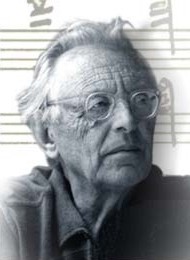
Born in 1895 in Munich, Carl Orff began piano studies at the age of five under the tutelage of his mother. The boy's great interest in language and poetry were fostered in school, where classical languages and literature were among his favorite studies. He received his formal musical training at the Akademie der Tonkunst in Munich. From 1915 to 1917, Orff was musical director of the Munich Kammerspiele, an experience that had a profound effect on his later work. Upon the advice of his mentor and friend Curt Sachs, he soon immersed himself in the study of Renaissance and early Baroque composers, most notably Claudio Monteverdi. In 1923 he met Dorothee Gunther, who envisioned the founding of a school for movement, dance, and rhythmic training. The idea of a training in elemental music - a music which is not abstract, but which integrates the elements of speech, movement, and dance - emerged and took shape in his discussions with Gunther. In 1924 they founded the Guntherschule in Munich. Core studies, taught by several instructors, included gymnastics and dance. As musical director, Orff was responsible for the musical training of the students. During the 1930's and 40's, Orff's approach to music pedagogy was declared in conflict with the prevailing ideological and political climate in Germany. A number of his published works were dropped from publication because he had used poems by writers no longer acceptable to the Reich. In 1944 the Guntherschule was closed due to political pressure; the building and most of its inventory were completely destroyed by bombing.His exploration of the connections between music and movement in music education is mirrored in his compositions where he found a similar connection between the dramatic and the musical, couched in his very personal style of writing, with its insistent, repeated patterns of notes and compelling rhythms. Between 1935 and 1942 Orff created his first "mature" stage works: Carmina Burana and the two Grimms' fairy tales Der Mond and Die Kluge. The best known of all Orff's works is undoubtedly the Carmina Burana. This large scale work is now generally performed only as a form of secular oratorio, in the concert-hall, rather than on the stage and it has become ever more familiar to unmusical audiences by the use of elements from it in advertising and in films.The German Lieder Aus Beuern is a 13th-century manuscript that contains songs (the Carmina Burana proper) and six religious plays. The contents of the manuscript are attributed to the goliards, wandering scholars and students in western Europe during the 10th to the 13th century who were known for their songs and poems in praise of revelry. The collection is also called the Benediktbeuern manuscript, because it was found (in 1803) at the Benedictine monastery in Benediktbeuern (from which burana is derived), Bavaria. The two parts of the manuscript, though written at the same time, have been separated. The songs, rhymed lyrics mainly in Latin with a few in Old German, vary in subject and style: there are drinking songs, serious and licentious love songs, religious poems, pastoral lyrics, and satires of church and government. The plays, in Latin, include the only known two surviving complete texts of medieval Passion dramas. The other plays include an Easter play and an unusually comprehensive Christmas play."The goddess Fortuna must have been smiling on me when, as if by chance, she put a copy of a catalogue in my hands. It was published by a seller of old books in W�rzburg, and one title in the list attracted me with an almost magical force: Carmina Burana," wrote Carl Orff in his memoirs about the discovery of the manuscript which would serve as the basis for his best-known work. After its premiere in 1937, Orff told his publisher: "Now you can take everything I've written thus far and which, you've unfortunately already printed, and smash it into pulp."Carl Orff died on March 29, 1982 in Munich. He is buried in the Schmerzhafte Chapel at the monastery church in Andechs.
� Graham Anstey 2001 |