|
|
|
|
_sein Leben
seinLeben_verschiedene Reden, Zitate
Reden,Zitate_Zeittafel
Zeittafel
English Version
|
Martin Luther King wurde am 15. Januar 1929 in Atlanta, Georgia geboren. Sein Vater war Pastor einer afrikanisch-amerikanischen Babtistengemeinde. Mit 15 Jahren trat King ins Morehousecollege ein und bereits zwei Jahre später wurde er zum Babtistenpriester geweiht. Er hatte seine liebe Mühe mit der wörtlichen Bibelauslegung. Jedoch bewunderte er die schwarze Gospelbewegung (evangelische Kirche würde man das bei uns nennen). Genauso, wie sein Vater, der die Kirche als ein Instrument ansah, um die Lebensumstände der Schwarzen zu verbessern, sah auch er darin die grosse Chance. Nachdem er 1951 seinen Abschluss am "Crozer Theological Seminary" machte, arbeitete er für eine kurze Zeit als Graduiter an der Universität von Bosten. Durch seine Nachforschungen in Crozer und Bosten, kam er mit den Werken des indischen Freiheitskämpfer Mohandas K. Ghandi in Berührung, dessen Ideen des gewaltlosen Widerstandes und Protests er übernahm. |
|
|
|
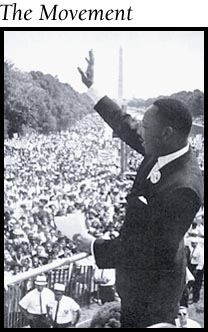
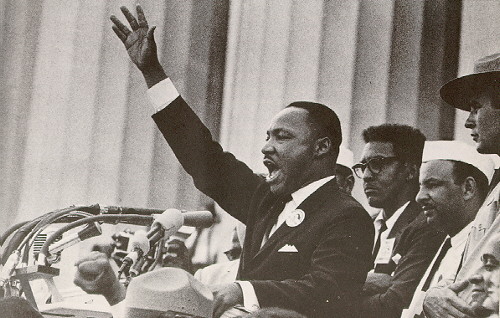
Während der Zeit in Boston lernte er Coretta Scott aus Marion, Alabama kennen. Die beiden heirateten im Juni 1953. King entschied sich gegen eine akademische Laufbahn und wurde Pastor der "Dexter Avenue Babtist Church"in Montgomery, Alabama. 1953 erliess der oberste Gerichtshof der Vereinigten Staaten ein Gesetz, das die Rassentrennung als ungesetzlich erklärte. Als Reaktion darauf kam es in den Südstaaten zu einer Bestreikung der öffentlichen Einrichtungen gegen die Schwarzen. In öffentlichen Verkehrsmitteln herrschte immer noch strickte Rassentrennung. Um dagegen zu demonstrieren, begannen einige schwarze Anwohner in Montgomery einen Busboykott (1955-1956). Sie wählten King als Anführer ihrer neu gegründeten "Montgomery Improvement Association". Durch seinen Mut und seine Redegewandtheit erlangte King landesweites Aufsehen. Während dieses Boykotts, der im ganzen 381 Tage dauerte, wurde er verhaftet und ins Gefängnis geworfen, sein Haus fiel einem Bombenattentat zum Opfer. Kings Leben und das seiner Familie wurde mehrmals bedroht. Trotz allem beschloss das Bundesgericht, die Rassentrennung in öffentlichen Verkehrsmitteln der Stadt zu verbieten. Die Aktion endete also mit einem Erfolg. Es war ein Sieg für die Unterstützer des gewaltfreien Widerstandes (Bürgerrechtsbewegung). 1957 wurde King Präsident der "Southern Christian Leadership Conference"(SCLC), einer Vereinigung, die von schwarzen Geistlichen aus dem gesamten Süden gegründet wurde. King wollte sich jetzt vermehrt für die Wahlrechte der Schwarzen einsetzen. 1960 verliess er seine Pastorenstelle in Montgomery, um sich mit seinem Vater ein Pastorrat in der "Ebenezer Baptist Church" zu teilen. Das ermöglichte ihm, effektiver in der Führung der schwarzen Bürgerrechtsbewegung zu arbeiten. In den fünf Jahren nach dem Montgomery Bus Boykott hielt King zwar viele Reden, mobilisierte jedoch keine Massenproteste. Schwarze Studenten aus dem Süden übernahmen dafür die Initiative. Sie organisierten Sitzproteste im Winter und Frühling 1960 um ihren Willen durchzusetzen. In dieser Zeit wurde die Führung der Bürgerrechtsbewegung radikalen Veränderungen unterworfen. Es wurde weniger verhandelt und die Reformen wurden mit "allen möglichen Mitteln" gefordert. Uneinigkeiten zwischen der SCLC und anderen Organisationen waren unvermeindlich. Martin Luther hatte Mühe, die vielen Protestorganisationen unter Kontrolle zu behalten. Aber schlussendlich war es seinem Engagement und seiner Autorität zu verdanken,dass der gewaltlose Widerstand die offizielle Weise des Protests blieb, obwohl er nicht mehr so beliebt war wie am Anfang. 1963 leitete King eine grosse Bürgerrechts-Kampagne in Birmingham, Alabama. Er forderte bessere Wohnverhältnisse und Schulausbildung für die schwarze Bevölkerung und setzte sich für das Wahlrecht der schwarzen Amerikaner ein. Die (weisse) Polizei in Birmingham war bekannt für ihre Anti-Schwarze Haltung. Sie griff gewaltsam in die Proteste ein. Es kam zu immer mehr Ausschreitungen, v.a. zwischen jungen, schwarzen Studenten und der Polizei. Auch King wurde mehrere Male verhaftet. Die verschiedenen Massendemonstrationen erreichten ihren Höhepunkt am 28. August 1963 bei einem Marsch auf Washington. Über 250‘000 Schwarze und Weisse schlossen sich zusammen und marschierten gemeinsam nach Washington, um vor dem Denkmal Abraham Lincolns zu demonstrieren. Dort hielt Marin Luther King seine berühmte Rede "I have a dream.."Im nächsten Jahr wurde King vom Time Magazine zum "Mann des Jahres" erklärt und es wurde über ihn geschrieben: "Nach 1963 wird der Neger dank der Hilfe Martin Luther Kings nie wieder sein, was er vorher war." Im Dezember 1964 erhielt Martin Luther King den Friedensnobelpreis. King hatte viele Problem zu bewältigen. In Chigago, wo er die erste Kampage im Norden startete wurde er von schwarzen Babtisten öffentlich attackiert. Seine Anhänger trafen auf gewalttätige, bewaffnete Gruppen, die oft von uniformierten Neo-Nazis oder von Mitglierdern des Klu Klux Klan angeführt wurden. Martin Luther war ausglaugt vom Stress und in seinen Reden machte er oft Andeutungen über seinen möglichen, baldigen Tod. In einer Rede am 3. April 1968 sagte er: "Ich war auf dem Gipfel des Berges und habe das verheissene Land gesehen.." ( "I’ve been to the mountain top an saw the promised land"). Am folgenden Tag wurde King von einem weissen Attentäter in Memphis, Tennessee, erschossen , als er an einem Müllarbeiterstreik teilnahm. Mehrere 100‘000 Menschen kamen zu seiner Beerdingung nach Atlanta. King blieb die Symbolfigur für den afrikanisch-amerikanischen Bürgerrechtskampf und seit 1986 ist der dritte Montag im Monat Januar amerikanischer Nationalfeiertag zum Gedenken an Martin Luther King. Sein "I have a dream" ist noch heute für viele Hoffnungsträger. |
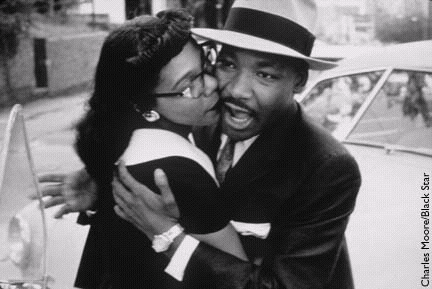
King mit seiner Frau Coretta Scott
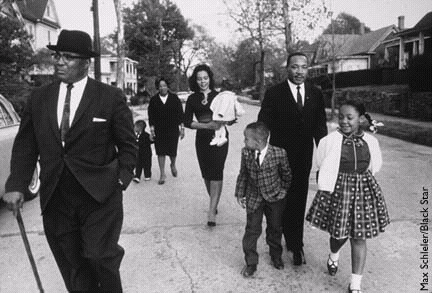
King und Familie
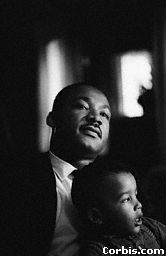
King mit seinem Sohn
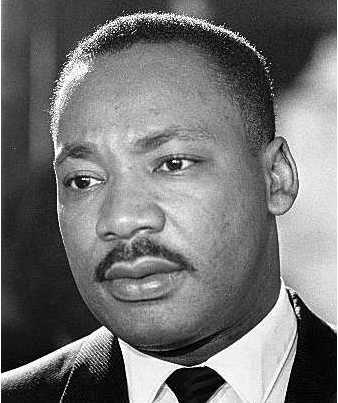
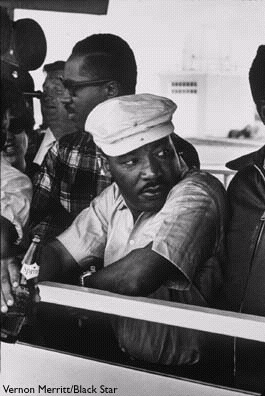
King 1956 (während Montgomery Busboykott)
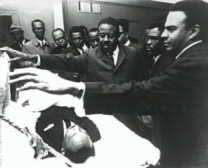
Kings Beisetzung
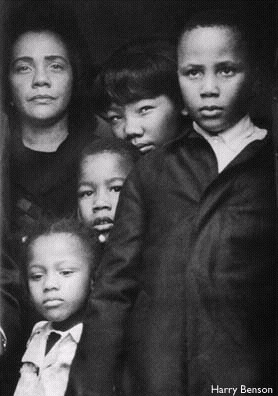
Kings Familie 1968 |
|
Clayborne Carson
One of the world's best known advocates of non-violent social change strategies, Martin Luther King, Jr., synthesized ideas drawn from many different cultural traditions. Born in Atlanta on January 15, 1929, King's roots were in the African-American Baptist church. He was the grandson of the Rev. A. D. Williams, pastor of Ebenezer Baptist church and a founder of Atlanta's NAACP chapter, and the son of Martin Luther King, Sr., who succeeded Williams as Ebenezer's pastor and also became a civil rights leader. Although, from an early age, King resented religious emotionalism and questioned literal interpretations of scripture, he nevertheless greatly admired black social gospel proponents such as his father who saw the church as a instrument for improving the lives of African Americans. Morehouse College president Benjamin Mays and other proponents of Christian social activism influenced King's decision after his junior year at Morehouse to become a minister and thereby serve society. His continued skepticism, however, shaped his subsequent theological studies at Crozer Theological Seminary in Chester, Pennsylvania, and at Boston University, where he received a doctorate in systematic theology in 1955. Rejecting offers for academic positions, King decided while completing his Ph. D. requirements to return to the South and accepted the pastorate of Dexter Avenue Baptist Church in Montgomery, Alabama.
On December 5, 1955, five days after Montgomery civil rights activist Rosa Parks refused to obey the city's rules mandating segregation on buses, black residents launched a bus boycott and elected King as president of the newly-formed Montgomery Improvement Association. As the boycott continued during 1956, King gained national prominence as a result of his exceptional oratorical skills and personal courage. His house was bombed and he was convicted along with other boycott leaders on charges of conspiring to interfere with the bus company's operations. Despite these attempts to suppress the movement, Montgomery bus were desegregated in December, 1956, after the United States Supreme Court declared Alabama's segregation laws unconstitutional.
In 1957, seeking to build upon the success of the Montgomery boycott movement, King and other southern black ministers founded the Southern Christian Leadership Conference (SCLC). As SCLC's president, King emphasized the goal of black voting rights when he spoke at the Lincoln Memorial during the 1957 Prayer Pilgrimage for Freedom. During 1958, he published his first book, Stride Toward Freedom: The Montgomery Story. The following year, he toured India, increased his understanding of Gandhian non-violent strategies. At the end of 1959, he resigned from Dexter and returned to Atlanta where the SCLC headquarters was located and where he also could assist his father as pastor of Ebenezer.
Although increasingly portrayed as the pre-eminent black spokesperson, King did not mobilize mass protest activity during the first five years after the Montgomery boycott ended. While King moved cautiously, southern black college students took the initiative, launching a wave of sit-in protests during the winter and spring of 1960. King sympathized with the student movement and spoke at the founding meeting of the Student Nonviolent Coordinating Committee (SNCC) in April 1960, but he soon became the target of criticisms from SNCC activists determined to assert their independence. Even King's decision in October, 1960, to join a student sit-in in Atlanta did not allay the tensions, although presidential candidate John F. Kennedy's sympathetic telephone call to King's wife, Coretta Scott King, helped attract crucial black support for Kennedy's successful campaign. The 1961 "Freedom Rides," which sought to integrate southern transportation facilities, demonstrated that neither King nor Kennedy could control the expanding protest movement spearheaded by students. Conflicts between King and younger militants were also evident when both SCLC and SNCC assisted the Albany (Georgia) Movement's campaign of mass protests during December of 1961 and the summer of 1962.
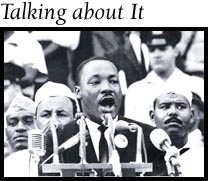
After achieving few of his objectives in Albany, King recognized the need to organize a successful protest campaign free of conflicts with SNCC. During the spring of 1963, he and his staff guided mass demonstrations in Birmingham, Alabama, where local white police officials were known from their anti-black attitudes. Clashes between black demonstrators and police using police dogs and fire hoses generated newspaper headlines through the world. In June, President Kennedy reacted to the Birmingham protests and the obstinacy of segregationist Alabama Governor George Wallace by agreed to submit broad civil rights legislation to Congress (which eventually passed the Civil Rights Act of 1964). Subsequent mass demonstrations in many communities culminated in a march on August 28, 1963, that attracted more than 250,000 protesters to Washington, D. C. Addressing the marchers from the steps of the Lincoln Memorial, King delivered his famous "I Have a Dream" oration.
During the year following the March, King's renown grew as he became Time magazine's Man of the Year and, in December 1964, the recipient of the Nobel Peace Prize. Despite fame and accolades, however, King faced many challenges to his leadership. Malcolm X's (1927-1965) message of self-defense and black nationalism expressed the discontent and anger of northern, urban blacks more effectively than did King's moderation. During the 1965 Selma to Montgomery march, King and his lieutenants were able to keep intra-movement conflicts sufficiently under control to bring about passage of the 1965 Voting Rights Act, but while participating in a 1966 march through Mississippi, King encountered strong criticism from "Black Power" proponent Stokely Carmichael. Shortly afterward white counter-protesters in the Chicago area physically assaulted King in the Chicago area during an unsuccessful effort to transfer non-violent protest techniques to the urban North. Despite these leadership conflicts, King remained committed to the use of non-violent techniques. Early in 1968, he initiated a Poor Peoples campaign designed to confront economic problems that had not been addressed by early civil rights reforms.
King's effectiveness in achieving his objectives was limited not merely by divisions among blacks, however, but also by the increasing resistance he encountered from national political leaders. FBI director J. Edgar Hoover's already extensive efforts to undermine King's leadership were intensified during 1967 as urban racial violence escalated and King criticized American intervention in the Vietnam war. King had lost the support of many white liberals, and his relations with the Lyndon Johnson administration were at a low point when he was assassinated on April 4, 1968, while seeking to assist a garbage workers' strike in Memphis. After his death, King remained a controversial symbol of the African-American civil rights struggle, revered by many for his martyrdom on behalf of non-violence and condemned by others for his militancy and insurgent views.
|
_Worauf es ankommt deutsch_Ausschnitt aus "I have a dream..." deutsch
_"I have a dream..." english_"I’ve been to the mountaintop" english
|
|
|
|
|
Worauf es ankommt
Es kommt nicht darauf an,
geliebt zu werden, sondern zu lieben.
Es kommt nicht darauf an,
zu geniessen, sondern zu schenken.
Es kommt nicht darauf an,
sich durchzusetzen, sondern sich einzusetzen.
Es kommt nicht darauf an,
den Frieden zu erwarten, sondern den Frieden zu schaffen.
Es kommt nicht darauf an,
das Gott tut, was ich will,
sondern dass ich tue, was Gott will.
|
Ich habe einen Traum Ich habe einen Traum, dass eines Tages die Söhne früherer Sklaven und die Söhne früherer Sklavenhalter miteinander am Tisch der Brüderlichkeit sitzen werden. Ich habe einen Traum, dass eines Tages jedes Tal erhöht und jeder Hügel und jeder Berg erniedrigt wird. Die rauhen Orte werden geglättet und die unebenen werden begradigt. Die Herrlichkeit des Herrn wird offenbar werden und alles Fleisch wird es sehen. (Jes. 40,4+5) Das ist unsere Hoffnung! Mit diesem glauben werde ich fähig sein sua sem Berg der Verzweiflung einen Stein der Hoffnung zu hauen. Mit diesem Gauben werden wir fähig sein, zusammen zu arbeiten, zusammen zu beten, zusammen zu kämpfen, zusammen ins Gefängnis zu gehen, zusammen für die Freiheit aufzustehen, in dem Wissen, dass wir eines Tages frei sein werden. |
|
"Jetzt ist der Zeitpunkt da, an den die Grundsätze der Demokratie zur lebendigen Wirklichkeit
werden ... Es wird weder Ruhe noch Rast in Amerika geben, bis dem Neger die vollen
bürgerlichen Rechte anerkannt werden. Die Stürme des Aufruhrs werden die Grundfesten
unseres Volkes erschüttern, bis der helle Tag der Gerechtigkeit anbricht. Und das muß ich
meinem Volk sagen, das an der Schwelle der Tür steht, die in das Haus der Gerechtigkeit
führt : Bei alledem, was wir tun, um den Platz zu gewinnen, der uns zusteht, dürfen wir uns
keiner Handlung des Unrechts schuldig machen ...
Der wunderbare neue kämpferische Geist, der die Gemeinschaft der Neger erfaßt hat, darf
uns nicht dazu führen allen Weißen zu mißtrauen. Viele unserer weißen Brüder - und das
beweist ihre Anwesenheit heute in unserer Mitte - sind zu der Einsicht gekommen, daß ihre
Zukunft mit der unseren untrennbar verbunden ist ...
Und jetzt sage ich euch, meine Freunde, im Angesicht all der Schwierigkeiten von heute und
morgen, daß ich trotz allem einen Traum mit mir trage. Es ist ein Traum, der tief verwurzelt
ist im Traum ganz Amerikas. Ich habe einen Traum, der mir sagt, das eines Tages diese
Nation aufwachen wird und ihr Bekenntnis lebendig erfüllen wird,das da sagt : 'Wir glauben,
das diese Wahrheiten für sich selbst sprechen : das alle Menschen gleich geschaffen sind.' Ich
habe einen Traum, daß eines Tages auf den roten Hügeln von Georgia, daß eines Tages die
Söhne der früheren Sklaven und die Söhne der früheren Sklavenhalter zusammensitzen an
einem Tisch der Brüderlichkeit. Ich habe einen Traum, daß eines Tages sogar der Staat
Mississippi, in dem Ungerechtigkeit schwelt und ihr Wesen treibt mit dem Feuer der
Unterdrückung, sich in eine Oase der Freiheit und Gerechtigkeit verwandeln wird. Ich habe
einen Traum, daß eines Tages meine vier kleinen Kinder in einem Volk leben werden, in dem
man sie nicht nach der Farbe ihrer Haut, sondern nach ihrem Charakter behandeln wird. Das
ist mein Glaube. Das ist unsere Hoffnung. Das ist mein Glaube, das ich zurückgehen werde in
den Süden, mit - ja, mit diesem Glauben, daß wir den Berg der Verzweiflung verwandeln
können in einen Felsen der Hoffnung."
28 August 1963
Washington, D.C.
I am happy to join with you today in what will go down in history as the greatest demonstration for freedom in the history of our nation. [Applause]
Five score years ago, a great American, in whose symbolic shadow we stand today, signed the Emancipation Proclamation. This momentous decree came as a great beacon light of hope to millions of Negro slaves who had been seared in the flames of withering injustice. It came as a joyous daybreak to end the long night of their captivity.
But one hundred years later, the Negro still is not free. [Audience:] (My Lord) One hundred years later, the life of the Negro is still sadly crippled by the manacles of segregation and the chains of discrimination. One hundred years later, the Negro lives on a lonely island of poverty in the midst of a vast ocean of material prosperity. One hundred years later, (My Lord) [Applause] the Negro is still languished in the corners of American society and finds himself an exile in his own land. And so we’ve come here today to dramatize a shameful condition.
In a sense we've come to our nation’s capital to cash a check. When the architects of our republic wrote the magnificent words of the Constitution and the Declaration of Independence, (Yeah) they were signing a promissory note to which every American was to fall heir. This note was a promise that all men, yes, black men as well as white men, would be guaranteed the "unalienable Rights of Life, Liberty, and the pursuit of Happiness." It is obvious today that America has defaulted on this promissory note insofar as her citizens of color are concerned. Instead of honoring this sacred obligation, America has given the Negro people a bad check, a check which has come back marked "insufficient funds." [Sustained applause]
But we refuse to believe that the bank of justice is bankrupt. (My Lord) [Applause. Laughter] (Sure enough) We refuse to believe that there are insufficient funds in the great vaults of opportunity of this nation. And so we’ve come to cash this check, (Yes) a check that will give us upon demand the riches of freedom (Yes) and the security of justice. [Sustained applause]
We have also come to this hallowed spot to remind America of the fierce urgency of now. This is no time (My Lord) to engage in the luxury of cooling off or to take the tranquilizing drug of gradualism. [Applause] Now is the time to make real the promises of democracy. (Now) Now is the time (Now) to rise from the dark and desolate valley of segregation to the sunlit path of racial justice. Now is the time [Applause] to lift our nation from the quicksands of racial injustice to the solid rock of brotherhood. Now is the time [Applause] to make justice a reality for all of God’s children.
It would be fatal for the nation to overlook the urgency of the moment. This sweltering summer of the Negro’s legitimate discontent will not pass until there is an invigorating autumn of freedom and equality. (Right) Nineteen sixty-three is not an end, but a beginning. And those who hope that the Negro needed to blow off steam and will now be content will have a rude awakening if the nation returns to business as usual. [Applause] There will be neither rest nor tranquility in America until the Negro is granted his citizenship rights. The whirlwinds of revolt will continue to shake the foundations of our nation until the bright day of justice emerges.
But there is something that I must say to my people, who stand on the warm threshold which leads into the palace of justice: in the process of gaining our rightful place, we must not be guilty of wrongful deeds. Let us not seek to satisfy our thirst for freedom by drinking from the cup of bitterness and hatred. [Applause] We must forever conduct our struggle on the high plane of dignity and discipline. We must not allow our creative protest to degenerate into physical violence. Again and again, we must rise to the majestic heights of meeting physical force with soul force. The marvelous new militancy which has engulfed the Negro community must not lead us to a distrust of all white people, for many of our white brothers, as evidenced by their presence here today, have come to realize that their destiny is tied up with our destiny. [Applause] And they have come to realize that their freedom is inextricably bound to our freedom. We cannot walk alone.
And as we walk, we must make the pledge that we shall always march ahead. We cannot turn back. There are those who are asking the devotees of civil rights, "When will you be satisfied?" (Never)
We can never be satisfied as long as the Negro is the victim of the unspeakable horrors of police brutality. We can never be satisfied [Applause] as long as our bodies, heavy with the fatigue of travel, cannot gain lodging in the motels of the highways and the hotels of the cities. [Applause] We cannot be satisfied as long as the Negro’s basic mobility is from a smaller ghetto to a larger one. We can never be satisfied as long as our children are stripped of their selfhood and robbed of their dignity by signs stating "for whites only." [Applause] We cannot be satisfied as long as a Negro in Mississippi cannot vote and a Negro in New York believes he has nothing for which to vote. (Yes) [Applause] No, no, we are not satisfied and we will not be satisfied until justice rolls down like waters and righteousness like a mighty stream. [Applause]
I am not unmindful that some of you have come here out of great trials and tribulations. (My Lord) Some of you have come fresh from narrow jail cells. Some of you have come from areas where your quest for freedom left you battered by the storms of persecution (Yes) and staggered by the winds of police brutality. You have been the veterans of creative suffering. Continue to work with the faith that unearned suffering is redemptive. Go back to Mississippi, (Yes) go back to Alabama, go back to South Carolina, go back to Georgia, go back to Louisiana, go back to the slums and ghettos of our northern cities, knowing that somehow this situation can and will be changed. (Yes) Let us not wallow in the valley of despair. [Applause]
I say to you today, my friends, [Applause] so even though we face the difficulties of today and tomorrow, I still have a dream. (Yes) It is a dream deeply rooted in the American dream.
I have a dream that one day (Yes) this nation will rise up and live out the true meaning of its creed: "We hold these truths to be self-evident, that all men are created equal." (Yes) [Applause]
I have a dream that one day on the red hills of Georgia, the sons of former slaves and the sons of former slave owners will be able to sit down together at the table of brotherhood.
I have a dream that one day even the state of Mississippi, a state sweltering with the heat of injustice, (Well) sweltering with the heat of oppression, will be transformed into an oasis of freedom and justice.
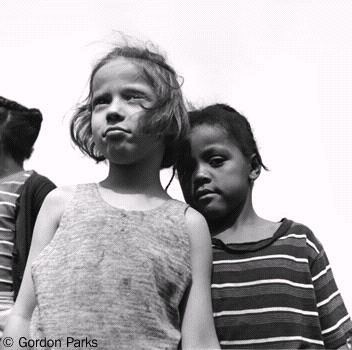
I have a dream (Well) [Applause] that my four little children will one day live in a nation where they will not be judged by the color of their skin but by the content of their character. (My Lord) I have a dream today. [Applause]
I have a dream that one day down in Alabama, with its vicious racists, (Yes) with its governor having his lips dripping with the words of "interposition" and "nullification," (Yes) one day right there in Alabama little black boys and black girls will be able to join hands with little white boys and white girls as sisters and brothers. I have a dream today. [Applause]
I have a dream that one day every valley shall be exalted, (Yes) every hill and mountain shall be made low, the rough places will be made plain, and the crooked places will be made straight, (Yes) and the glory of the Lord shall be revealed, and all flesh shall see it together. (Yes)
This is our hope. This is the faith that I go back to the South with. (Yes) With this faith we will be able to hew out of the mountain of despair a stone of hope. With this faith (Yes) we will be able to transform the jangling discords of our nation into a beautiful symphony of brotherhood. (Talk about it) With this faith (My Lord) we will be able to work together, to pray together, to struggle together, to go to jail together, to stand up for freedom together, knowing that we will be free one day. [Applause] This will be the day, [Applause continues] this will be the day when all of God’s children (Yes) will be able to sing with new meaning:
My country, ’tis of thee, (Yes) sweet land of liberty, of thee I sing.
Land where my fathers died, land of the pilgrim’s pride, (Yes)
From every mountainside, let freedom ring!
And if America is to be a great nation, this must become true.
So let freedom ring (Yes) from the prodigious hilltops of New Hampshire.
Let freedom ring from the mighty mountains of New York.
Let freedom ring from the heightening Alleghenies of Pennsylvania. (Yes. All right)
Let freedom ring from the snow-capped Rockies of Colorado. (Well)
Let freedom ring from the curvaceous slopes of California. (Yes)
But not only that: Let freedom ring from Stone Mountain of Georgia. (Yes)
Let freedom ring from Lookout Mountain of Tennessee. (Yes)
Let freedom ring from every hill and molehill of Mississippi. [Applause]
From every mountainside, [Applause] let freedom ring.
And when this happens, [Applause continues] when we allow freedom ring, when we let it ring from every village and every hamlet, from every state and every city, (Yes) we will be able to speed up that day when all of God’s children, black men and white men, Jews and Gentiles, Protestants and Catholics, will be able to join hands and sing in the words of the old Negro spiritual:
Free at last! (Yes) Free at last!
Thank God Almighty, we are free at last! [Applause]
back to the top
3 April 1968
Memphis, Tenn.
Thank you very kindly, my friends. As I listened to Ralph Abernathy in his eloquent and generous introduction and then thought about myself, I wondered who he was talking about. [Laughter] It’s always good to have your closest friend and associate to say something good about you, and Ralph Abernathy is the best friend that I have in the world.
I’m delighted to see each of you here tonight in spite of a storm warning. You reveal that you are determined [Audience:] (Right) to go on anyhow. (Yeah. All right) Something is happening in Memphis, something is happening in our world. And you know, if I were standing at the beginning of time with the possibility of taking a kind of general and panoramic view of the whole of human history up to now, and the Almighty said to me, "Martin Luther King, which age would you like to live in?" I would take my mental flight by Egypt, (Yeah) and I would watch God’s children in their magnificent trek from the dark dungeons of Egypt through, or rather, across the Red Sea, through the wilderness, on toward the promised land. And in spite of its magnificence, I wouldn’t stop there. (All right)
I would move on by Greece, and take my mind to Mount Olympus. And I would see Plato, Aristotle, Socrates, Euripides, and Aristophenes assembled around the Parthenon, [Applause] and I would watch them around the Parthenon as they discussed the great and eternal issues of reality. But I wouldn’t stop there. (Oh yeah)
I would go on even to the great heyday of the Roman Empire, (Yes) and I would see developments around there, through various emperors and leaders. But I wouldn’t stop there. (Keep on)
I would even come up to the day of the Renaissance and get a quick picture of all that the Renaissance did for the cultural and aesthetic life of man. But I wouldn’t stop there. (Yeah)
I would even go by the way that the man for whom I’m named had his habitat, and I would watch Martin Luther as he tacks his ninety-five theses on the door at the church of Wittenberg. But I wouldn’t stop there. (All right)
I would come on up even to 1863 and watch a vacillating president by the name of Abraham Lincoln finally come to the conclusion that he had to sign the Emancipation Proclamation. But I wouldn’t stop there. (Yeah) [Applause]
I would even come up to the early thirties and see a man grappling with the problems of the bankruptcy of his nation, and come with an eloquent cry that "we have nothing to fear but fear itself." But I wouldn’t stop there. (All right)
Strangely enough, I would turn to the Almighty and say, "If you allow me to live just a few years in the second half of the twentieth century, I will be happy." [Applause]
Now that’s a strange statement to make because the world is all messed up. The nation is sick, trouble is in the land, confusion all around. That’s a strange statement. But I know, somehow, that only when it is dark enough can you see the stars. (All right. Yes) And I see God working in this period of the twentieth century in a way that men in some strange way are responding. Something is happening in our world. (Yeah) The masses of people are rising up. And wherever they are assembled today, whether they are in Johannesburg, South Africa; Nairobi, Kenya; Accra, Ghana; New York City; Atlanta, Georgia; Jackson, Mississippi; or Memphis, Tennessee, the cry is always the same: "We want to be free." [Applause]
And another reason that I’m happy to live in this period is that we have been forced to a point where we are going to have to grapple with the problems that men have been trying to grapple with through history, but the demands didn’t force them to do it. Survival demands that we grapple with them. (Yes) Men for years now have been talking about war and peace. But now, no longer can they just talk about it. It is no longer a choice between violence and nonviolence in this world; it’s nonviolence or nonexistence. That is where we are today. [Applause]
And also, in the human rights revolution, if something isn’t done and done in a hurry to bring the colored peoples of the world out of their long years of poverty, their long years of hurt and neglect, the whole world is doomed. (All right) [Applause] Now, I’m just happy that God has allowed me to live in this period, to see what is unfolding. And I’m happy that he’s allowed me to be in Memphis. (Oh yeah)
I can remember, [Applause] I can remember when Negroes were just going around, as Ralph has said so often, scratching where they didn’t itch and laughing when they were not tickled. [Laughter. Applause] But that day is all over. (Yeah) [Applause] We mean business now and we are determined to gain our rightful place in God’s world. (Yeah) [Applause] And that’s all this whole thing is about. We aren’t engaged in any negative protest and in any negative arguments with anybody. We are saying that we are determined to be men. We are determined to be people. (Yeah) We are saying, [Applause] we are saying that we are God’s children. (Yeah) [Applause] And if we are God’s children, we don’t have to live like we are forced to live.
Now, what does all of this mean in this great period of history? It means that we’ve got to stay together. (Yeah) We’ve got to stay together and maintain unity. You know, whenever Pharaoh wanted to prolong the period of slavery in Egypt, he had a favorite formula for doing it. What was that? He kept the slaves fighting among themselves. [Applause] But whenever the slaves get together, something happens in Pharaoh’s court, and he cannot hold the slaves in slavery. When the slaves get together, that’s the beginning of getting out of slavery. [Applause] Now let us maintain unity.
Secondly, let us keep the issues where they are. (Right) The issue is injustice. The issue is the refusal of Memphis to be fair and honest in its dealings with its public servants, who happen to be sanitation workers. [Applause] Now, we’ve got to keep attention on that. (That’s right) That’s always the problem with a little violence. You know what happened the other day, and the press dealt only with the window breaking. (That’s right) I read the articles. They very seldom got around to mentioning the fact that one thousand three hundred sanitation workers are on strike, and that Memphis is not being fair to them, and that Mayor Loeb is in dire need of a doctor. They didn’t get around to that. (Yeah) [Applause]
Now we’re going to march again, and we’ve got to march again (Yeah), in order to put the issue where it is supposed to be (Yeah) [Applause] and force everybody to see that there are thirteen hundred of God’s children here suffering, (That’s right) sometimes going hungry, going through dark and dreary nights wondering how this thing is going to come out. That’s the issue. (That’s right) And we’ve got to say to the nation, we know how it’s coming out. For when people get caught up with that which is right and they are willing to sacrifice for it, there is no stopping point short of victory. [Applause]
We aren’t going to let any mace stop us. We are masters in our nonviolent movement in disarming police forces; they don’t know what to do. I’ve seen them so often. I remember in Birmingham, Alabama, when we were in that majestic struggle there, we would move out of the Sixteenth Street Baptist Church day after day. By the hundreds we would move out, and Bull Connor would tell them to send the dogs forth, and they did come. But we just went before the dogs singing, "Ain’t gonna let nobody turn me around." [Applause] Bull Connor next would say, "Turn the fire hoses on." (Yeah) And as I said to you the other night, Bull Connor didn’t know history. He knew a kind of physics that somehow didn’t relate to the trans-physics that we knew about. And that was the fact that there was a certain kind of fire that no water could put out. [Applause] And we went before the fire hoses. (Yeah) We had known water. (All right) If we were Baptist or some other denominations, we had been immersed. If we were Methodist and some others, we had been sprinkled. But we knew water. That couldn’t stop us. [Applause]
And we just went on before the dogs and we would look at them, and we’d go on before the water hoses and we would look at it. And we’d just go on singing, "Over my head, I see freedom in the air." (Yeah) [Applause] And then we would be thrown in the paddy wagons, and sometimes we were stacked in there like sardines in a can. (All right) And they would throw us in, and old Bull would say, "Take ’em off." And they did, and we would just go on in the paddy wagon singing, "We Shall Overcome." (Yeah) And every now and then we’d get in jail, and we’d see the jailers looking through the windows being moved by our prayers (Yeah) and being moved by our words and our songs. (Yeah) And there was a power there which Bull Connor couldn’t adjust to, (All right) and so we ended up transforming Bull into a steer, and we won our struggle in Birmingham. [Applause]
Now we’ve got to go on in Memphis just like that. I call upon you to be with us when we go out Monday. (Yes) Now about injunctions. We have an injunction and we’re going into court tomorrow morning (Go ahead) to fight this illegal, unconstitutional injunction. All we say to America is be true to what you said on paper. (Oh yes) [Applause] If I lived in China or even Russia, or any totalitarian country, maybe I could understand some of these illegal injunctions. Maybe I could understand the denial of certain basic First Amendment privileges, because they haven’t committed themselves to that over there. But somewhere I read of the freedom of assembly. Somewhere I read (Yes) of the freedom of speech. (Yes) Somewhere I read (Yes) of the freedom of press. (Yes) Somewhere I read (Yes) that the greatness of America is the right to protest for rights. [Applause] And so just as I say we aren’t going to let any dogs or water hoses turn us around, we aren’t going to let any injunction turn us around. [Applause] We are going on. We need all of you.
You know what’s beautiful to me is to see all of these ministers of the Gospel. (Amen) It’s a marvelous picture. (Yes) Who is it that is supposed to articulate the longings and aspirations of the people more than the preacher? Somehow the preacher must have a kind of fire shut up in his bones, (Yes) and whenever injustice is around he must tell it. (Yeah) Somehow the preacher must be an Amos, who said, "When God speaks, who can but prophesy?" (Yes) Again with Amos, "Let justice roll down like waters and righteousness like a mighty stream." (Yes) Somehow the preacher must say with Jesus, "The spirit of the Lord is upon me, (Yes) because he hath anointed me, (Yes) and he has anointed me to deal with the problems of the poor." (Go ahead)
And I want to commend the preachers, under the leadership of these noble men: James Lawson, one who has been in this struggle for many years. He’s been to jail for struggling; he’s been kicked out of Vanderbilt University for this struggling; but he’s still going on, fighting for the rights of his people. [Applause] Reverend Ralph Jackson, Billy Kiles; I could just go right down the list, but time will not permit. But I want to thank all of them, and I want you to thank them, because so often preachers aren’t concerned about anything but themselves. [Applause]
And I’m always happy to see a relevant ministry. It’s all right to talk about long white robes over yonder, in all of its symbolism, but ultimately people want some suits and dresses and shoes to wear down here. [Applause] It’s all right to talk about streets flowing with milk and honey, but God has commanded us to be concerned about the slums down here and his children who can’t eat three square meals a day. [Applause] It’s all right to talk about the new Jerusalem, but one day God’s preacher must talk about the new New York, the new Atlanta, the new Philadelphia, the new Los Angeles, the new Memphis, Tennessee. (Yes) [Applause] This is what we have to do.
Now the other thing we’ll have to do is this: always anchor our external direct action with the power of economic withdrawal. Now we are poor people individually, we are poor when you compare us with white society in America. We are poor. But never stop and forget that collectively, that means all of us together, collectively we are richer than all the nations in the world, with the exception of nine. Did you ever think about that? After you leave the United States, Soviet Russia, Great Britain, West Germany, France, and I could name the others, the American Negro collectively is richer than most nations of the world. We have an annual income of more than thirty billion dollars a year, which is more than all of the exports of the United States and more than the national budget of Canada. Did you know that? That’s power right here, if we know how to pool it. (Yeah) [Applause]
We don’t have to argue with anybody. We don’t have to curse and go around acting bad with our words. We don’t need any bricks and bottles; we don’t need any Molotov cocktails. (Yes) We just need to go around to these stores, (Yes, sir) and to these massive industries in our country (Amen), and say, "God sent us by here (All right) to say to you that you’re not treating his children right. (That’s right) And we’ve come by here to ask you to make the first item on your agenda fair treatment where God’s children are concerned. Now, if you are not prepared to do that, we do have an agenda that we must follow. (All right) And our agenda calls for withdrawing economic support from you." [Applause]
And so, as a result of this, we are asking you tonight (Amen) to go out and tell your neighbors not to buy Coca-Cola in Memphis. (Yeah) [Applause] Go by and tell them not to buy Sealtest milk. (Yeah) [Applause] Tell them not to buy—what is the other bread?—Wonder Bread. (Yes) [Applause] And what is the other bread company, Jesse? Tell them not to buy Hart’s bread. [Applause] As Jesse Jackson has said, up to now only the garbage men have been feeling pain, now we must kind of redistribute the pain. [Applause] We are choosing these companies because they haven’t been fair in their hiring policies, and we are choosing them because they can begin the process of saying they are going to support the needs and the rights of these men who are on strike. And then they can move on downtown and tell Mayor Loeb to do what is right. (That’s right. Speak) [Applause]
Now not only that, we’ve got to strengthen black institutions. (That’s right. Yeah) I call upon you to take your money out of the banks downtown and deposit your money in Tri-State Bank. (Yeah) [Applause] We want a "bank-in" movement in Memphis. (Yes) Go by the savings and loan association. I’m not asking you something that we don’t do ourselves in SCLC. Judge Hooks and others will tell you that we have an account here in the savings and loan association from the Southern Christian Leadership Conference. We are telling you to follow what we’re doing, put your money there. [Applause] You have six or seven black insurance companies here in the city of Memphis. Take out your insurance there. We want to have an "insurance-in." [Applause] Now these are some practical things that we can do. We begin the process of building a greater economic base. And at the same time, we are putting pressure where it really hurts, (There you go) and I ask you to follow through here. [Applause]
Now let me say as I move to my conclusion that we’ve got to give ourselves to this struggle until the end. (Amen) Nothing would be more tragic than to stop at this point in Memphis. We’ve got to see it through. [Applause] When we have our march, you need to be there. If it means leaving work, if it means leaving school, be there. (Amen) [Applause] Be concerned about your brother. You may not be on strike, (Yeah) but either we go up together or we go down together. [Applause] Let us develop a kind of dangerous unselfishness.
One day a man came to Jesus and he wanted to raise some questions about some vital matters of life. At points he wanted to trick Jesus, (That’s right) and show him that he knew a little more than Jesus knew and throw him off base. [Recording interrupted] Now that question could have easily ended up in a philosophical and theological debate. But Jesus immediately pulled that question from mid-air and placed it on a dangerous curve between Jerusalem and Jericho. (Yeah) And he talked about a certain man who fell among thieves. (Sure) You remember that a Levite (Sure) and a priest passed by on the other side; they didn’t stop to help him. Finally, a man of another race came by. (Yes, sir) He got down from his beast, decided not to be compassionate by proxy. But he got down with him, administered first aid, and helped the man in need. Jesus ended up saying this was the good man, this was the great man, because he had the capacity to project the "I" into the "thou," and to be concerned about his brother.
Now you know, we use our imagination a great deal to try to determine why the priest and the Levite didn’t stop. At times we say they were busy going to a church meeting, an ecclesiastical gathering, and they had to get on down to Jerusalem so they wouldn’t be late for their meeting. (Yeah) At other times we would speculate that there was a religious law that one who was engaged in religious ceremonials was not to touch a human body twenty-four hours before the ceremony. (All right) And every now and then we begin to wonder whether maybe they were not going down to Jerusalem, or down to Jericho, rather, to organize a Jericho Road Improvement Association. [Laughter] That’s a possibility. Maybe they felt that it was better to deal with the problem from the causal root, rather than to get bogged down with an individual effect. [Laughter]
But I’m going to tell you what my imagination tells me. It’s possible that those men were afraid. You see, the Jericho Road is a dangerous road. (That’s right) I remember when Mrs. King and I were first in Jerusalem. We rented a car and drove from Jerusalem down to Jericho. (Yeah) And as soon as we got on that road I said to my wife, "I can see why Jesus used this as the setting for his parable." It’s a winding, meandering road. (Yes) It’s really conducive for ambushing. You start out in Jerusalem, which is about 1200 miles, or rather, 1200 feet above sea level. And by the time you get down to Jericho fifteen or twenty minutes later, you’re about 2200 feet below sea level. That’s a dangerous road. (Yeah) In the days of Jesus it came to be known as the "Bloody Pass." And you know, it’s possible that the priest and the Levite looked over that man on the ground and wondered if the robbers were still around. (Go ahead) Or it’s possible that they felt that the man on the ground was merely faking. (Yeah) And he was acting like he had been robbed and hurt, in order to seize them over there, lure them there for quick and easy seizure. (Oh yeah) And so the first question that the priest asked, the first question that the Levite asked was, "If I stop to help this man, what will happen to me?" (All right)
But then the Good Samaritan came by, and he reversed the question: "If I do not stop to help this man, what will happen to him?" (Yeah) That’s the question before you tonight. (Yes) Not, "If I stop to help the sanitation workers, what will happen to my job?" Not, "If I stop to help the sanitation workers, what will happen to all of the hours that I usually spend in my office every day and every week as a pastor?" (Yes) The question is not, "If I stop to help this man in need, what will happen to me?" The question is, "If I do not stop to help the sanitation workers, what will happen to them?" That’s the question. [Applause]
Let us rise up tonight with a greater readiness. Let us stand with a greater determination. And let us move on in these powerful days, these days of challenge, to make America what it ought to be. We have an opportunity to make America a better nation. (Amen)
And I want to thank God, once more, for allowing me to be here with you. (Yes, sir) You know, several years ago I was in New York City autographing the first book that I had written. And while sitting there autographing books, a demented black woman came up. The only question I heard from her was, "Are you Martin Luther King?" And I was looking down writing and I said, "Yes."
The next minute I felt something beating on my chest. Before I knew it I had been stabbed by this demented woman. I was rushed to Harlem Hospital. It was a dark Saturday afternoon. And that blade had gone through, and the X-rays revealed that the tip of the blade was on the edge of my aorta, the main artery. And once that’s punctured you’re drowned in your own blood; that’s the end of you. (Yes, sir) It came out in The New York Times the next morning that if I had merely sneezed, I would have died.
Well, about four days later, they allowed me, after the operation, after my chest had been opened and the blade had been taken out, to move around in the wheelchair in the hospital. They allowed me to read some of the mail that came in, and from all over the states and the world kind letters came in. I read a few, but one of them I will never forget. I had received one from the president and the vice-president; I’ve forgotten what those telegrams said. I’d received a visit and a letter from the governor of New York, but I’ve forgotten what that letter said. (Yes)
But there was another letter (All right) that came from a little girl, a young girl who was a student at the White Plains High School. And I looked at the letter and I’ll never forget it. It said simply, "Dear Dr. King: I am a ninth-grade student at the White Plains High School." She said, "While it should not matter, I would like to mention that I’m a white girl. I read in the paper of your misfortune and of your suffering. And I read that if you had sneezed, you would have died. And I’m simply writing you to say that I’m so happy that you didn’t sneeze." (Yes) [Applause]
And I want to say tonight, [Applause] I want to say tonight that I, too, am happy that I didn’t sneeze. Because if I had sneezed (All right), I wouldn’t have been around here in 1960, (Well) when students all over the South started sitting-in at lunch counters. And I knew that as they are sitting in, they were really standing up (Yes, sir) for the best in the American dream and taking the whole nation back to those great wells of democracy, which were dug deep by the founding fathers in the Declaration of Independence and the Constitution.
If I had sneezed, (Yes) I wouldn’t have been around here in 1961, when we decided to take a ride for freedom and ended segregation in interstate travel. (All right)
If I had sneezed, (Yes) I wouldn’t have been around here in 1962, when Negroes in Albany, Georgia, decided to straighten their backs up. And whenever men and women straighten their backs up, they are going somewhere, because a man can’t ride your back unless it is bent.
If I had sneezed, [Applause] if I had sneezed, I wouldn’t have been here in 1963, (All right) when the black people of Birmingham, Alabama, aroused the conscience of this nation and brought into being the civil rights bill.
If I had sneezed, I wouldn’t have had a chance later that year, in August, to try to tell America about a dream that I had had. (Yes)
If I had sneezed, [Applause] I wouldn’t have been down in Selma, Alabama, to see the great movement there.
If I had sneezed, I wouldn’t have been in Memphis to see a community rally around those brothers and sisters who are suffering. (Yes) I’m so happy that I didn’t sneeze. (Yes)
And they were telling me. [Applause] Now it doesn’t matter now (Go ahead). It really doesn’t matter what happens now. I left Atlanta this morning, and as we got started on the plane—there were six of us—the pilot said over the public address system, "We are sorry for the delay, but we have Dr. Martin Luther King on the plane. And to be sure that all of the bags were checked and to be sure that nothing would be wrong on the plane, we had to check out everything carefully. And we’ve had the plane protected and guarded all night."
And then I got into Memphis. And some began to say the threats, or talk about the threats that were out, (Yeah) or what would happen to me from some of our sick white brothers.
Well, I don’t know what will happen now; we’ve got some difficult days ahead. (Amen) But it really doesn’t matter with me now, because I’ve been to the mountaintop. (Yeah) [Applause] And I don’t mind. [Applause continues] Like anybody, I would like to live a long life—longevity has its place. But I’m not concerned about that now. I just want to do God’s will. (Yeah) And He’s allowed me to go up to the mountain. (Go ahead) And I’ve looked over, (Yes, sir) and I’ve seen the promised land. (Go ahead) I may not get there with you. (Go ahead) But I want you to know tonight (Yes), that we, as a people, will get to the promised land. [Applause] (Go ahead) So I’m happy tonight; I’m not worried about anything; I’m not fearing any man. Mine eyes have seen the glory of the coming of the Lord. [Applause]
|
1929 15.Januar |
_Martin Luther King wird in Atlanta, Georgia geboren |
|
|
1944 |
_Eintritt ins Morehouse College |
|
|
1946 |
_King wird zum Babtistenpriester geweiht |
|
|
1951 |
_Abschluss am "Crozer Theological Seminary" |
|
|
1953 |
_Heirat mit Coretta Scott _Boykott öffentlicher Einrichtungen in den Südstaaten gegen Schwarze |
|
|
1954 |
_King wird Pastor der "Dexter Babtist Church" in Montgomery |
|
|
1955-1956 |
_King organisiert Busboykott um gegen die Rassentrennung in öffentlichen Verkehrsmitteln zu demonstrieren |
|
|
1959 |
_Besuch in Indien |
|
|
1960 |
_King wird Pastor der "Ebenezer Babtist Church" in Atlanta |
|
|
1963 |
_King leitet Bürgerrechtskampange in Birmingham, Alabama für Wahlrecht der Schwarzen, Beendigung der Rassentrennung, bessere Schulausbildung und bessere Wohnverhältnisse im Süden |
|
|
1963 28.August |
_"Marsch auf Washington" _ King's rede "I have a dream..." |
|
|
1967 |
_King wird Mitglied der anti-Kriegsbewegung |
|
|
1968 4.April |
_King wird von einem weissen Attentäter in Memphis, Tennesse erschossen |
|