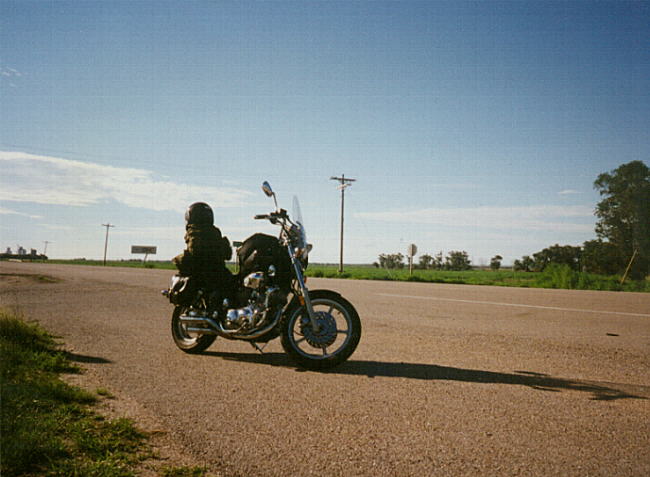
Somewhere on the Plains
Part 4: The AftermathOver the next several weeks, I took the bike into the shop to find out what was wrong with it. As I had expected, there was a problem with the charging system and the alternator would have to be replaced, along with other components. The valves were also badly out of adjustment and there were some other minor adjustments I had to make. One of them was to send the �new� Saddleman seat back to the manufacturer, since it had so clearly and absolutely failed to provide a more comfortable riding surface.
My trip had taken just over two weeks, and in that time, I had covered 4,032 miles. My longest travel day had been the first day of my return trip (Denver to Ponca City), when I rode 669 miles. My shortest had been the last day of my outbound trip (Dodge City to Denver), when I had covered �only� 378 miles. Altogether, my outbound trip from Charlotte to Denver had been 1810 miles, and my return trip had been 1789 miles. Total miles while in Colorado were only 433.
This was the last big trip I took with this bike. In November, 1996, mounting college expenses forced me to consider whether I could afford a luxury �toy� like a motorcycle. When I left the Army in January of 96, after more than 10 years of active duty, I told myself I wasn�t going to let anything get in the way of my education. By the end of 1996, with the bike needing expensive electrical repairs, and with me not having that kind of discretionary income, I reluctantly sold the bike. I had owned it for just under 18 months and in that time I had put about 18,000 miles on it.
Lessons learned:
So what did I learn from this, only my second motorcycle tour? Well, in no particular order, here are the things that stick in my mind. I�ve grouped them into two categories: �Things I wish I�d done� and �things I actually did right�. Needless to say, the first list is much longer than the second!
Things I should have done:
� If I had known how uncomfortable the stock seat was going to be, I�d definitely have replaced it with a more comfortable one before the trip. This points out the importance of �training up� for a long tour and having several one-day �shakedown runs� before embarking on a days-long tour.
� Although I could not have anticipated the electrical problem, this again shows the critical importance of making sure your bike is in tip-top condition before setting out on a long trip. It also shows the importance of having some kind of backup plan (through AAA or the AMA) to provide for towing in the event of a breakdown or accident.
� The reason I was so fatigued on the trip back was because I cut a travel day. Lesson learned: Plan for a �maximum miles� each day and stick with it.
� As I mentioned earlier, I lost a lot of time because I overpacked and because I didn�t practice packing all my gear. Next time I tour, I will only take a bare minimum of clothing: 1 extra pair of jeans, 2 shirts, 2 pairs of socks and underwear, one sweatshirt, raingear, one pair of comfortable shoes. There�s no need to take more, and I know I will be much happier if I pack lighter. The savings of time alone is worth it. One thing that I could have done, since my travel was to a destination, where I was staying for a week and a half before returning, was that I could have mailed extra clothing ahead and then shipped it back when I left. As for the practice-packout, this, again should be mandatory.
� Sunblock is your friend. Failure to use sunblock is just plain stupid. Ask the guy with the 2nd degree sunburn (that would be me.)
� If you know you�re going to be traveling in an urban area, plan it out ahead of time and make sure you have a good idea of where you�re going. Getting lost in a big city in rush hour is no fun, especially when it happens at the end of the day and you�re already exhausted.
Things I actually did right (much to my surprise.):
� The forced water/no caffeine/no big meals before the end of the day plan worked out great. The only time I didn�t stick to it (on the 3rd day of the trip out) I really regretted it.
� On the way out I stuck to a fairly limited number of miles (about 450.day) and that seemed to work.. Staying off the interstate (except where it was impossible to do so) was also a good idea that made for a more relaxing trip.
� Windshield, tank bag, rain suit and full-face helmet all proved to be worth their weight in gold.
Would/will I do it again? If so, what would I do differently?
Yes, I�d do it again, in a second. BUT, I wouldn�t do it in the same way. When I get another bike (not soon enough, as far as I�m concerned.), I will do a few things differently.
First of all, I�ll get a multi-cylinder (probably an I-4 or V-4) bike. A big twin like the Virago is not the best bike for this kind of riding. Those two big cylinders hammering away were noisy, rough, and tiring, and all that long distance cruising on the bike took their toll on the bike as well. Yes, I know people tour on Harleys and BMWs, and power to them. I�ve ridden twins and fours, and I can tell you which one is more pleasant to ride, and it�s not the twin! Water cooling is also a big plus in keeping the engine running smoothly and lasting a long time. Shaft drive is a must (one of the things I liked about the Virago.) A center stand is also great, if you can find a bike anymore that has one. Center stands are great for packing because the bike is not �leaned over� on the sidestand when you pack it.
Second, I�d give serious second thoughts to both the route and the time of year. I hope people in the Midwest don�t take offense at this, but a single one-way ride through the Midwest is plenty, especially in the dead of Summer. I was getting tired of wheat farms and feed lots long before I got to Kansas. For that reason, if I wanted to travel from the East coast to the West I�d probably just trailer the bike through the boring parts (relaxing in an air-conditioned truck, sipping a soda and listening to the CD player instead of baking along a steaming road and hearing only the drone of the motor.) I�m sure short trips through the Midwest can be fun, but after the first time, a long trip through there is just boring. As an alternative, I�d plan an itinerary that would require no more than � days travel each day, no more than 300 miles. At that speed, it would take 6 days to travel from North Carolina to Colorado, but the trip would be much more enjoyable.
If one must tour through the center of the country, Spring and Fall are probably better times to do it, when the temperatures aren�t so brutal and there may be more variety in the scenery.
Click on the links below to continue the narrative
Part Five: Would I do it again?