A Crewed Mission to Mars...
Is it really possible ?
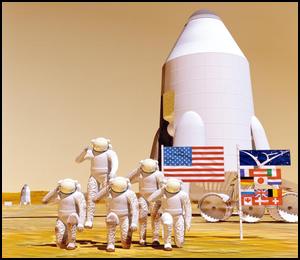 The logistics of a crewed mission to Mars are
complex to say the least. Before setting out into the solar system on our way to
the Red Planet, there are a seemingly endless number of factors to take into
consideration. These factors range from transit vehicles and trajectories, to
crew safety and stay-times, to required resources and equipment, and much, much
more. Every aspect of mission requirements must be investigated in fine detail
before departure because, due to the nature of the flight trajectory, there will
be no quick return to, or supplementary supply from, Earth in the event of the
unexpected. Upon Earth departure, the crew must be completely self-sufficient,
flexible enough to adapt to new situations, and they will undoubtedly require
expertise in a wide range of disciplines. A landing site must be chosen, mission
objectives must be defined, and a commitment must be made.
The logistics of a crewed mission to Mars are
complex to say the least. Before setting out into the solar system on our way to
the Red Planet, there are a seemingly endless number of factors to take into
consideration. These factors range from transit vehicles and trajectories, to
crew safety and stay-times, to required resources and equipment, and much, much
more. Every aspect of mission requirements must be investigated in fine detail
before departure because, due to the nature of the flight trajectory, there will
be no quick return to, or supplementary supply from, Earth in the event of the
unexpected. Upon Earth departure, the crew must be completely self-sufficient,
flexible enough to adapt to new situations, and they will undoubtedly require
expertise in a wide range of disciplines. A landing site must be chosen, mission
objectives must be defined, and a commitment must be made.
The commitment to a human Mars exploration program
would certainly be an ambitious undertaking. A crewed mission to Mars c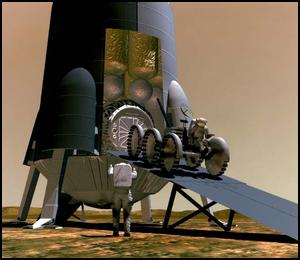 urrently
lies on the very
edge of our technological ability and the realization of this ambition (as well
as other space science projects) would undoubtedly stand as a testament to the
possibilities which technology presents to our civilization. Such a mission
would give us a more complete understanding of Mars than ever before which would
then, in turn, provide us with a more complete understanding of the processes
and evolution of our own planet.
urrently
lies on the very
edge of our technological ability and the realization of this ambition (as well
as other space science projects) would undoubtedly stand as a testament to the
possibilities which technology presents to our civilization. Such a mission
would give us a more complete understanding of Mars than ever before which would
then, in turn, provide us with a more complete understanding of the processes
and evolution of our own planet.
A crewed mission to Mars would define a new frontier of human exploration
both scientifically and philosophically. The human exploration of Mars raises
valid scientific questions of interplanetary biological contamination which must
be addressed before the departure of a crewed mission. Furthermore,
philosophical issues pertaining to our interference with the natural evolution
of another planet must also be resolved. Indeed, especially if a crewed mission
to Mars is a precursor to human settlement of the Red Planet, these
uncertainties must be thoroughly investigated by the visionaries who strive to
implement a human Mars exploration program.
Mission
Objectives:
The "Why Mars" workshop in Houston also
broadly defined 2 primary mission objectives:
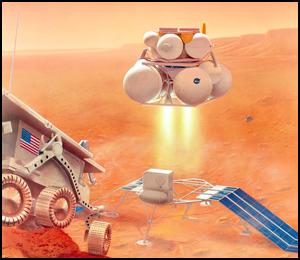 1) To arrive at a better understanding of Mars both currently and
historically and to answer scientific questions existing at the time of
exploration (e.g. existence of subsurface water, existence of life in the past
or present, global geology/tectonics, atmospheric evolution, nitrogen reservoirs
etc.)
1) To arrive at a better understanding of Mars both currently and
historically and to answer scientific questions existing at the time of
exploration (e.g. existence of subsurface water, existence of life in the past
or present, global geology/tectonics, atmospheric evolution, nitrogen reservoirs
etc.)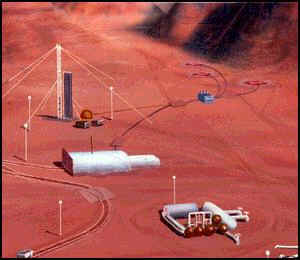
2) To demonstrate the feasibility future longer
term Mars exploration and/or colonization.

