Updated June 22, 2006
 |
 |
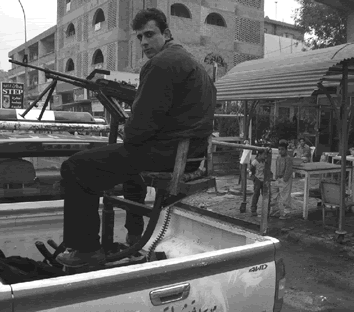
| A police officer sits behind a machine gun mounted in the rear of a police truck right off the bat.” parked outside a restaurant in Baghdad’s Karrada district. Photo courtesy of KRT Campus |
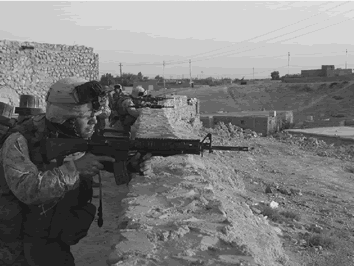
Marines from the 3rd battalion of the 2nd Marine Regiment scan the horizon during a
|
By Tom Lasseter
KRT Campus
U.S. officials were warned for more
than two years that Shiite Muslim militias
were infiltrating Iraq’s security forces and
taking control of neighborhoods, but they
failed to take action to counteract it,
Iraqi and American officials said.
Now American officials call the militias
the primary security concern in Iraq,
blaming them for more civilian deaths
than the Sunni Muslim-based insurgency
and demanding that the Iraqi government
move quickly to stem their influence.
U.S. officials concede that they didn’t
act, in part because they were focused on
fighting the Sunni-dominated insurgency
and on recruiting and training Iraqi security
forces.
“Last year, as we worked through the
problem set, that (militias) wasn’t a
problem set we focused on,” Maj. Gen.
Rick Lynch, the top American military
spokesman, said at a recent news briefing.
U.S. inaction gave the militias, with
support from Iran, time to become a major
force inside and outside the Iraqi government,
and American officials acknowledge
that dislodging them now would be
difficult.
Among U.S. officials’ missteps:
White House and Pentagon officials
ignored a stream of warnings from
American intelligence agencies about the
mounting danger posed by two Shiite militias,
the Badr Organization and the Mahdi
Army. The Badr Organization is the armed
wing of the Iranian-backed Supreme
Council for Islamic Revolution in Iraq, the
most powerful Shiite political faction in
the country; the Mahdi Army is loyal to
radical cleric Muqtada al-Sadr.
A group of high-ranking Iraqis appointed
in 2004 to persuade militia leaders to
disband their groups received no funding
and was allowed to wither away.
U.S. diplomats in Baghdad were slow
to recognize that the majority Shiite
population’s ascent to political power
would expand rather than diminish militia
activity. Many believed that the groups’
members would retire or would be integrated
into the security forces without
significant problems.
Acting against the Shiite militias would
have undercut the administration’s arguments
that foreign terrorists and holdovers
from Saddam Hussein’s regime were
the problem in Iraq. It also would have
raised doubts about the administration’s
reliance on training largely Shiite security
forces to replace U.S. troops in Iraq.
The American military’s inability to
curb the Sunni insurgency, in part because
U.S. troops are spread thin in Iraq, also
played a role. As the insurgency continued
to kill Shiite civilians, Shiites came
to see the militias as their only reliable
means of protection.
In the weeks since the February bombing
of a Shiite shrine in the town of Samarra,
the militias and their allies in the
Interior Ministry are thought to have been
responsible for the deaths of hundreds,
if not thousands, of Sunnis, who’ve been
shot, hanged or tortured.
The belated U.S. effort to persuade
Iraq’s Shiite-led government to crack
down on the militias is being met with
resentment. Many Shiite leaders say the
militias are an important defense against
Sunni aggression.
“They forget that the Sunnis have
been killing us for 45 years for every action
there is a reaction,” said Abu Haider
Lami, a senior official in the Badr Organization
who used his nom de guerre during
an interview at Badr offices in Baghdad.
“What do they expect?”
At the beginning of 2005, neither militia
was nearly as powerful as it is today.
Al-Sadr’s men had been defeated twice
during uprisings against the U.S. military
in 2004, and Badr was still operating
largely outside the Iraqi security forces.
L. Paul Bremer, then the top American
official in Iraq, and then-Secretary of
State Colin Powell wanted to destroy al-
Sadr’s Mahdi militia in 2004, but Pentagon
officials and U.S. military commanders
balked, saying it was unwise to open a
new battle with Shiite fighters at the
same time the United States was concentrating
on the Sunni insurgency.
In May 2005, the new Iraqi government
appointed Bayan Jabr, a prominent
member of the Supreme Council for Islamic
Revolution in Iraq with close ties to
Badr, to head the Interior Ministry, which
oversees the nation’s police and several
specialized security units.
Less than a month after the interim
government took power, the bodies of
Sunni clerics began turning up in Baghdad.
Many bore signs of torture: cuts,
bruises and holes apparently made by
electric drills.
Al-Sadr’s militia, meanwhile, underwent
a reorganization in which its provincial
offices were streamlined into a
national council in Baghdad, giving Mahdi
commanders much better tactical control
of their men. As they regrouped, the
Mahdi gunmen continued to exert considerable
control in Sadr City, Baghdad’s
largest neighborhood and home to more
than 2 million Iraqis.
The killings continued into the summer.
Sunni family members said the dead
had been picked up by men wearing security
forces uniforms and driving SUVs
similar to Interior Ministry vehicles.
Iraqi politicians said they tried to get
the Americans to intervene. They were
met with sympathetic words but little
action.
“The American politicians couldn’t understand
the deepness and complications
of the region,” said Falah al-Nakib, the
interior minister from June 2004 to April
2005, who said he raised the militia problem
and the growing Iranian influence
in Iraq with U.S. Secretary of Defense
Donald H. Rumsfeld. “They didn’t take us
seriously.”
U.S. officials long have known that the
Shiite militias could become a problem.
Officials in Washington said alarms
about the growing power of the militias
began in late 2003 and were raised
throughout 2004 and 2005 by a variety of
agencies, including the CIA, the Defense
Intelligence Agency and the U.S. Embassy
in Baghdad.
Senior officials dismissed the reports as
“nay-saying” and “hand-wringing,” said
two former senior officials in Washington
who were responsible for Iraq policy
through most or all of that period and one
top official who remains in government.
The officials agreed to speak only on
the condition of anonymity because they
discussed intelligence reports that remain
classified.
In May 2004, Bremer, who headed the
Coalition Provisional Authority, which
then governed Iraq, formed a committee
of high-ranking Iraqi officials who were to
meet with militia leaders and persuade
them to disband their groups.
The next month, weeks before returning
sovereignty to an interim Iraqi government,
Bremer signed a law banning militias.
The order enshrined the committee,
known as the Transition Reintegration
Implementation Committee, and named it
as a key part of the disarmament process.
But no money was allocated to fund
the committee’s support offices, according
to a U.S. diplomat in Baghdad. That
rendered it almost completely ineffective.
“They were really never given any
teeth,” another American Embassy official
said.
The U.S. Embassy agreed to allow interviews
with the two American officials,
both of whom have extensive knowledge
of Iraq’s militias, on the condition that
they not be identified.
Other officials showed little zeal to
investigate militia activity, in spite of the
growing evidence that they’d infiltrated
Iraqi police commando units and were using
their positions to kill Sunnis.
Asked last June about the possibility,
Steven Casteel, a senior U.S. adviser to
the Interior Ministry, brushed the question
aside.
“The small numbers that we’ve investigated
we’ve found to be either rumor or
innuendo,” he told Knight Ridder at the
time.
In July, a top Sunni politician, Saleh al-
Mutlak, publicly accused Shiite militias of
infiltrating the security forces and killing
Sunnis involved with drafting the nation’s
constitution.
The arrival of Zalmay Khalilzad as
U.S. ambassador in Baghdad last summer
brought renewed discussion of the militia
threat. In one of his first news conferences,
Khalilzad said America opposed
militias.
The issue gained attention last November
when American forces discovered
more than 160 prisoners at a secret Interior
Ministry bunker. Many had been
beaten with leather belts and steel rods
and forced to sit in their own excrement
in tiny cells crammed with dozens of prisoners.
Two police officers who had knowledge
of the facility said Badr ran it.
The two U.S. officials at the American
Embassy in Baghdad were asked what
steps the U.S. mission in Iraq had taken
before the bunker raid. One of them
replied: “Nothing’s jumping to my mind."