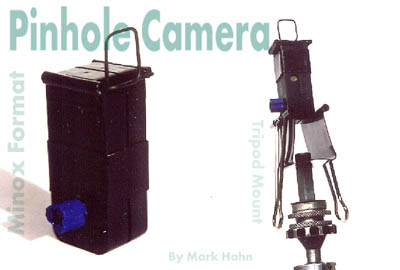
Being obsessed with subminiature cameras in general and Minox cameras specifically it is no surprise that I chose the Minox format for my first pinhole camera experiments.� I have greatly enjoyed using the resulting camera and am presenting the general details required to construct one in this report.� I also present a number of photographs taken with my camera.
In general, the camera is simply a pinhole and wind knob added to a Minox film casket.� The wind mechanism is the real innovation that I stumbled onto at Home Depot.� A 1/4 inch plastic wall anchor fits perfectly into the Minox cassette take-up side and engages the spool tangs without damaging them.��
To convert a Minox film casket into a pinhole camera you start by drilling an 1/8 inch hole in the bottom of the film casket, as shown in Figure 1, installing a length of� 1/8 inch dowel rod which is then inserted into cut lengths of 1/4 wall anchor.� Since the film is safely inside the Minox film cassette no light is able to reach the film, but note that the wall anchor must have 3 expansion grooves and not 4.
�
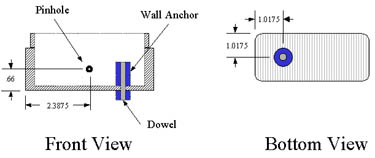
Figure 1.� Critical Dimensions For Pinhole Camera Construction.
A 1/4 inch hole is drilled into the front of the camera, behind which a pinhole in brass shim stock is taped inside the camera.� A piece of corrugated cardboard is cut to fit above the film cassette to hold it firmly in place.� A strip of flexible tin is then bent around the camera and wrapped in electricians tape.� This serves to both clasp the camera closed and act as a shutter mechanism.��
I then made a crude clip-on sports finder by bending wire to the correct size (note that the finder should be the same size as the negative and viewed at a distance equal to the "focal" length of the camera).� I sized my finder to the Minox negative size of 8x11mm, which is undersized for the actual negative size of this camera, but� allows for the inaccuracy of the finder and also lets me frame my photos as they will be enlarged in my Minox enlarger.�
The camera has a focal length of 16.75mm which is roughly "normal" for the 9.2x14mm negative size.� I used a non-optimized pinhole diameter of .15mm so that my base "sunny 16" exposure would be exactly one second for Kodak Techpan film (rated at 50 ASA).� For these long exposures a tripod clamp was needed and I constructed one from a large "bull dog" paper clip, a 1/4 inch spacer and 1/4 inch bolt (see heading photo).
Camera operation is quite straight forward.� After loading your film you wind one full rotation, then with the camera firmly in the tripod clamp you frame your shot using the sports finder.� When you are ready to take the shot you slide the shutter up to expose the pinhole.� Note that the "shutter" should be wrapped tightly enough around the camera so that it will stay open, but loose enough to slide smoothly.� After closing the shutter you should advance the film.� For the first ten or fifteen frame you should advance the film roughly 1/3 turn and after that about 1/4 turn.� I get approximately 35 frames for my standard 50 exposure Minox load.