First, a resume of sort. Sometime in the late 1960s, I joined a neighbor child at Sailing Camp at the Southern Yacht Club in New Orleans, La. Unlike a lot of kids there who came from boating families, I knew didley squat about boating in general and sailing in particular when I arrived.
We learned on Fish Boats. Here's a picture of a new, fiberglass reconstruction of the old Fish Boat. Our were wood. The spars were wood. The damn gaffs were wood. I can't tell you how heavy they seemed to me as an eight or nine year old. I felt like something out of a sea book, two or three of us hauling on a line to get that damned thing up.
I was hooked. I spent countless hours on a friend's dad's Ensign on Lake Pontchartrain. A college/professor buddy had a Rhodes Bantam (this was decked forward, and we didn't quite look like that back around 1980), and when I moved into my twenties spent many hours in that boat. Spent all my time at the beach on rental cats, and rented Flying Scott's on the Potomac River weekends we didn't make it to Rehoboth when I lived on the East Coast.
Then I met my wife. After a brief introduction to the ladies facilities on the Scott (aka the centerboard trunk), my next few trips to the boat show found me looking at larger, and more expensive boats. She was also a non-sailer, and just the sort of (non-sailing, female spouse) person the salesmen over at the Compac booth are waiting for.
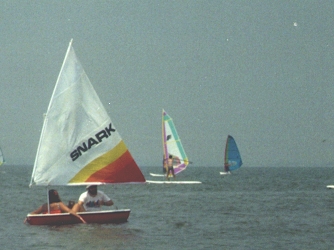
As things turned out, we didn't buy a boat. (Ok, I picked up a Snark at a garage sale which turned into my favorite beach toy, but that barely counts),Then my daughter was born. Another reason not to buy a boat. Then we moved back to the Midwest, and my son was born. We were living a block from Little Detroit Lake, and two blocks from the marina where our Precision 18 is now kept. But Rebecca was staying home with the kids, we were working on our 1919, mostly original home, and money was tight. No boat.
About two years ago, I started looking, but found nothing in my price range that I wanted. It would be easy to pick up a scow or a Buccaneer or a Johnson or a Hobie Cat on one of the lakes in north west Minnesota. But I couldn't find a reasonably priced, reasonably good condition boat in the 18-22 range with a decent cuddy cabin. By decent, I mean not to much and not too little. (Someday I will learn not to try to brace myself on the Catalina 22 table. I swear. If you know what I'm talking about, that's a "too much" cabin for our needs).
We brought the Tangent home on June 21, and parked her in the driveway. I spent a lot the next week, medicated on hydrocodone from having three wisdom teeth extracted, staring through the driving rain at the boat. I mentally rehearsed the rigging, launching, and first sail. I'd spent enough time sailing, even if I'd been out of the sport for a very long time, to think that the first two steps would be where I could confront challenges and problems. I was wrong.
The only real issue I had launching and rigging the boat, was misjudging a couple of very high tree branches. The Precision 18 is a relatively tall-masted, fractional rig (P=20', plus hull, keel, trailer, etc.). But we caught it just at the back stay started to snag, extricated ourselves, and got around and onto the ramp.
We were worried about getting a boat that draws almost 2' off the motor boat ramp, dreading having to back and steer with the Precision Trailer extension on. But we didn't need it. Got my Taurus Wagon into the water to probably just below the axle, snorkeling the exhaust, and with a slight shove, she was off.
Motor started right up. Got the tiller into barn door position thinking I could steer with the tiller and lock the motor down. And away we go.
I spent a lot of time loosening and tightening the motor pivot lock, and trying to trim the motor so that it didn't feel like the prop was was trying to literally suck the rudder in. I still haven't got that entirely figured out after two sailings, and when I want to make time, I pull up the rudder entirely and steer with the outboard tiller. I'm not sure how one is supposed to steer without turning the throttle, but I assume that is a learned skill that time will bring.
(An aside: My wife insists that the bits of missing glass on the motor side of the rudder were done by me on the first day, and not during the time I was training her to run the boat and motor tiller together while I raised and lowered sail. I am having none of that. I'm absolutely certain I have no recollections whatsoever of having let the rudder touch the propeller. Honest.)
Next came trying to sail. I really should have just motored the maybe 2 and a half miles from the boat launch at the south end of Big Detroit up to marina on Little Detroit. But I hate damn outboards (in case I wasn't being clear enough above) and was bound and determined to sail the boat in.
The sail tracks started to jam at about the point where the reef cringle passes the reef hook, as the boat fell off and the wind caught the sail. Not a problem: snag the reef hook, haul down hard on the halyard and away we go. I had already killed and hauled up the motor, so I did a lot of sculling back up into the wind to get the reef line in and the reef ties on. Those of you who have ever navigated something like a Fish Boat out of the back of a large marina on a light wind day may still have a lot of experience in sculling. Or perhaps not.
But finally, through three episodes of sculling and trying to backwind handfuls of the not very well secured mainsail, I managed to get the halyard passably tight with the sail on the reef cringle, the reefing line lead and secured, and one of the reef ties in a a perfect example of the Granny Knot from Chapman's Piloting.
But I was sailing again.
The wind was piping up to about 15, gusting 20 (weatherman's guess, not mine), and I was glad I'd abandoned raising the mainsail at the reef cringle, and hadn't even considered getting a jib up. Things were a bit bouncy out there in the white caps, but nothing I didn't think the boat and I could handle. In fact, I was generally very pleased with the way the boat handled under a (poorly) reefed mainsail alone. Except that I thought that, for safety's sake, I ought to motor sail through the cut.
Parts of this should probably be Lesson 4, but we'll get to that later. Put briefly, a boat with a loosely turned rig and a baggy reefed main pounding through chop will not tend to holds its course while you're ass up in the air wrestling with the outboard. This is especially true if you boat has a y-harness at the end of the back stay, and the motor's on the lee side of the boat.
I think my efforts in getting the motor down and running while sailing in perfect S's around Big Detroit Lake (yes I had enough sense to not let it gybe itself while my posterior was high enough up in the air to possible interfere with the maneuver), was probably every bit as entertaining to someone not an active participant as it seems now, a few days and several beers later.
Solo sailors who are not having particularly good days on unfamiliar boats should probably not, as a practice, lash the tiller while dousing the mainsail, but I had had entirely enough fun boating for one day. My wife was calling me a second time on the cell phone to find out when I was coming to rescue her from the children and the dog. I asked her not to use the word "rescue" again during this conversation, noted that I was not having an entirely lovely sail across the lake, and that I was getting there as fast as I could.
Even with the helm lashed, the Precision 18 is sufficiently tender that a 235 pound guy moving not to terribly gracefully around the base of the mast tends to set the boat off the wind. But once the sail was coming down with the boom sheeted amidships, I really didn't care if I motored in goofy circles around the lake. Just so long as I got mostly back under control and through the cut before I emptied the internal tank on the Mercury 5 or found that the wife had take the car (trailer still attached) and gone home to her mother's. Well, her mother's lake condo, where we were supposed to be spending the night. I could tell from her tone of voice that I was to get the damn boat in soon or I'd probably be sleeping on it.
Which brings us to the moral of this lesson. Disregarding the ink jet print out of the Minnesota Department of Natural Resources depth chart of the lake, the two buoys I could make out on the south side were so close together I mistook them for the cut. Of course, I was trying to beat to windward to reach what I thought was the channel, and not succeeding too well with shifting winds around the headland and my badly shaped, main only rig. Which led to trying to get the motor down. After all the travails listed above, I got close enough to realize that the entire sandbar is marked by warning buoys, including the two that were placed so close together that I mistook them for channel markers.
But by the time I'd doused the main and stuffed it into the cabin (and even bagged it with moderate concern for its long term well-being) it was no big deal motoring up the length of the sand bar (less than a mile) to find the actual cut--except for some of the problems of motor/helm trim noted in part one, which kept me running the motor at about 1/3 throttle for fear the prop wash was going to rip the tiller out of my hands. This is OK, as at full throttle the P-18, being a fairly light boat, tends to bury the stern far enough to backwash the cockpit drains and immerse one's feet.
The second day was mostly pleasant under almost identical sailing conditions. No crushed fingers in the motor mount or bruised egos. Our first "hat overboard" drill was not a stunning success, but that was mostly due to the fact that I didn't toss the orange PFD over the side to mark the position of the black baseball cap on the mostly dark lake.
The one unpleasant discovery was that the motor mount was not locking properly in the down position. This is not something you notice going forward, but is immediately obvious when you engage the motor in reverse and give it the gun, and it tries to jump up into the boat with you. I will probably have some further opportunities to mangle my fingers while dangling upside down figuring this out, but pushing off wasn't too bad in spite of my wife's fear of going forward.
We motored the half-mile to the cut, since there is more and deeper water on Big Detroit than on Little Detroit where the marina is. Getting the main up was a much more pleasant experience with somebody on board to keep the boat pointed into the wind. One of the first improvements I will add to the boat, as I want to be able to sail alone, will be a tiller tamer. Then I'll need to figure out the thrust angle at which a lashed mast and an engine running slow will keep the bow into the wind for a reasonable period of time (or at least long enough to get the main all the way up and the halyard swatted tight.
Because the weather was promising the same, I decided to raise the main only to the reef cringle again. Having some leisure time with somebody to keep us into the wind allowed to get the sail set up properly, although my wife was having the first-time sailors typical trouble with the tiller, which is not intuitive to the born and raised power boater.
As I said in the title, I was pleased to find that "big boat feel" is mostly a euphemism for "big boat look". And by that, they mean some extra free board, and a view into the cabin. Sailing the P-18 was a pleasantly small boat experience, both in terms of my experience and comfort level and in terms of the promise of fun sailing.
The boat sailed very well under a reefed main only. There's no knotmeter, and I've been off the water too long to make any sort of good guess at actual speed. But we were making good time based on watching the bits of flotsam (and my baseball cap) as they disappeared back behind the boat.
The ability to point under main only was impressive. Tacking was definitely small-boat, of the get-the-bow-over-now sort. Not Laser or even catamaran quick, but the boat is high and light enough that you want to put the bow though the wind in fairly short order.
Another familiar sensation was the way the boat accelerated in puffs. I believe that the literature on this boat uses the words "initially tender". The practical impact of this that when a strong puff comes along, the initial temptation for a smaller-boat sailer like myself was to trim and hike, but the coamings of the cockpit are in the way. My first-day experience was that the boat will set up at a fairly decent angle of heel (the glued on inclinometer fell off on day one) and jump into the wind. A very nice feeling for me, and one that didn't concern my wife too much.
I didn't set up the vang, but with end-boom sheeting I could see the boom riding up as we fell off the wind. I'm sure I had at good half a knot off the wind sitting below in a bucket if I had just hanked it on.