 |
 |
|
|
|
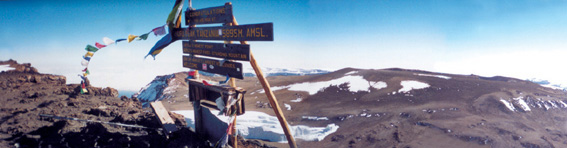
At just below 6,000m, Kilimanjaro is the highest mountain in Africa. It is the highest free-standing mountain in the world, and the second highest volcano in the world. The first attempt at the summit was made by a missionary to the area, who was deserted by his guides, and left to die near the top. It was successfully conquered in 1898, by another missionary – Hans Myer. So it is a devastating and defiant mountain, shrouded in mystery and a strange allure. 1 June 2002 – And so it was, that we awoke at 5:00am, to catch the bus that would take us from Nairobi, past the Tanzanian border, to Moshi. It was a seven-hour trip that took us past the smaller mountain, Little Meru and then onto Kili. From a distance the ice-capped peak looks incredibly surreal, as it juts out in the middle of an expanse of arid landscape. |



