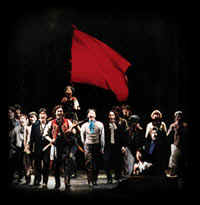
JAPANESE PRODUCTION
JAPANESE PRODUCTION
|
The Toho Company is
Japan’s large television and Entertainment Corporation.
John Caird remarks that musical traditions are different in Japan
and so are singing standards. Musicals
are not entirely unknown to the Japanese because their backgrounds are
mostly in classical theatre and film work.
The Japanese cast of Les Misérables was to be picked later; it
was to be dealt with an introduction to musical theatre first.
The Toho organization set up the ‘Les Misérables School’ to
teach candidates of the musical theatre.
Agents do not exist in Japan; therefore, volunteers advertised in
campuses, newspapers, and entrances of existing theatres.
Those who auditioned to the school were mostly kids with strong
voices. Since revolution is
not basically a Japanese concept, the Japanese cast started from
‘grass roots’. Language
was another problem. Mie
Kakigahara was Caird’s interpreter, a remarkable lady who translated
all of Caird’s dialogue to the Japanese cast.
The Japanese language is greatly difficult to translate because one
must hear the entire sentence of Japanese in order to translate it into
English. A musical score was prepared and above the piano score, there
were the singers’ musical notes in English.
Under the singers’ score was the translation of it in Japanese.
Lyrics had to be ‘singable’ and so Fantine’s famous
soliloquy ‘I Dreamed a Dream’ which starts:
There was a time when men were kind became in Japanese:
Long ago men sweet words whispered,
-- Do You Hear
the People Sing? --
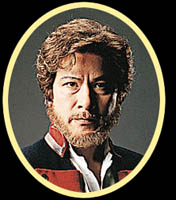
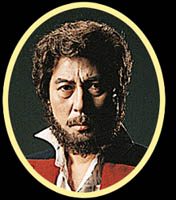
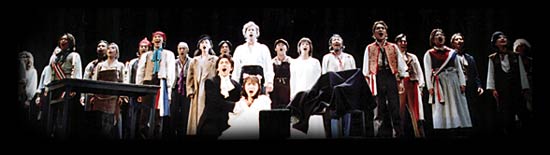
The Japanese production was sponsored by the Japanese perfume corporation Shiseido and it established a unique cast. The two major roles, Javert and Valjean, Sakae Takita and Takeshi Kaga, alternated the role. Caird suggested that Kaga would make a wonderful Javert, but Kaga insisted that he would not do it because Takita was in the lead role. Caird suggested Kaga to open as Valjean for the preview and Takita would play Valjean for the Royal Opening.
Takeshi
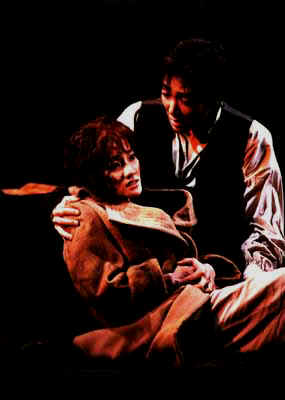
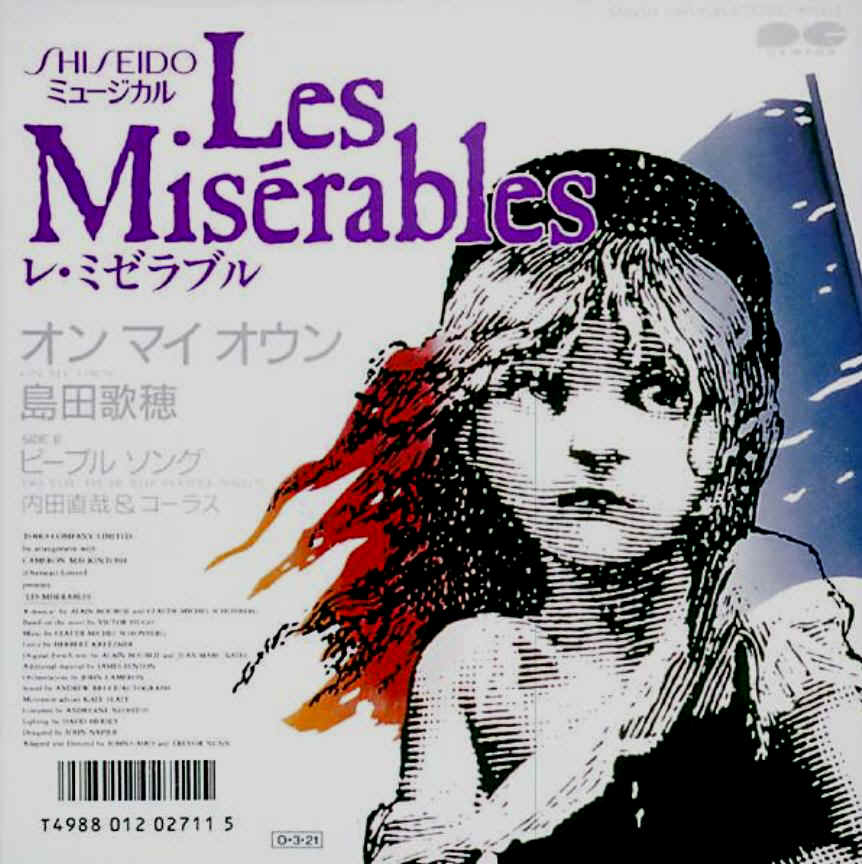
Kaga (Left, Jean Valjean); Sakae Takita (Right, Jean Valjean) The Japanese cast of Les Misérables was unbelievably hard working. They insisted to work 17 hours a day including Sundays. The Japanese cast also provided many surprises. Kaho Shimada, the singer playing Éponine, began rehearsals with no knowledge of English. Kaho Shimada later sang Éponine in the Complete Symphonic Recording. She turned out to be an extraordinary Éponine. The Japanese Fantine, Caird remarks, was probably the best Fantine of all time.
Practically the entire Japanese Royal Family attended the Tokyo première, with the exception of Emperor Hirohito and Empress Nagako. Caird was warned that Japanese audiences were less demonstrative than the audiences in West End and in Broadway. Little ripples of applause followed each song and in the Act finales, the clapping became more significant, although it ended before the actors/actresses came on stage to make their final bow. The Toho organization remarked that this was the most extraordinary thing they had encountered. It was the complete opposite to Broadway reactions, where the audiences cheered almost too overwhelming. There are currently
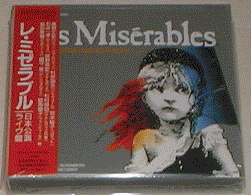
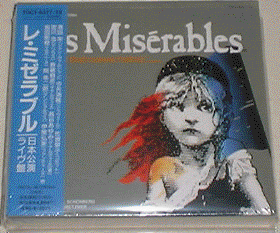
three Japanese Les Misérables recordings available for sale: One
single, and two double albums:
|
Back
to the Main Page
Please e-mail me if you have any suggestions or
comments.
" Les Misérables - C'est Pour Demain" officially opened in January 2000.