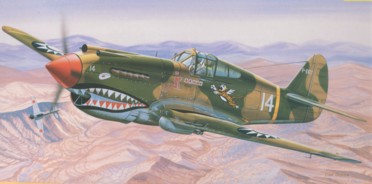
The P-40B Tiger Shark, made famous by General Claire Chennault's "Flying Tigers" in China, was a direct off-spring of the P-36 (Hawk 75-A) built by the Curtiss-Wright Corp. Airplane Division
The original XP-40 was a production Hawk 75A modified for the installation of the more powerful Allison V-12, 1,150 h.p. liquid cooled engine. This new fighter was flown for the first time in October, 1938.
The P-40 had a wing span of 37 ft. 3½ in, fuselage length of 31 ft. 8½ in., and a height of 10 ft. 7 in. Armament consisted of two .50 caliber machine guns in the nose and two .30 caliber machine guns in each wing.
Although lacking somewhat in maneuverability and rate of climb, the P-40's top speed of 352 m.p.h. coupled with its rugged construction, armor plating and fast diving speed, enabled it to hold its own against most of the fighter planes in existence at that time. In the hands of such capable pilots as Colonel Robert L. Scott of the famed "Flying Tigers" and Lieutenant Neville Duke of R.A.F. No. 112 "Shark" Squadron in North Africa, the P-40 became a potent fighting machine. Wing-Commander Clive "Killer" Caldwell, R.A.A.F., while flying the P-40, scored more than twenty victories in the Middle East.
Names for the P-40B ranged from the Curtiss "Hawk", in the United States, "Tomahawk" in Great Britain, to the "Tiger Shark" of the "Flying Tigers" in China. This Group was formed into three squadrons, the 1st (Adam and Eve), the 2nd (Panda Bears), and the 3rd (Hell's Angels). They fought their first action on December 20, 1941 and in the following six and one-half months complied a record of 299 victories with a loss of only 50 planes, eight pilots killed and four missing.
 During the war years the P-40 fought on many battle fronts and bore the insignia of various countries. Among these were the United States, Britain, Australia, China, South Africa, Turkey, and Russia. The P-40 and P-40Bs were the first of a long line of P-40s whose performance improved with each modification.