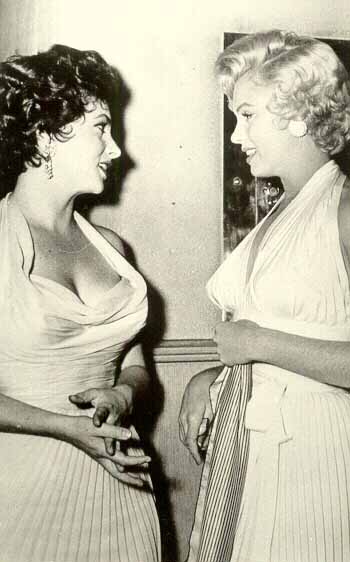
 it's an
 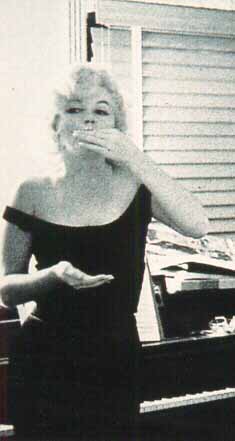 Sometimes wearing a scarf and a polo coat and no make up and
 with a certain attitude of walking, I go shopping or just
looking at people living. But then you know, there will be a few
teenagers who are kind of sharp and they'll say, "Hey, just a
minute. You know who I think that is?" And they'll start
tailing me. And I don't mind. I realize some people want to see if
you're real. The teenagers, the little kids, their faces light up.
They say, "Gee," and they can't wait to tell their friends. And
old people come up and say, "Wait till I tell my wife." You've
changed their whole day. In the morning, the garbage men
that go by 57th Street when I come out the door say,
"Marilyn, hi! How do you feel this morning?" To me,
it's an
honor, and I love them for it. The working men, I'll go by and
they'll whistle. At first they whistle because they think, oh,
it's a girl. She's got blond hair and she's not out of shape,
and then they say, "Gosh, it's Marilyn Monroe!" And that has
it's, you know, those are times it's nice. People knowing who
you are and all of that, and feeling that you've meant
something to them.
I don't know quite why, but somehow I feel they know that I
mean what I do, both when I'm acting on the screen or
when if I see them in person and greet them. That I really always
do mean hello, and how are you? In their fantasies they feel
"Gee, it can happen to me!"
But when you're famous you kind of run into human nature
in a raw kind of way. It stirs up envy, fame does. People you
run into feel that, well, who is she who does she think she is,
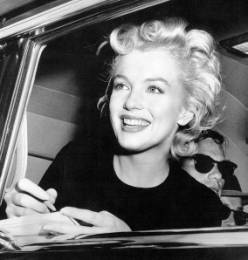 Marilyn Monroe? They feel fame gives them some kind of
privilege to walk up to you and say anything to you, you
know, of any kind of nature and it won't hurt your feelings. Like
it's happening to your clothing. One time here I am looking
for a home to buy and I stopped at this place. A man came
out and was very pleasant and cheerful, and said, "Oh, just a
moment, I want my wife to meet you." Well, she came out
and said, "Will you please get off the premises?" You're
always running into peoples unconscious. Let's take some
actors or directors. Usually they don't say it to me, they say it
to the newspapers because that's a bigger play. 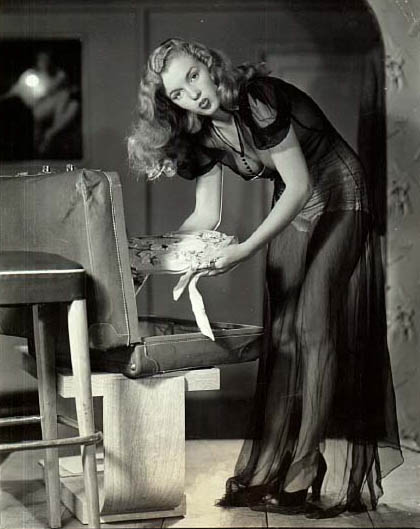 you know, if
they're only insulting me to my face that doesn't make a big
enough play because all I have to say is, "See you around,
like never." But if it's in the newspapers, it's coast to coast
and all around the world. I don't understand why people
aren't a little more generous with each other. I don't like to say
this, but I'm afraid there is alot of envy in this business. The
only thing I can do is stop and think, "I'm all right but I'm not
so sure about them!" For instance, you've read there was
some actorthat once said that kissing me was like kissing Hitler.
Well, I think that's his problem. If I have to do intimate love
scenes with somebody who really has these kinds of feelings
toward me, then my fantasy can come into play. In other
words, out with him, in with my fantasy. He was never there.
But one thing about fame is the bigger the people are, the
simpler they are, the more they are not awed by you! They
don't feel they have to be offensive, they don't feel they
have to insult you. You can meet Carl Sandburg and he is so
 pleased to meet you. He wants to know about you, and you want
to know about him. Not in any way has he ever let me down.
Or else you can meet working people who want to know
what it is like. You try to explain to them. I don't like to disillusion
them and tell them it's sometimes nearly impossible. They
kind of look toward you for something that's away from their
everyday life. I guess you call that entertainment, a world to
escape into, a fantasy. Sometimes it makes you a little bit sad
because you'd like to meet somebody kind of on face value.
It's nice to be included in peoples fantasies but you also like
to be accepted for your own sake. I don't look at myself as a
commodity, but I'm sure alot of people have. Including, well,
one corporation in particular which shall be nameless. If I'm
sounding picked on or something, I think I am. I'll think I
have a few wonderful friends and all of a sudden, ooh, here it
comes.  They do alot of things. They talk about you to the
press, to their friends, tell stories, and you know, it's
disappointing. These are the ones you aren't interested in seeing
everyday of your life.
Of course, it does depend on the people, but sometimes I'm
invited places to kind of brighten up a dinner table like a
musician who'll play the piano after dinner, and I know you're
not really invited for yourself. You're just an ornament.
When I was 5 I think, that's when I started wanting to be an
actress. I loved to play. I didn't like the world around me
because it was kind of grim, but I loved to play house. It was like
you could make your own boundaries. It goes beyond house,
you could make your own situations and you could pretend,
and even if the other kids were a little slow on the imagining
 part you could say, "Hey, what about if you were such and
such, and I were such and such wouldn't that be fun?" And
they'd say, "Oh, yes," and then I'd say,
"Well, that will be a horse and this will be..." it was play,
playfulness. When I heard that this was acting, I said that's
what I want to be. You
can play. But then you grow up and find out about playing,
that they make playing very difficult for you. Some of my
foster families used to send me to the movies to get me out of
the house and there I'd sit all day and way into the night. Up
in front, there with the screen so big, a little kid all alone, and
I loved it. I loved anything that moved up there and I didn't
miss anything that happened and there was no popcorn either.
When I was 11, the whole world which was closed to me. I
just felt I was on the outside of the world. Suddenly,
everything opened up. Even the girls paid a little attention to me
because they thought, "Hmmm, she's to be dealt with!" And I
had this long walk to school 2 1/2 miles to school, 2 1/2 miles
back. It was just sheer pleasure. Every fellow honked his
horn you know, workers driving to work, waving, you know,
and I'd wave back. The world became friendly. All the
newspaper boys when they delivered the paper would come
around to where I lived, and I used to hang from the limb of a
tree, and I had sort of a sweatshirt on. I didn't realize the
value of a sweatshirt in those days, and then I was sort of
beginning to catch on, but I didn't quite get it, because I
couldn't really afford sweaters. But here they come with their
bicycles, you know, and I'd get these free papers and the
family liked that, and they'd all pull their bicycles up around
the tree and then I'd be hanging, looking kind of like a
monkey, I guess. I was a little shy to come down. I did get down
to the curb, kinda kicking the curb and kicking the leaves and
talking, but mostly listening. And sometimes the family used
to worry because I used to laugh so loud and so gay; I guess
they felt it was hysterical. It was just this sudden freedom
because I would ask the boys, "Can I ride your bike now?"
and they'd say, "Sure." Then I'd go zooming, laughing in the
wind, riding down the block, laughing, and they'd all stand
around and wait till I came back, but I loved the wind. It
caressed me. But it was kind of a double edged thing. I did find
too, when the world opened up that people took alot for
granted, like not only could they be friendly, but they could
suddenly get overly friendly and expect an awful lot for very
little. When I was older, I used to go to Grauman's Chinese
Theater and try to fit my foot in the prints in the cement there.
And I'd say, "Oh, oh, my foot's too big! I guess that's out." I
did have a funny feeling later when I finally put my foot down
into that wet cement. I sure knew what it really meant to
me. Anything's possible, almost.
It was the creative part that kept me going, trying to be an
actress. I enjoy acting when you really hit it right. And I
guess I've always had too much fantasy to be only a housewife.
Well, also, I had to eat. I was never kept, to be blunt about
it. I always kept myself. I have always had a pride in the fact
that I was my own. And Los Angeles was my home, too, so
when they said, "Go home!" I said, "I am home." The time I
sort of began to think I was famous, I was driving somebody
to the airport, and as I came back there was this movie
house and I saw my name in lights. I pulled the car up at a
distance down the street, it was too much to take up close, you
know, all of a sudden. And I said, "God, somebody's made a
mistake." But there it was, in lights. And I sat there and said,
"So that's the way it looks," and it was all very strange to
me, and yet at the studio they had said, "Remember you're
not a star." Yet there it is up in lights. I really got the idea I
must be a star, or something from the newspapermen, I'm
saying men, not the women who would interview me and
they would be warm and friendly. By the way, that part of
the press, you know, the men of the press, unless they have
their own personal quirks against me, they were always very
warm and friendly and they'd say, "You know, you're the
only star," and I'd say, "Star?" and they'd look at me as if I
were nuts. I think they, in their own kind of way, made me
realize I was famous.
I remember when I got the part in Gentlemen Prefer
Blondes. Jane Russell, she was the brunette in it and I was the
blonde. She got $200,000 for it, and I got my $500 a week,
but that to me was, you know, considerable. She by the way,
was quite wonderful to me. The only thing was I couldn't get
a dressing room. I said, finally, I really got to this kind of
level, I said, "Look, after all, I am the blonde, and it is Gentlemen
Prefer Blondes!" Because still they always kept saying,
"Remember, you're not a star." I said, "Well, whatever I am,
I am the blonde!" And I want to say the people, if I am a
star, the people made me a star. No studio, no person, but the
people did. There was a reaction that came to the studio, the
fan mail, or when I went to a premiere, or the exhibitors
wanted to meet me. I didn't know why. When they all rushed
toward me I looked behind me to see who was there and I
said, "My heavens!" I was scared to death. I used to get the
feeling, and sometimes I still get it, that sometimes I was
fooling somebody. I don't know who or what, maybe myself.
I've always felt toward the slightest scene, even if all I had
to do in a scene was just to come in and say, "Hi," that the
people ought to get their money's worth and that this is an
obligation of mine, to give them the best you can get from
me. I do have feelings some days when there are scenes
with alot of responsibility toward the meaning, and I'll wish,
"Gee, if only I had been a cleaning woman." On the way to
the studio I would see somebody cleaning and I'd say,
"That's what I'd like to be. That's my ambition in life. "But I
think that all actors go through this. We not only want to be
good, we have to be. You know, when they talk about
nervousness, my teacher, Lee Strasberg, when I said to him, "I
don't know what's wrong with me but I'm a little nervous,"
he said, "When you're not, give up, because nervousness
indicates sensitivity. "Also, a struggle with shyness is in every
actor more than anyone can imagine. There is a censor inside
us that says to what degree do we let go, like a child playing.
I guess people think we just go out there, and you know,
that's all we do. Just do it. But it's a real struggle. I'm one of
the world's most self conscious people. I really have to struggle.
An actor is not a machine, no matter how much they want to
say you are. Creativity has got to start with humanity and
when you're a human being, you feel, you suffer. You're
gay, you're sick, you're nervous or whatever. Like any
creative human being, I would like a bit more control so that it
would be a little easier for me when the director says, "One
tear, right now," that one tear would pop out. But once
there came two tears because I thought, "How dare he?"
Goethe said, "Talent is developed in privacy," you know? And it's
really true. There is a need for aloneness which I don't think
most people realize for an actor. It's almost having certain
kinds of secrets for yourself that you'll let the whole world in
on only for a moment, when you're acting. But everybody is
always tugging at you. They'd all like sort of a chunk of you.
They kind of like to take pieces out of you. I don't think they
realize it, but it's like "rrr do this, rrr do that." But you do
want to stay intact. Intact and on two feet.
I think that when you are famous every weakness is
exaggerated. This industry should behave like a mother whose
child has just run out in front of a car. But instead of clasping
the child to them, they start punishing the child. Like you
don't dare get a cold. How dare you get a cold! I mean, the
executives can get colds and stay home forever and phone it in,
but how dare you, the actor, get a cold or a virus. You know,
no one feels worse than the one who's sick. I sometimes
wish, gee, I wish they had to act a comedy with a
temperature and a virus infection. I am not an actress who
appears at a studio just for the purpose of discipline. This doesn't
have anything at all to do with art. I myself would like to
become more disciplined within my work. But I'm there to give a
performance and not to be disciplined by a studio! After all,
I'm not in a military school. This is supposed to be an art
form, not just a manufacturing establishment. The sensitivity that
helps me to act, you see, also makes me react. An actor is
supposed to be a sensitive instrument. Isaac Stern takes
good care of his violin. What if everybody jumped on his violin?
If you've noticed in Hollywood where millions and billions of
dollars have been made, there aren't really any kind of
monuments or museums, and I don't call putting your footprint in
Grauman's Chinese a monument, all right this did mean a lot,
sentimentally at the time. Gee, nobody left anything behind,
they took it, they grabbed it and they ran, the ones who
made the billions of dollars, never the workers.
You know alot of people have, oh gee, real quirky problems
that they wouldn't dare have anyone know. But one of my
problems happens to show, I'm late. I guess people think
that why I'm late is some kind of arrogance and I think it is
opposite of arrogance. I also feel that I'm not in this big
American rush, you know, you got to go and you got to go fast
but for no good reason. The main thing is, I want to be
prepared when I get there to give a good performance or
whatever to the best of my ability. A lot of people can be there on
time and do nothing, which I have seen them do, and you
know, all sit around and sort of chit chatting and talking trivia
about their social life. Gable said about me, "When she's
there, she's there. All of her is there! She's there to work."
I was honored when they asked me to appear at the
President's birthday rally in Madison Square Garden. There was
like a hush over the whole place when I came on to sing
Happy Birthday, like if I had been wearing a slip I would have
thought it was showing, or something. I thought, "Oh, my
gosh, what if no sound comes out!"
A hush like that from the people warms me. It's sort of like
an embrace. Then you think, by God, I'll sing this song if it's
the last thing I ever do. And for all the people. Because I
remember when I turned to the microphone I looked all the way
up and back, and I thought, "That's where I'd be, way up
there under one of those rafters, close to the ceiling, after I
paid my $2 to come into the place." Afterwards they had
some sort of reception. I was with my former father-in-law,
Isadore Miller, so I think I did something wrong when I met the
President. Instead of saying, "How do you do?" I just said
"This is my former father-in-law, Isadore Miller." He came
here an immigrant and I thought this would be one of the
biggest things in his life, he's about 75 or 80 years old and I
thought this would be something that he would be telling his
grandchildren about and all that. I should have said, "How do
you do, Mr. President," but I had already done the singing,
so well you know. I guess nobody noticed it. Fame has a
special burden, which I might as well state here and now. I don't
mind being burdened with being glamorous and sexual. But
what goes with it can be a burden. Like the man was going to
show me around but the woman said, "Off the premises." I
feel that beauty and femininity are ageless and can't be
contrived, and glamour, although the manufacturers won't like
this, cannot be manufactured. Not real glamour, it's based on
femininity. I think that sexuality is only attractive when it's
natural and spontaneous. This is where alot of them miss the
boat. And then something I'd just like to spout off on. We are
all born sexual creatures, thank God, but it's a pity so many
people despise and crush this natural gift. Art, real art,
comes from it, everything.
I never quite understood it, this sex symbol. I always thought
symbols were those things you clash together! That's the
trouble, a sex symbol becomes a thing. I just hate to be a
thing. But if I'm going to be a symbol of something I'd rather
have it sex than some other things they've got symbols of!
These girls who try to be me, I guess the studios put them up
to it, or they get the ideas themselves. But gee, they haven't
got it. You can make alot of gags about it like they haven't
got the foreground or else they haven't the background. But
I mean the middle, where you live.
All my stepchildren carried the burden of my fame.
Sometimes they would read terrible things about me and I'd
worry about whether it would hurt them. I would tell them, don't
hide these things from me. I'd rather you ask me these
things straight out and I'll answer all your questions. Don't be
afraid to ask anything. After all, I have come up from way down.
I wanted them to know of life other than their own. I used to
tell them, for instance, that I worked for 5 cents a month and
I washed one hundred dishes, and my step kids would say,
"One hundred dishes!" and I said, "Not only that, I scraped
and cleaned them before I washed them. I washed them and
rinsed them and put them in the draining place, but I said,
"Thank God I didn't have to dry them." Kids are different
from grown ups. You know when you get grown up you can
get kind of sour, I mean that's the way it can go, but kid's
accept you the way you are. Fame to me certainly is only a
temporary and a partial happiness, even for a waif and I was
brought up a waif. But fame is not really for a daily diet,
that's not what fulfills you. It warms you a bit but the warming is
temporary. It's like caviar, you know, it's good to have caviar
but not when you have it every meal every day.
I was never used to being happy, so that wasn't something I
ever took for granted. I did sort of think, you know, marriage
did that. You see, I was brought up differently from the
average American child because the average child is brought up
expecting to be happy. That's it, successful, happy, and on
time. Yet because of fame I was able to meet and marry two
of the nicest men I'd ever met up to that time.
I don't think people will turn against me, at least not by
themselves. I like people. The "public" scares me but people I
trust. Maybe they can be impressed by the press or when a
studio starts sending out all kinds of stories. But I think when
people go to see a movie, they judge for themselves. We
human beings are strange creatures and still reserve the right to think
for ourselves.
Once I was supposed to be finished, that was the end of me.
When Mr. Miller was on trial for contempt of Congress, a
certain corporation executive said either he named names and I
got him to name names, or I was finished. I said, "I'm proud
of my husband's position and I stand behind him all the
way," and the court did too. "Finished," they said. "You'll never
be heard of."
It might be a kind of relief to be finished. It's sort of like, I
don't know, what kind of a yard dash you're running, but
then you're at the finish line and you sort of see you've made
it! But you never have. You have to start all over again. But I
believe you're always as good as your potential.
I now live in my work and in a few relationships with the few
people I can really count on. Fame will go by and, so long,
I've had you fame. If it goes by, I've always known it was
fickle. So at least it's something I experienced, but that's not where I live.