Columbia

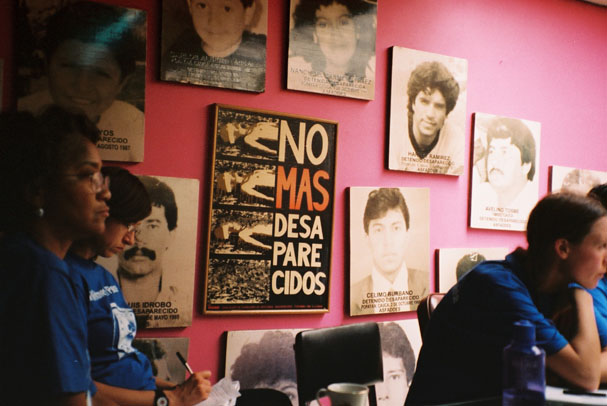 |
The Association for the Families of the
Detained and Disappeared (ASFADDES) was born in 1982 and
came out of the disappearance of 13 students. People went to the
government to try and find out about their family members to no avail. ASFADDES was founded to find out information about family members and to work for peace, justice and human rights. The organization has several areas of work, one of which is education and human rights. Education is a very important focus because there have been many new laws and reforms that have an impact on human rights. |
| Displacement
of AfroColombians It has been a long time and continuous struggle by a number of Afro-Colombian organizations for our territorial rights. The 1991 Constitution was able to get passed transitory Article 55, which deals with lands in the Pacific coast watershed, particularly lands along river banks. Out of that transitory article, Law 70 was created, which covered our territorial right to participate in local government organization as an Afro-Colombian. Law 70 also gives us certain cultural and organizational rights as Afro-Colombians. We don’t assume the land is for private use. It's for public use and should be available for everybody. So we have been working to get the collective title to the land as the law allows us. The most important thing is that these lands we hold in collective title are permanent, cannot be transferred/sold/no liens by third parties (Witness for Peace, 2002). |
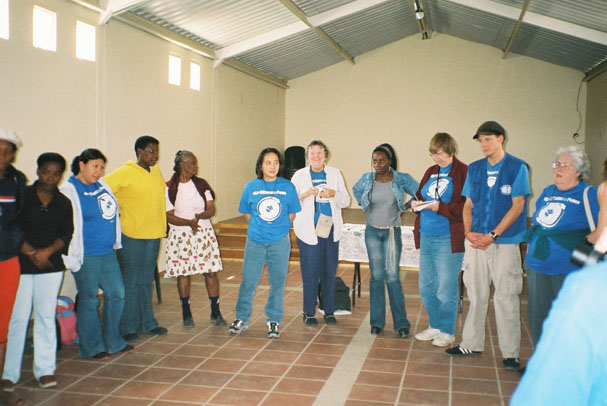 |
| Witness for Peace has visited
AFRODES in Soacha several times over the years, including visits in
2001 and again in July/August 2002 and the quote above is from the
2002. AFRODES, founded in 1999, is an organization that helps displaced
AfroColombians (Podur and Witness for Peace, 2001). In November 2004,
our Witness for Peace delegation visited Soacha but this time we
focused on the voices of women. |
| Dorothia | Maria Louise | |
|
I
came because of the violence. I came
with my grand children. We went through a lot of pain. Afrodes helps
but it is
not enough. There are so many bad times for our children. It is a hard
life for
women with children. So here I am, without work. They don’t give us
work. We
don’t have friends here. We have no chickens. We have no farm and we
don’t have
work. We used to live off agriculture in the mountains. We had a little
farm.
But we had to leave because of the violence. |
I
am the head of the household with
three children. Right now I am unemployed. It is important to give
employment
to women heads of households. I come from a small town [in Antioquia],
very
tranquil. Then one day we found bodies. We were not used to violence.
That is
why we started our group. We need to organize to protect ourselves. I
have been
inn the city seven years. No work. I have to be mother and father to my
children.
My children can’t be in school because there is nobody supporting me.
My daughter
is in Afrodes kindergarten. Even in the Afrodes kindergarten, you need
to
support or how could the school remain open. |
We
lived in Rio Sucio in Choco. My first husband was murdered. We don’t
know why
they killed him. They gave us 24 hours to leave. We went to a small
town then I
moved to |