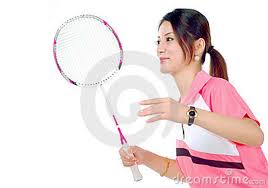
Badminton is a racquet sport played by either two opposing players (singles) or two opposing pairs (doubles), who take positions on opposite halves of a rectangular court divided by a net. Players score points by striking a shuttlecock with their racquet so that it passes over the net and lands in their opponents' half of the court. Each side may only strike the shuttlecock once before it passes over the net. A rally ends once the shuttlecock has struck the floor, or if a fault has been called by either the umpire or service judge or, in their absence, the offending player, at any time during the rally.
The shuttlecock (or shuttle) is a feathered (or, mainly in uncompetitive games, plastic) projectile whose unique aerodynamic properties cause it to fly differently than the balls used in most racquet sports; in particular, the feathers create much higher drag, causing the shuttlecock to decelerate more rapidly than a ball. Shuttlecocks have a much higher top speed, when compared to other racquet sports. Because shuttlecock flight is affected by wind, competitive badminton is played indoors. Badminton is also played outdoors as a casual recreational activity, often as a garden or beach game.
Since 1992, badminton has been an Olympic sport with five events: men's and women's singles, men's and women's doubles, and mixed doubles, in which each pair consists of a man and a woman. At high levels of play, especially in singles, the sport demands excellent fitness: players require aerobic stamina, agility, explosive strength, speed and precision. It is also a technical sport, requiring good motor coordination and the development of sophisticated racquet movements.
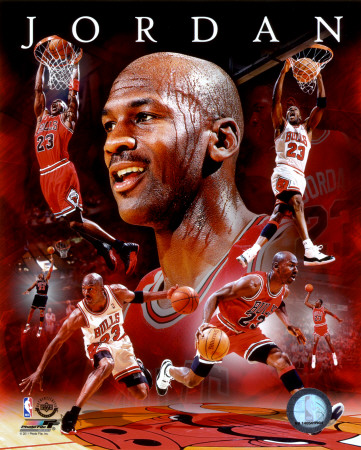
Basketball is a sport played by two teams of five players on a rectangular court. The objective is to shoot a ball through a hoop 18 inches (46 cm) in diameter and 10 feet (3.0 m) high mounted to a backboard at each end. Basketball is one of the world's most popular and widely viewed sports.[1]
A team can score a field goal by shooting the ball through the basket during regular play. A field goal scores two points for the shooting team if a player is touching or closer to the basket than the three-point line, and three points (known commonly as a 3 pointer or three) if the player is behind the three-point line. The team with the most points at the end of the game wins, but additional time (overtime) may be issued when the game ends with a draw. The ball can be advanced on the court by bouncing it while walking or running or throwing it to a team mate. It is a violation to move without dribbling the ball, to carry it, or to hold the ball with both hands then resume dribbling.
Violations are called "fouls". A personal foul is penalized, and a free throw is usually awarded to an offensive player if he is fouled while shooting the ball. A technical foul may also be issued when certain infractions occur, most commonly for unsportsmanlike conduct on the part of a player or coach. A technical foul gives the opposing team a free throw, and the opposing team also retains possession of the ball.
As well as many techniques for shooting, passing, dribbling and rebounding, basketball has specialized player positions and offensive and defensive structures (player positioning). Typically, the tallest members of a team will play "center", "power forward" or "small forward" positions, while shorter players or those who possess the best ball handling skills and speed play "point guard" or "shooting guard".
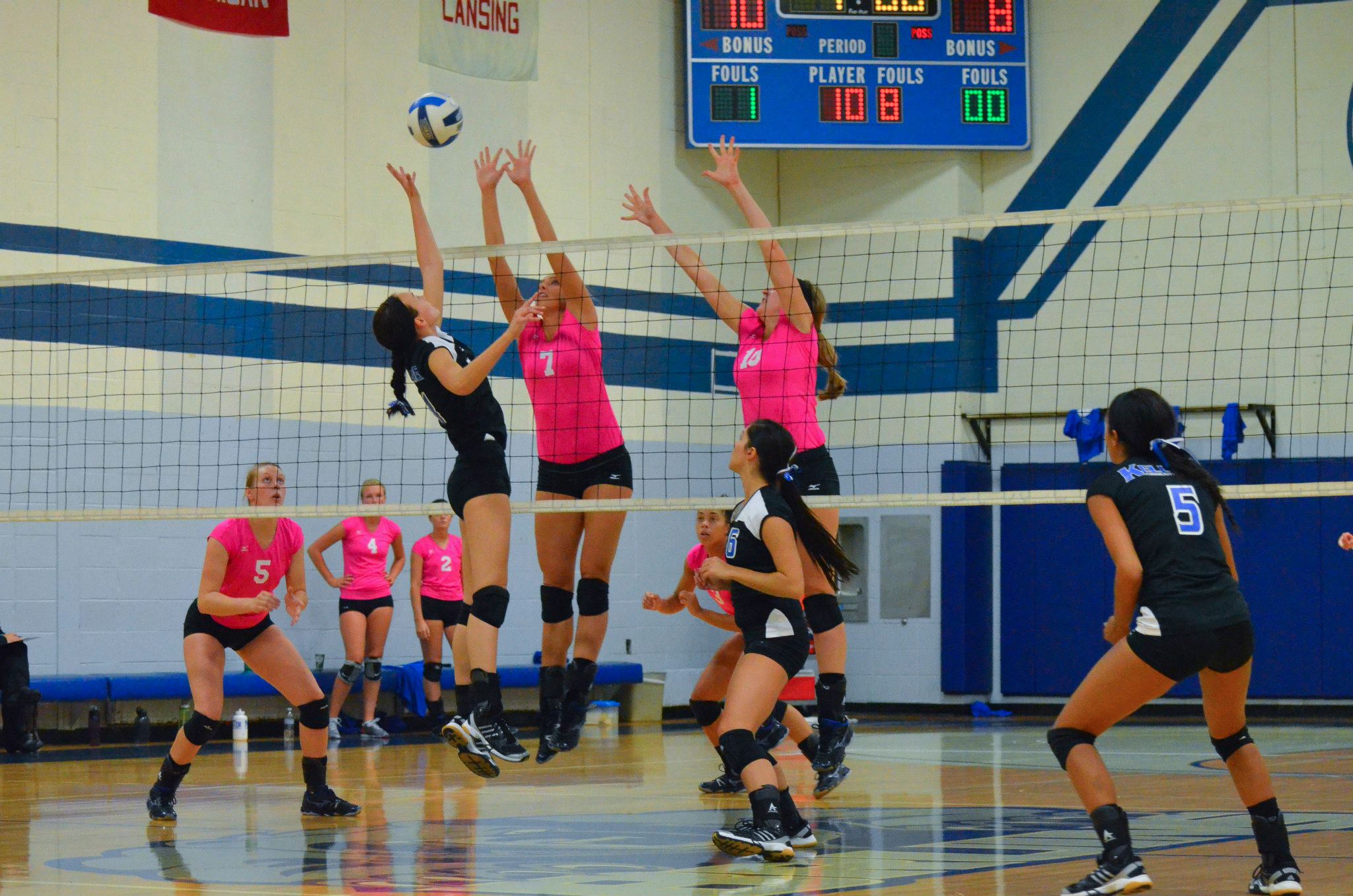
Volleyball is a team sport in which two teams of six players are separated by a net. Each team tries to score points by grounding a ball on the other team's court under organized rules. It has been a part of the official program of the Summer Olympic Games since 1964.
A scene of volleyball play in an Erwadi village.
The complete rules are extensive. But simply, play proceeds as follows: a player on one of the teams begins a 'rally' by serving the ball (tossing or releasing it and then hitting it with a hand or arm), from behind the back boundary line of the court, over the net, and into the receiving team's court. The receiving team must not let the ball be grounded within their court. The team may touch the ball up to 3 times but individual players may not touch the ball twice consecutively. Typically, the first two touches are used to set up for an attack, an attempt to direct the ball back over the net in such a way that the serving team is unable to prevent it from being grounded in their court.
The rally continues, with each team allowed as many as three consecutive touches, until either: a team makes a kill, grounding the ball on the opponent's court and winning the rally; or: a team commits a fault and loses the rally. The team that wins the rally is awarded a point, and serves the ball to start the next rally. A few of the most common faults include:
causing the ball to touch the ground or floor outside the opponents' court or without first passing over the net;
catching and throwing the ball;
double hit: two consecutive contacts with the ball made by the same player;
four consecutive contacts with the ball made by the same team;
net foul: touching the net during play;
foot fault: the foot crosses over the boundary line when serving.
The ball is usually played with the hands or arms, but players can legally strike or push (short contact) the ball with any part of the body.
A number of consistent techniques have evolved in volleyball,