
Our Lady of Kevelaer
Kevelaer�s object of pilgrimage is a small 17th-century print of Our Lady of Luxembourg, a miraculous statue that at the time stood in a chapel outside the city of Luxembourg. It is a copper engraving of 7,5 by 11 centimetres and is dated 1640. It was probably made in Antwerp, then an international centre for the production of devotional prints.
The small engraving is a typical pilgrimage souvenir; a depiction of a cult image and site that is taken home by pilgrims for devotional purposes and as a memento of their journey.
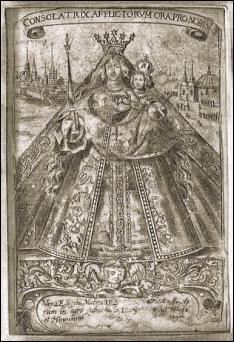
In the left background the city of Luxembourg is depicted. On the right one can see the old Lady chapel of Luxembourg, surrounded by pilgrims in procession. The banner above reads the honorary title of Our Lady of Luxembourg and an invocation: Consolatrix Afflictorum ora pro nobis. In English: �Consoler of the Afflicted, pray for us�. The title �Consoler of the Afflicted� has been part of the Litany of Loreto since the 16th century.
The text frame at the bottom is adorned with a cherub. The faded Latin text reads: Vera Effigies Matris IESU Consolatricis afflictorum in agro suburbano Luxemburgi Miraculis et Hominum Visitatione celebris, anno 1640. In English this means: �True image of the Mother of Jesus, Consoler of the Afflicted, as it stands outside the walls of the city of Luxembourg, celebrated through miracles and visiting of the people, in the year 1640�.
Origins of the devotion
According to tradition, the copper engraving came into possession of Hendrik Busman and his wife in the first half of 1642. The protocol of the Synod of Venlo (1647) recounts how two soldiers tried to sell a set of prints of Our Lady of Luxembourg to Mechel Schrouse, Busman�s wife. She found them too expensive and did not buy one. However, some time later she saw one of the images in a nightly vision. After telling her husband about this, she went looking for the two soldiers to obtain one of the prints. However, in the meantime the men had given the images to their lieutenant, who was detained in Kempen. As soon as the lieutenant was released, Mechel went to visit him. When she told him about her vision, he let her choose one of the images.
After these events the print was kept in the city of Geldern for a short while; first in the convent of the Carmelites and later at the Capuchin. On the last Saturday of May, vicar Johannes Schink brought the image to Kevelaer. The next day, Sunday the 1st of June 1642, he placed it in the small road shrine build by Hendrik Busman. That same day the first pilgrims came to the small picture of Our Lady of Luxembourg. Five years later, at the Synod of Venlo, the Church acknowledged eight miracle healings. The image is considered miraculous since.
Display and adornment
Many gifts and offerings have shaped the present appearance of the shrine that houses the small copper engraving of Our Lady of Luxembourg. During the first decades after 1642, the display of the image must have been quite simple though. In 1642, the picture was just glued on a wooden plank before it was placed in the road shrine.
The first decoration of precious metal was offered about ten years after the present Chapel of Grace was constructed: a silver smith from �s-Hertogenbosch, the Netherlands, and a vicar from Eindhoven, also in the Netherlands, offered the gold plated frame is which the picture is mounted. In 1681 this frame was attached to an ornamented silver plate, a gift from count Wolfgang of Oedingen.
During the 250-year jubilee of the shrine in 1892, the image was solemnly crowned. The coronation took place on behalf of Saint Peter�s basilica in Rome. The crown was made from offered jewels with brilliants, diamonds and precious stones. It is the work of local artisan Bausch.
The heavily gold plated rose branches around the miraculous image also date from 1892. They are a jubilee gift from the �mother shrine� in Luxembourg. In enamel letters the close relationship between �mater et filiae� (mother and daughter) is confirmed: �A token of love from the mother to her daughter�.
The image in procession
In the 19th century, the print was carried in procession through the streets of Kevelaer twice. The first time on the occasion of the 200-year jubilee in 1842 and the second time in 1892. Due to the Second World War it was impossible to celebrate the 300-year jubilee in the same way. It was not until June 1951 that the image was carried around in procession again, to celebrate the dogma proclamation of the Virgin Mary�s Assumption. On the 8th of June 1992, during the celebration of the 350-year jubilee, the image was carried around for the last time.
BACK