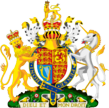
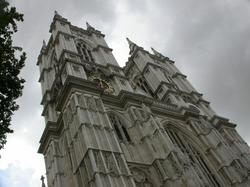
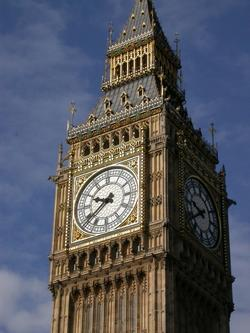
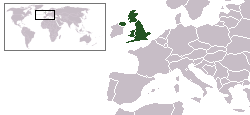
The United Kingdom is a country situated in the British Isles of the north-western coast of continentak Europe.. The United Kingdom is a constitutional monarchy and a unitary state, composed by the political union of four constituent parts: the three constituent countries of England, Scotland, and Waleson the island of Great Britain, and the province of Northern Ireland on the island of Ireland. The capital of United Kingdom is London.
The United Kingdom has a highly developed economy, the fourth-largest in the world. It is one of the more populous member states of the European Union. It has a 244,820 km2 and the minister is Tony Blair.
The United Kingdom of Great Britain and Northern Ireland (usually shortened to the United Kingdom, or the UK) is a country and state situated in the British Isles, off the north-western coast of mainland Europe with a land border with the Republic of Ireland and otherwise surrounded by the North Sea, the English Channel, the Celtic Sea, the Irish Sea, and the Atlantic Ocean.
The United Kingdom, often confusingly referred to as "Britain", is aconstitutional monarchy and a "unitary state", composed by the political union of four constituent entities: the three constituent countries of England, Scotland, and Wales on the island of Great Britain, and the province of Northern Ireland on the island of Ireland. The UK has several overseas territories, including Gibraltar and the Falkland Islands, and has sovereignty over the Crown dependiences of the Isle of Man and the Channel Islands. The UK has close relationships with the fifteen other Commonwealth Realms, which share the same monarch as head of state.
The UK has a highly developed economy, the fourth-largest in the world. It is one of the more populous member states of the European Union and a founding partner of both the UN and NATO.
clicar aquíclicar aquí
The present United Kingdom is the latest of several unions formed over the last 840 years. Scotland and England have existed as separate political entities since the 9th century. Wales, under the control of English monarchs from the Statue of Rhuddlan in 1284, became part of the Kingdom of England by the Laws in Wales Act 1535. With the Act of Union 1707, the independent states of England and Scotland, having been in personal union since 1603, agreed to a political union as theKingdom of Great Britain.
The
Act of Union 1800 united the Kingdom of Great Britain with the Kingdom
of Ireland, which had been gradually brought under English control
between 1169 and 1691, to form the United Kingdom of Great Britain and
Ireland. Independence for the now Republic of Ireland in 1922 brought
the partition of the island of Ireland, with six of the nine countries
of the province of Ulster remaining within the UK, which changed to the
current name in 1929 in recognition.
The
United Kingdom, the dominant industrial and maritime power of the 19th
century, played a leading role in developing Western ideas of property,
liberty, capitalism and parliamentary
democraci—to say nothing of its part in advancing world
literature and science. At its zenith, the British Empire stretched
over one quarter of the Earth's surface and encompassed a third of its
population - making it the largest empire in history. The first half of
the 20th century saw the UK's strength seriously depleted from the
effects of World War 1
and World War 2. The
second half witnessed the dismantling of the Empire and the UK
rebuilding itself into a modern and prosperous nation. The UK
has been a member of the European
Union since
1973
Most of England consists of rolling lowland terrain, divided east from west by more mountainous terrain in the Northwest (Cumbrian Mountains of the Lake District) and north (the upland moors of the Pennines) and limestone hills of the Peak District by the Tees-Exe line. The lower limestone hills of the Isle of Purbeck, Cotswolds, Lincolnshire and chalk downs of the Southern England Chalk Formation. The main rivers and estuaries are the Thames, Severn and the Humber Estuary. The largest urban area is Greater London. Near Dover, the Channel Tunnel links the United Kingdom with France. There is no peak in England that is 1000 metres (3,300 ft) or greater.
Scotland's geography is varied, with lowlands in the south and east and highlands in the north and west, including Ben Nevis, the UK's highest mountain at 1344 metres (4,408 ft). There are many long and deep-sea arms, firths, and lochs. A multitude of islands west and north of Scotland are also included, notably the Hebrides, Orkney Islands and Shetland Islands. The capital city is Edinburgh, the centre of which is a World Heritage Site. The largest city is Glasgow.
Wales is mostly mountainous, the highest peak being Snowdon at 1085 metres (3,560 ft) above sea level. North of the mainland is the island of Anglesey. The largest and capital city is Cardiff, located in South Wales.
Northern Ireland, making up the north-eastern part of Ireland, is mostly hilly. The main cities are Belfast ('Béal Feirste' in Irish) and Londonderry / Derry ('Doire' in Irish). The province is home to one of the UK’s World Heritage Sites, the Giant's Causeway, which consists of more than 40,000 six-sided basalt columns up to 40 feet (12 m) high. Lough Neagh, the largest body of water in the British Isles, by surface area (388 square kilometres), can be found in Northern Ireland.
In total it is estimated that the UK includes around 1098 small islands, some being natural and some being crannogs, a type of artificial island which was built in past times using stone and wood, gradually enlarged by natural waste building up over time.
Economy:
The United Kingdom, a leading trading power and financial centre, has an essentially capitalist economy, the fourth largest in the world in terms of market exchange rates and the sixth largest by purchasing power parity (PPP) exchange rates. Over the past three decades, the government has greatly reduced public ownership by means of privatisation programmes, and has contained the growth of the Welfare State.
Agriculture is intensive, highly mechanised, and efficient by European standards, producing about 60% of food needs with only 1% of the labour force. The UK has large coal, natural gas, and oil reserves; primary energy production accounts for 10% of GDP, one of the highest shares of any industrial state.
Services, particularly banking, insurance and business services, account for by far the largest proportion of GDP. Industry continues to decline in importance, although the UK is still Europe's largest manufacturer of armaments, petroleum products, personal computers, televisions, and mobile telephones. Tourism is also important: with over 24 million tourists a year, the United Kingdom is ranked as the sixth major tourist destination in the world, between China (33) and Austria (19.1).
The Blair government has put off the question of participation in the Euro system, citing five economic tests that would need to be met before they recommend that the UK adopts the Euro, and hold a referendum.
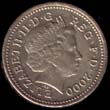
one pound coin
The
United Kingdom contains many of the world's leading universities,
including the University of Oxford, the University of Cambridge and the
University of London (which incorporates, amongst others, Imperial
College London, The London School of Economics and University College
London) and has produced many great scientists and engineers including
Sir Isaac Newton, Charles Darwin and Isambard Kingdom Brunel; the
nation is credited with many inventions including the locomotive,
vaccination, television, the railway, and both the internal combustion
and the jet engine.
The English language has spread to all corners of the world (primarily
because of the British empire) and is referred to as a "global
language". It is taught as a second language more than any other around
the world. Britain's other languages are also spoken by small groups
across the world, including Welsh in Argentina [3] and Gaelic in Canada.
Playwright William Shakespeare is arguably the most famous writer in
the history of the English language; other well-known writers from the
United Kingdom include the Brontë sisters (Charlotte, Emily, and
Anne), Jane Austen, William Thackeray, J. R. R. Tolkien, C. S. Lewis,
John Milton, H. G. Wells, Charles Dickens, and J.K. Rowling. Important
poets include Lord Byron, Robert Burns, Lord Tennyson and William Blake.
Notable composers from the United Kingdom have included William Byrd,
John Taverner, William Lawes, John Dowland, Thomas Tallis, and Henry
Purcell from the 16th and early 17th centuries, and, more recently, Sir
Edward Elgar, Sir Arthur Sullivan (most famous for working with
librettist Sir W. S. Gilbert), Ralph Vaughan Williams and Benjamin
Britten in the 19th and 20th. George Frideric Handel spent most of his
composing life in England.
The BBC is the oldest and perhaps the most respected broadcasting network on the globe, with the BBC World Service radio channel and its news output held in particularly high regard. The other main television networks are ITV, Channel 4, Five and Sky Television. Popular programmes in the UK include the three major soaps - EastEnders, Coronation Street and Emmerdale - as well as the comedy news quiz Have I Got News For You and Reality TV shows such as Big Brother. Various British TV formats have been exported to other nations, notably Who Wants To Be A Millionaire?, The Weakest Link and The Office.
The UK was, with the US, one of the two main contributors in the development of rock and roll, and the UK has provided some of the most famous rock stars, including The Beatles, Queen, Led Zeppelin, Pink Floyd, the Rolling Stones, The Who, and many others. The UK was at the forefront of punk rock music in the 1970s with bands such as the Sex Pistols and The Clash, and the subsequent rebirth of heavy metal with bands such as Motörhead and Iron Maiden. In the mid to late 1990s, the Britpop phenomenon saw bands such as Oasis, Blur, Radiohead and Coldplay gain international fame. The UK is also at the forefront of electronica, with British artists such as The Prodigy, Faithless, Aphex Twin, Nitin Sawhney and Lamb at the cutting edge. The United Kingdom is also associated with music from the Caribbean, with a large number of Jamaicans and other Caribbean nationals being present in the UK. Recent rock bands to emerge as great talents are the Kaiser Chiefs (all ex-temporary teachers from Leeds), Franz Ferdinand and the Arctic Monkeys.
The United Kingdom is a constitutional monarchy, with executive power exercised on behalf of the Queen by the Prime Minister and other cabinet ministers who head departments. The cabinet, including the Prime Minister, and other ministers collectively make up Her Majesty's Government. These ministers are drawn from and are responsible to Parliament, the legislative body, which is traditionally considered to be "supreme" (that is, able to legislate on any matter and not bound by decisions of its predecessors). The UK is one of the few countries in the world today that does not have a codified constitution, relying instead on customs and separate pieces of constitutional law.
While the monarch is Head of State and holds all executive power, it is the Prime Minister who is the head of government. The government is answerable chiefly to the House of Commons and the Prime Minister is drawn from this chamber of Parliament by constitutional convention. The majority of cabinet members will be from the House of Commons, the rest from the House of Lords. Ministers do not, however, legally have to come from Parliament, though that is the modern day custom. The British system of government has been emulated around the world - a legacy of the United Kingdom's colonial past - most notably in the other Commonwealth Realms. The Prime Minister is chosen as the MP who can command a majority in the House of Commons - usually the leader of the largest party or, if there is no majority party, the largest coalition. The current Prime Minister is (Anthony) Tony Blair of the Labour Party, who has been in office since 1997.
In the United Kingdom the monarch has extensive theoretical powers, but his or her role is mainly, though not exclusively, ceremonial. The monarch is an integral part of Parliament (as the "Crown-in-Parliament") and theoretically gives Parliament the power to meet and create legislation. An Act of Parliament does not become law until it has been signed by the Queen (known as Royal Assent), no monarch has refused assent to a bill that has been approved by Parliament since Queen Anne in 1708). Although the abolition of the monarchy has been suggested several times, the popularity of the monarchy remains strong in spite of recent controversies. Support for a British republic usually fluctuates between 15% and 25% of the population, with roughly 10% undecided or indifferent [2]. The current monarch is Queen Elizabeth II who acceded to the throne in 1952 and was crowned in 1953.
Parliament
is the national legislature of the United Kingdom. It is the ultimate
legislative authority in the United Kingdom, according to the doctrine
of parliamentary sovereignty (however, questions over sovereignty have
been brought forward due to the U.K's entry in to the European Union).
It is bicameral, composed of the elected House of Commons and the
unelected House of Lords, whose members are mostly appointed. The House
of Commons is the more powerful of the two houses. The House of Commons
has 646 members who are directly elected from single-member
constituencies based on population. The House of Lords has 724 members
(though this number is not fixed), constituted of hereditary peers,
life peers, and bishops of the Church of England. The Church of England
is the established church of the state in England.
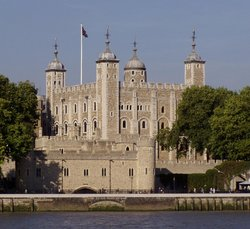
|
|||||
| Motto:
Dieu et mon droit (Royal motto) (French for "God and my right")3 |
|||||
| Anthem: God Save the Queen4 | |||||
 |
|||||
| Capital | London |
||||
| Largest city | London | ||||
| Official language(s) | English de facto 5 | ||||
| Government
Queen
Prime Minister |
Constitutional
monarchy Elizabeth II Tony Blair |
||||
| Establishment |
18016 | ||||
| Area • Total • Water (%) |
244,820 km² (77th) 1.34% |
||||
| Population • July 2004 est. • 2001 census • Density |
59,834,300 7 (21st) 58,789,194 246.5/km² (33rd) |
||||
| GDP
(PPP) • Total • Per capita |
2005
estimate $1.867 trillion (6th) $30,900 (18th) |
||||
| HDI (2003) | 0.939 (15th) – high | ||||
| Currency | Pound
sterling (£) (GBP |
||||