
|
|
|
 People
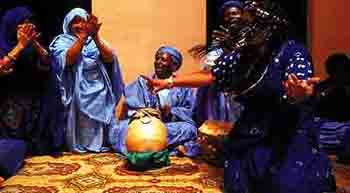
Morocco has a rich culture and civilization. Each region possesses its own specificities, contributing, thus, to the making of national culture and to the civilization legacy. Morocco has set among its top priorities to protect all forms of its legacy and preserve its historical monuments.
Since its independence, Morocco has witnessed deep socio-cultural mutations like all other countries in the second half of the XX century. It is within these changes that arts are being organized for several decades.
It was also decided to allocate 1% of the local councils budget to the building in each prefecture or province of a culture compound, that comprises a theater, and to the sponsorship of artists. It is likewise projected to create in each region, two drama companies that local councils will finance and supply with the appropriate means.
Morocco has two institutes :
-The higher archeology institutes, created in 1986;
-The national institute of drama arts and cultural entertainment, created in 1987.
Morocco's cultural wealth finds expression in a variety of creative disciplines: oral and written literature, poetry, music, architecture and visual arts, a heritage that imposes itself as a reference for Morocco's contemporary intellectuals and artists. From the end of the nineteenth century until independence in 1956, western ideas influenced Moroccan culture and sometimes even gave birth to new forms of expression (easel painting, the novel, the cinema, etc.). But towards the end of the sixties, Moroccan artists affirmed their desire to reclaim that which was their own.
People
Morocco has a rich culture and civilization. Each region possesses its own specificities, contributing, thus, to the making of national culture and to the civilization legacy. Morocco has set among its top priorities to protect all forms of its legacy and preserve its historical monuments.
Since its independence, Morocco has witnessed deep socio-cultural mutations like all other countries in the second half of the XX century. It is within these changes that arts are being organized for several decades.
It was also decided to allocate 1% of the local councils budget to the building in each prefecture or province of a culture compound, that comprises a theater, and to the sponsorship of artists. It is likewise projected to create in each region, two drama companies that local councils will finance and supply with the appropriate means.
Morocco has two institutes :
-The higher archeology institutes, created in 1986;
-The national institute of drama arts and cultural entertainment, created in 1987.
Morocco's cultural wealth finds expression in a variety of creative disciplines: oral and written literature, poetry, music, architecture and visual arts, a heritage that imposes itself as a reference for Morocco's contemporary intellectuals and artists. From the end of the nineteenth century until independence in 1956, western ideas influenced Moroccan culture and sometimes even gave birth to new forms of expression (easel painting, the novel, the cinema, etc.). But towards the end of the sixties, Moroccan artists affirmed their desire to reclaim that which was their own.
Language:
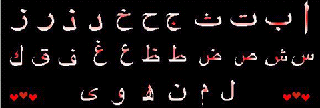
One of the first things one notices about Morocco is its linguistic diversity. French, Berber, Modern Standard Arabic, as well as Moroccan Arabic, can all be heard in all the major cities. This is due primarily to the rich historical past of the country. The Berbers, the original inhabitants, make up roughly half of the population, and the three major dialects of their language are widely spoken. When the Arabs came to Morocco in the 8th century they brought their language, which has evolved into the Moroccan Arabic of today. France officially entered the picture in 1912 when it began the Moroccan protectorate and French is still widely used in commerce and the educational system.
When one speaks of Arabic in Morocco there are two languages to be considered. On the one hand there is Modern Standard Arabic. This is the direct descendant of the language of the Koran and is understood throughout the contemporary Arab world. In Morocco it is used in newspapers, correspondence, news broadcasts and speeches but rarely in conversation. Moroccan Arabic, on the other hand, is the first language of the majority of Moroccans and really the most useful language to know when travelling in the country. It differs from Modern Standard Arabic to the extent that non-Moroccan speakers of Arabic, with the possible exception of Algerians and Tunisians, find it difficult to understand.
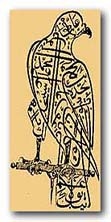
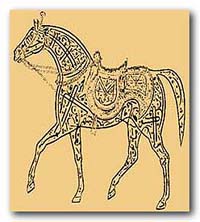
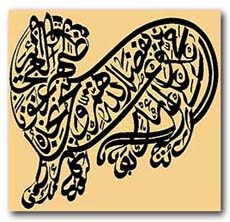
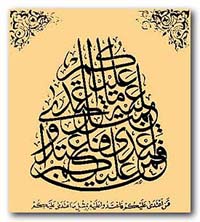
Art: Arabic calligraphy converted to decoration, as Arab kings and rulers favored writers who gained wide reputation and vast fame. Let alone, they, also, were poured by money to encourage them. Accordingly, Arabic calligraphy became the common grounds for developing both Arabic and Islamic arts. Arabs have mastered making ink of natural substances, as they used seeds of yam and glue. The black color was preferred but there were other colors: red, blue, green, brown, purple and ruby. Sometimes, fragrances were to be added to give ink good smell.
|
|
|
|
