|
|
|
 The foods of Morocco take great advantage of the natural bounty of a country where eating is both a practical and social ritual. The cooks in the kitchens of the four royal cities (Fez, Meknes, Marrakech and Rabat) helped to refine Moroccan cuisine and create the basis for what we know as Moroccan cuisine today. The midday meal is the main meal, except during the holy month of Ramadan, and abundant servings are the norm. The meal usually begins with a series of hot and cold salads which are followed by a tagine, or stew. The heartiest plate, often a lamb or chicken dish, is next, followed by a heaping plate of couscous topped with meats and vegetables. A soothing cup of sweet mint tea is the grace note to this repast. It is not uncommon for Moroccans to eat using the first three fingers of a hand, and to use bread as a "utensil."
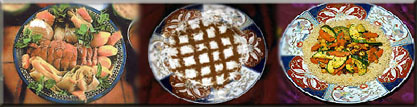
 The strong Arab influence found in two of the royal cities, Fez and Marrakech, contributed greatly to Moroccan cuisine, as did the Andalusian sensibilities of Tetuan and the Jewish traditions from the coastal city of Essaouira. Aspects of all of these cultures can be found in four of the best-loved Moroccan dishes: couscous, plumped semolina grains which are served with a variety of toppings; bisteeya, a delectable three-layer pie which is both savory and sweet and wrapped in the thinnest of pastry; mechoui, tender roasted lamb; and djej emshmel, succulent roasted chicken cooked with olives and lemon.
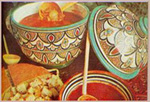 The Harira is the national soup. Quite possibly the best soup in the world. By custom the dish to break the fast in Morocco during Ramadan, this thick, rich version is a meal in itself any other time for any body. It is eaten along with dates, or honey sweeties(Chabakkia, briouats with almonds and honey).
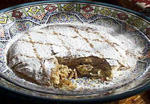 The pastilla or bastila almost more sweet than savoury, this delicate flaky pie or pastry from morocco is not entirely easy with wine. The filling is traditionally squab, although other poultry can be used, combined with spices, sugar, almonds, dried fruit and a layer of eggs, scrambled. In a moroccan meal the pastilla is served as a first course.this is the most classical recipe, it's a ceremony dish served as a starter.
This famous speciality has the name of tanjia, the earthenware in which it's cooked, we trow all the ingredients mingled all together ,we move it to mix them, we close it with paper and a string , take it to the hammam* (public turkish bath), where it should be cooked for 4 hours. It's a plate made up by men for men, (single men) for a fiesta or an occasion during which they will play cards , listening to music.
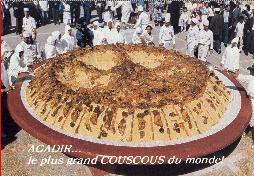
January 23, in the oasis of Tozeur (South West of Tunisia), was organized an operation to cook the biggest couscous (Tunisia's most popular meal) pot, a double record that will certainly be noticed by the Guinness Book of Records.
Initiated by Couscousserie du Sud (CDS), that company that launched industrially manufactured couscous on the Tunisian and world markets for the first time under the brand name "Diari", Couscous 2000 is part of celebrations of CDS's 20th anniversary.
It is also an effort from this company to regain its 1989 world title of making its entry into the Guinness Book of Records with the largest couscous meal in the world requiring 250 kilos of semolina. Morocco snatched the title a year later with a couscous that took up 1500 kilos and now CDS is striking back with 2000 kilos of semolina, 250 chickens, 30 sheep and 850 kilos of vegetables.
January 23 in Tozeur, there was enough couscous to feed up to 16 000 people. The meal was prepared in a giant couscous pot, or "couscoussier", 4.5 meter high, made of copper that took nine (9) months to build.
