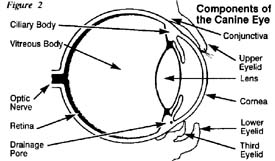
Disorders in jack russell terriers
1.Cataracts
A cataract
is defined as a lens opacity which leads to a loss of its transparency.It may
affect one or both eyes.It leads to a progressif loss of sight and may cause
blindness.
It may result from senility,inguries and infections of the eye,ultraviolet radiation,,exposure to great heat,diabetes,nutritional deficiences.
The prudent approach is to assume cataracts to be hereditary,in jack russells:any sire or dam must have the benefit of genetic control twice a year ,by a competent practitionner.
Breeding of affected animals is not recommended.
The treatment consists of surgical removal of the lens.
2.Luxated lens
This displacement of lens occurs when the ligament fiber which holds the lens in place deteriorate, allowing the lens to fall out of its normal site behind the pupil to:
-The posterior chamber of the eye;the eye appears normal
-The anterior chamber(forward);the lens rub against and irritate the cornea,causing tearing and bluish cast over the eye.
Anterior luxation is the most hazardous form of the displacement,because there is a high probability of glaucoma(increase of fluid pressure within the eyball caused by an interruption of fluid exchange between the eyeball and the venous circulation.Leads to partial or total blindness;may be primary(hereditary) or secondary to other conditions).If the lens touches the cornea it will cause damage leading to cornea oedema.
Observe your jack russell carefully, before the luxation is apparent ,you may notice behavior changes in the dog:bumping into stationnary objects,missing the first step in a staircass...ect
Primary lens luxation is assumed to be autosomal recessive(each parent must at least be carrier of the disorder).If a pup is affected,all his offsprings later,will be carriers of the disorder.Affected dogs should not be bred and known carriers should be pulled from the breeding program.This is an insidious disorder as it appears anywhere between 3-8 years of age ,well into the breeding program.
Secondary lens luxation is associated to trauma to the eye,and it is not hereditary.
Treatment varies:
-Surgical removal of the lens which allows partial vision.
-A combination of eye drops and oral medication is hepful.
-In severe cases,removal of the eye is necessary.
3.Legg-Calvé-Perthès disease(coxa plana or aseptic necrosis of the head of femur)
It is a pathology of the coxo-femoral joints (hip) of small breeds of dogs,which appears between 6-12 months.It is often unilateral.It is due to a trouble of vascularisation of the head of femur,brought on by trauma but can also have a genetic component(well documented in terriers(including jack russell terriers).
The head of femur disintegrate and necroses,which can cause,limping ,pain and eventually arthritis or a secondary coxarthrosis. The dog's mouvement becomes more and more strict and there is a muscle atrophia.
Diagnosis is made by a hip radiography.
The treatment consists on a surgical removal of head of femur ,giving the place to muscles to form a "false" join.The dog is able to move almost normally.
Bilateral cases are considered as hereditary and not the result of a trauma.
Breeding of affected animals is not recommended.
4.Patella luxation
It is a dislocation of the patella (knee join),due to a defect of articular capsule of the femoro-patellar joint.The dog presents a movement with his posteriors always flexed or a "blocking" of its knee,weakenning posterior's leggs movement.
The diagnosis is more often clinical(make some knnee-tests from the veterinarian while examination of the dog) than radiological.
If the pathology is occasional,the patella moves to its normal place spontaneously and you may ,by yourself,put it correctly,with pushing to the opposite side of the luxation,together with maintainning the legg in extension.
If the problem remains permanent,surgery is necessary.It consists in streaching the capsula articularis,from the opposite side,which allows the correct placement of the patella.The dog would be able to move normally.
It is recommended to make clinical tests to jack russells for this pathology twice a year.
5.Cerebellar ataxia
Initially observed in the USA ,this hereditary brain disease,seems to spread in some jack russells AND Parson russells,in europe.
It is a disorder due to premature death of particular brain cells,found in the cerebellum,leading to balance troubles(ataxia) and shacking.The disorder is inherited as an autosomal recessive condition.In affected litters ,puppies can show signs as early as two to four weeks of age,after they start walking.They show head bobbing, a "stepping",a wide-based stance and knuckling over at the paws,with progression to stumbling and falling over and even inability to stand.
The evolution is variable but always invalidant:some pups may not stand till 7 weeks,others have walking troubles all their life.The solution is ,in general,euthanasia,the maintain in life of theses pups needing intensive care support.
Researches(mainly in USA) tend to localise the genetic mutation and devellop genetic tests to identifie carriers of the abnormality and allow breeders to make informed breeding decisions.

Webmistress:Missirlis Maria
 See
vaccination and vermifugation calendar!
See
vaccination and vermifugation calendar!
See the most frequent
health troubles and how to manage them!