General regularities and criteria of development of noosphere
E.H. Liiv
([email protected])International Academy of Noosphere. The Baltic Branch
Doctrine of Noosphere researches possibilities of coexistence of mind, society and nature (both inanimate and animate) as a complete system. Mutual interaction of these elements and elucidation of optimum decision for ensuring sustainable development is researched. To ensured coordinated and optimum way of development of mind, society and nature it is necessary to elaborate any criteria of efficiency for all the above mentioned elements at different levels of generalizing. For different small groups of society corresponding different criteria of efficiency often do not coincide with each other, less they coincide with laws of nature development.
Therefore acute necessity to find general compromise criteria of development has araised. It is necessary to substitute the present realized descriptive method of research with scientific well-founded methods. The ground of existence and application of the new system and methods are described in our previous publication [
1–3]. The fundamental conceptions of infodynamics, which are valid, without exception in all systems of Universe, are present below.The fundamental conceptions of infodynamics:
1.
All the Universe consists of systems, which are interactive, interlaced between each other, and with hierarchical many-level and with higher standing more general systems.Information characterizes the process, which transfers
GNG from one system to another, like as the process of work or heat transfers energy from one system to another. Now researching the information they make just the same mistake as in researching the heat long befor (theory of phlogistone). Information as process and negentropy as function of state are not distinguished yet.1. Nature and physical reality
Physical reality is considered in expanded context in
ID. Often only those phenomena and processes that can be investigated and measured by today’s physical methods are considered physical systems. However, many phenomena that are not yet characterized because of their insignificant mass, energy or field potential are revealed in microcosm. Their existence is either proved or supposed theoretically or the basis of on indirect experimental data. Therefore they are also considered physical phenomena in ID. Proceeding from the primary substances accepted in physics till now: mass (matter) and energy (field), it is impossible to explain all phenomena known, including orderliness of some structures.The united or quantum field exists everywhere: in physical vacuum, in all world systems, in substances, and interacts with all elementary particles and atoms. All world phenomena (matter, energy,
GNG, etc.) result from differentiation, vibration, fluctuation or condensation of the quantum field. It thrusts forward that many fields and elementary particles display properties that are opposite to the common tendency of entropy increase. For example, gravitation force (field, energy) influences the bodies at any distances and time intervals strictly in one direction of attraction. Energy is transferred in the form of quantum in all fields. Quantums are characterized not only by mass and energy, but also by strict orderliness. Energy quantity, fluctuation frequency, orientation and other properties are strictly constant in quantum. Electron is a quantum of electron-positron field. It has strictly constant electric charge, spin and magnetic moment.Hence, strict orderliness of structures that counteracts to tendency of disorder increase, i.e. to common tendency of entropy increase, exists at microcosm level already. This confirms that in microcosm operate forces and fields, which are the reason of formation of structures, and mutual relations between elements, reduce a degree of elements freedom and limit their chaotic movement. Those forces and fields act not only in microcosm but also via it in all macrosystems as well starting with atoms and molecules and up to living organisms and public organizations. Therefore it is possible to conclude about existence of negentropy field at all levels of system hierarchy.
Quantum and gravitational fields are the primary medium at
GNG field occurrence. They interact with matter by the suggested mechanism:1.
At their interaction a great number of labile, easily excitable structures that can contain bistable and self-oscillatory elements occur. Interaction between quantum field and atoms, e.g. vibrations with occurrence of neutrons and neutrino, plays essential role.Thus,
GNG and GE are more common concepts than physical entropy and negentropy, as the first two exist in both physical systems and in all information systems and their models.Basic differences between physical entropy and the generalized concepts of
GE or GNG are the following:1.
GNG is determined by difference between GEmax and GEact, but GEact has different nature, more generalized than that of physical entropy. Criteria of system purpose or destination are the basic parameter for determining GEact. They can be established only basing on data from higher-hierarchy systems and considering at the same time data from surrounding systems. The categories of purpose or destination transcend classical physics. Considering purpose criteria enables one to investigate uncertainty factors and to generalize GE and GNG concepts with respect to any system existing in the world including economics, law, information, science, mentality and other ones.GNG
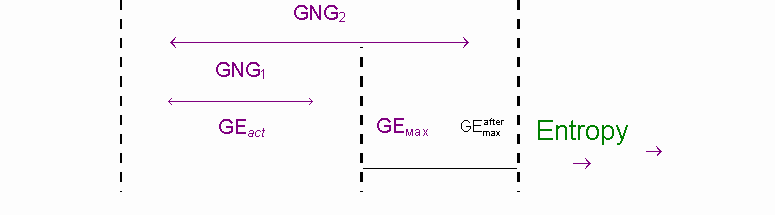
balance is based on the law of non-exceeding GNG maximum: GNG does not increase, but can decrease in isolated system. A system can receive GNG from other systems and donate it to them by means of information. Formula of inequality (for a certain period) for any system is the following (see scheme 1 as well):GNGstart + S IFreceived ³ GNGfinal ± S IFgiven
where:
IFreceived is IF received by a system (GNG);
Scheme 1
. Scheme of GNG CalculationHere:
GEact is actual GE of a system model; is maximum possible GE of a system model after receiving information – GEact (taking into account the increase of )
GEact
balance is deduced from the second thermodynamics law: total GEact cannot be below the sum of conditional entropies influencing a system of internal and external factors. total GEact cannot decrease in isolated system. Equation of entropy inequality is the following for any system: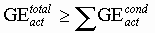
where:
 is total actual entropy of a system;
  is conditional actual entropy of a system influenced by one factor or impact.
Different concepts, for example structure, orderliness, organization, complexity, controllability, stage of development, etc., are widely applied for system characterization. However, methods of
GEmax, GEact and GNG calculation are the only to enable quantitative estimation and comparison of such concepts. At that it is necessary to take into account that the constancy of particular GEact and GNG values remains only with respect to specific purpose criterion. While drawing up GNG balance between systems all of them should be considered concerning the common purpose criterion. Purpose or expediency choice depends on higher-hierarchy system development tendency and on the place and functioning of the system under study in the higher-hierarchy one.2. Mind and Consciousness
Having good imagination it is possible to picture existence of “consciousness” in physical world of matter and fields. A number of metal alloys or polymers restore their prior form after residual deformation, pressure removal and subsequent heating, in other words they have “memory”. The Sun’s beams “recollect” its high temperature and “inform” it to the Earth. In the course of crystallization molecules “organize themselves” into strict order “according to a foreseen plan”, etc. In all these memory attributes
GNG participates, but control and modeling bodies being a source of a more advanced form of secondary reality, consciousnesses, are lacking.More complex organization mechanisms with control bodies appeared in systems in the course of development. All living systems, the man, cybernetic systems and public organizations are of that kind. It is already impossible to do without models or action programs in control bodies and systems. Therefore evolving nature created both bodies of modeling, and products of their interaction: models and programs. A characteristic example of modeling is living organism genomes. Models and programs had been gradually improving and growing more complex: from unconditional and conditioned reflexes, through consciousness components (concepts, speech and knowledge) to creation of ideas, projects, theory, forecasts and other products of intellectual work. At that it is necessary to distinguish two types of systems. The first one is modeling sphere that works according to the above-stated mechanism of
GNG development and its fields with participation of quantum field, matter and energy (e.g. brain). The second type is models themselves being independent systems (e.g. knowledge). Both system varieties differ by GNG, energy and mass, though in “pure” models GNG form prevails being the basic one.Thoughts and other consciousness processes are to some extend analogous to virtual reality (particles) in quantum field-vacuum. Indeed, thoughts, as well as virtual particles, can emerge, change and vanish according to the probability laws that are not subjected to the laws of classical physics. Apparently, they are indirectly associated with processes proceeding in quantum field.
It is possible to explain
GE and GNG distribution in the man’s consciousness schematically by the following model (Scheme 2).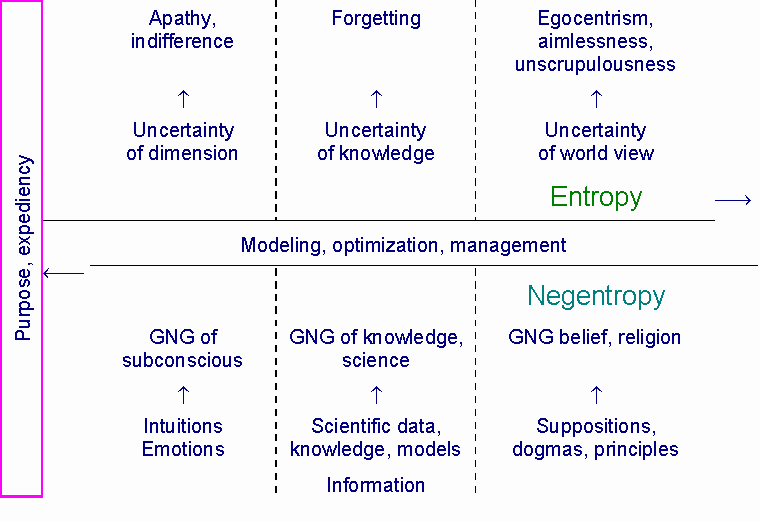
Scheme 2.
Negentropic model of consciousnessFull perception of really existing objects is impossible; their variety, dimension and
Emax are approaching infinity. Consciousness can operate with infinitely indefinite values neither mentally nor mathematically. Therefore it has to create simplified models or metaphors for taking decisions, and IF processing and transferring. These models are to be similar (homomorphic) to real objects as far as possible and simultaneously to possess GNG, GEact and GEmax with definite values. An essential task is developing optimum mathematical models, which would most precisely describe the effect of all factors on a system and at the same time would have quickly enough and reliable mathematical processing.To ensure efficient control of such complex system as man
GEmax entropy in his consciousness model should be as far as possible fully compensated by GNG introducing. A part of GEmax being out of reach of our knowledge can be compensated by belief only. Belief represents general principles accepted without sufficient proofs, as axioms (variety of GNG). We should aspires to our belief being most possibly closer to reality. A part of GEmax and GEact in the consciousness is compensated by our knowledge. The man has to care this part of indemnification being as large as possible. Acquired knowledge (IF) can compensate entropy in consciousness in two directions: to reduce GEact and to increase GEmax. Both directions are equally important for increase GNG and efficiency of the man’s decisions.Full compensation of
GEact up to zero is impossible in real objects. At GEact approaching zero uncertainty of dimension manifests itself with increasing intensity. Dimension of space of state is tremendous in real systems. A few several coordinates (factors) are usually enough in models. However, their selection causes additional uncertainty (GE). Very often, when GEact is approaching zero a great number of factors formerly either discounted or insignificant become actual for they cause additional uncertainty (GE) and demand for GNG input increase. To overcome the consequences of dimension uncertainty effective mechanism of subconsciousness (a variety of GNG) exists in the man and animals.Contrary to consciousness, subconsciousness does not settle on concrete knowledge, but it settles on previous experience, genetic information of preceding generations, feelings and emotions, as well as on data though forgotten, but kept in depth of brain. Subconsciousness is a part of a consciousness model too, but its difficult to definite, probabilistic part. It gives no concrete programs, but determines probabilistic preferences at decision acceptance. Subconsciousness answers questions: What is probably good (useful) and what is bad (dangerous)? In which direction purpose achieving is most possible and in which – vice versa? The subconsciousness mechanism enables taking decisions in conditions of sharp information deficiency. Despite the indirect, probabilistic data obtained this way are limited, nevertheless they provide more justified decisions than those accepted without considering any information.
Thus, a consciousness model represents a complex system, in which processes of changing
GEmax, GEact and GNG connected with IF receiving and delivering proceed simultaneously. Generally ∆GNG = ∆GEmax – ∆GEact. Deviations can arise only when investigating processes at separate stages of subconsciousness, knowledge and belief. Method of creating mental, conceptual and scientific models opens ample opportunities for deeper investigation of real world and drawing up forecasts for its changing.All systems that are to some extent homomorphic to the original, i.e. to objective reality, may be considered as generalized systems. Only essential features of the researched phenomena should be reflected in simplified models. Methods of modeling are widely used in different branches of science, especially in cybernetics and economy. Disadvantage of the models applied until now is that their area of similarity (homomorphism) is limited in case of studying more complex objects, especially infoprocessing systems. The widespread models contain parameters, which characterize material, energy-dependent and economic parameters, and their balances.
Objects studied by philosophy or humanities are mainly related to processes of generalized information or
GNG transfer and processing in the form of models. As such an essential coordinate as GNG is absent in so far used models, they do not reflect real public systems and sights with enough exactness. Products of creative activity: business plans, inventions, concepts, hypotheses, theories, forecasts, philosophical systems, works of art, literature and science, as well as other phenomena related to culture and spiritual life of man and society are also possible to consider more complex models. Such models also exist objectively and represent secondary reality.While investigating consciousness and perception processes, rather often the real-life objects (primary reality) and their simplified models that exist in people’s consciousness (secondary reality) are not distinguished. The reason for much misunderstanding, and many mistakes and conflicts is that people apprehend their inadequate or imperfect models as fully corresponding to real-life primary objects, i.e. take them for the absolute true.
Objective basis and criteria (
GNG) are created for estimating of both positive and negative factors effecting results of labor. This allows more resourceful fighting against latent factors reducing efficiency of decisions, people labor and computer functioning. It is obvious, that intellectual, creative work is associated with data processing in information systems, in particular with transformation of GNG and information flows. The quantity of creative, mental work is equal to the amount of GNG, which an author enters into the system with respect to some definite purpose. According to the new strategy, cost of mental work can be estimated in monetary units too. If a profit planned at goal achievement is known, then using GEact and ∆GNG probability of the profit realizing and its expected average probabilistic margins can be calculated.Optimization of models is a decisive step of information processing. The step begins with determining distinctive features, limits and contents of a system, and then its purposes or assignment. Probability of purpose achievement is the basis for calculating
GEact or degree of model uncertainty. The developed formulas give opportunity to determine influence upon GEact of all expected structural and functional factors. Using comparative analysis, essential factors influencing model efficiency and increasing GEact or GNG mostly are found. Unimportant factors can be removed out of the model thus simplifying it. At optimization of any system the general rule is desire to maximum reduce GEact and maximum increase GNG relative to purpose achieving. Method for technical and economic forecast at GEact application and optimization is described below.Generalized entropy of the project’s predetermined economic efficiency criterion (purpose) for the established period of time cannot be less than the sum of conditional entropies of analogous purpose calculated separately for all influencing factors. Of all probable technology variants the optimum one (giving minimum
GEact) is chosen. General criterion at estimating technological development and project efficiency is GNG increase with respect to whole of national economy.Efficiency forecast for different variants of choice is especially important at realization of control processes. control elements are present in sufficiently organized systems only: in living organisms, man’s consciousness, organizations or machines. Ashby’s law of necessary diversity known in cybernetics is a special case of a befor mentioned more general infodynamics law of controllability. Usage of
GE and GNG criteria also gives opportunities to define the dependence of controllability on each separate factor influencing the system as well as to ascertain the basic ones.GNG
criterion is of universal significance and can be applied for solving many complex problems. Among them:1.
Determination of speed (dynamics) of system development, e.g. changes of their complexity and efficiency, ageing or structuring.Complex ideology of information society not at all denies freedom, uniqueness and individuality of each personality. Yet the society is obliged to elaborate reliable and scientifically based forecasts for its development and corresponding evaluation scale, as well as to help each personality to estimate his/her abilities and on its basis to find optimum place in the community.
GNG
and GE criteria can prove to be of great help in research and management of complicated objects’ development. Apparently, one of the most complicated systems is noosphere and its subsystems: reason, society and nature systems. Real conditions of all these four systems are extremely complicated (GE verges towards infinity) and their absolute knowledge is impossible. But it is possible to explore their models, that are tried to be composed possibly close to the real condition. Of course, it is impossible to define GE and GNG absolute values in these model-systems. But their comparative values also allow to make more sound decisions for optimization of direction of development, speeds and factors affecting them.The biggest difficulty is the selection of right indices, that would characterize general development of human civilization. In some cases the total number of healthy (able-bodied) people can be an index. Sometimes annual gross product per person can be taken as an index. And gross product includes material and energetic, as well as mental product. The latter can be found through
GNG criterion in equivalent units. Reliable outcomes can be received if complex indices, that consist of the sum of the most essential indices, are used for calculation of GE and GNG. Additive indices are multiplied by coefficient of transition and importance. The latter can be determined researching the development of component indices’ influence on general criterion and speed with pretesting. Number and selection of component indices depend on specific task (objective) and precision of required decision.Thus,
GE and GNG criteria are indispensable for optimization and management of development process of noosphere and its subsystems. Decreases danger of appearance of incorrect, harmful decisions and chaos. In case of multilevel and multifactor systems GE and GNG should be determined for each one separately and compromise values, that are balanced with criteria of general system, should be found. Growth of GNG is a quantitative index and a sign of permanent, efficient, harmonic, progressive and stable development. It is accompanied by the increase of controllability of noosphere development and GE reduction.References
1.
Лийв Э.Х. Инфодинамика. Обобщённая энтропия и негэнтропия (Liiv E. Infodynamics. Generalized entropy and negentropy). Tallinn, 1998 (in Russian)3.
Лийв Э.Х. Инфодинамика как мировоззрение информационного общества (Liiv E. Infodynamics as Ideology of information Society). Проблемы информатизации (Problems of Informatization). 2001, No. 1, p. 31 (in Russian)Received,
May 24th 2002