Napoleon in Eygpt,Nelsons first major victory,Victoria,s occupation of Eygpt
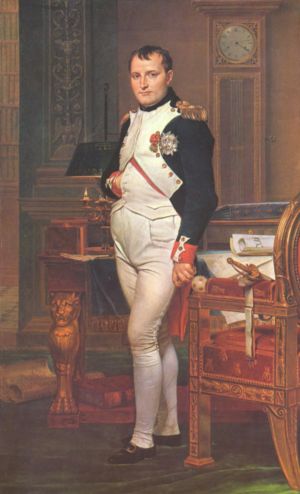
France had been at war with her neighbours for four years, her borders now pushed to the one of ancient Gaul (Rhine Alps).Holland and Belgium were conquered, Germany pushed beyond the Rhine .Victory against Austria was imminent as Britain led an army onto the continent .Britain fearing competition to the port of London by Sheldt of Holland .Russia was too busy to intervene as she was busy with Poland.
Napoleon was put in charge of the army in Italy .He introduced no new tactics, formations, drills or weapons, instead emphasising speed and the living off of the land .In three weeks he drove the Austrians army across the Po river forcing Piedmont out of the war .Austria hit back by mounting a siege on the Italian fortress of Mantua, Napoleon repulsing them five times thus leaving the way open to Vienna.
He went on to make a deal with the pope where territories and ports would be closed to this enemy�s .especially to the English. The republic was recognized by the Vatican, in addition handed over were hundreds of priceless works of art.
On April 7th Austria surrendered; Napoleon offering them the Republic of Venice in exchange for Belgium and Lombardy .A pretext was found by Napoleon for attacking Venice via and agent so as to ensure the deal went through.
Genoa suffered the same fate to become the Liguria Republic under France. Hostilities came to an end in 1797 with the treaty of Campo where Austria ,Niece ,Savoy ,Belgium where ceded to France, Venice to Austria .Ferrara and Bologna where taken from the Pope and made into Republics of Rome .Naples was also made into a Republic on the French model.
With the defeat of Austria Napoleon now liked towards England ,his view being that the best way to beat her would be to invade Egypt thus cutting the Suez route to the far east forcing her to abandon her eastern territories .In order to pay fort this expedition he invaded Switzerland .In 1798 he set sail from the port of Toulon with his expedition which included along with the army artist ,engineers ,geologists mathematicians ,antiquarians and chemists .He captured Alexandria in a day and then marched on to Cairo crushing the Mamulukes at the battle of the Pyramids with a day, forty centuries looking down upon him.
Napoleon set up a colony in Egypt ,found the Rosetta stone containing demotic Greek and Egyptian text This invasion brought France into war with Turkey ,the colonial power, Turkey declaring war on September 2nd .Napoleon captured El Arish and Jaffa .
On 1 August 1798 the French fleet lay in line astern in the Bay of Akoubir Egypt. The bay was dominated by an old fort, its walls sweeping in from the coastline extending 30 miles to the westerly end of the Nile at Rosetta. The ships were anchored a mile or so off shore, a shoal and patrolling frigates guarding their starboard side ,the shore on the port side. At 12 o�clock the look out reported sails on the horizon and by 4 o�clock Nelsons squadron was in full view bearing down from the north with thirteen 74-gun ships of the line.
The French admiral Breury was torn between contradictory advice. His chief of staff Genleume had urged him to fight at anchor, another aide had advised he put to sea immediately.
At 6.15 pm, HMS Zealous and HMS Goliath came within firing range.Goliath crossed the head of the French line intending to lie alongside Le Guerrier on the landward side anchoring from the stern. This manoeuvre was achieved ,the anchor pulling away from the bottom putting the Goliath in line with the second in line French ship, the Conquerant. Goliath opened fire while HMS Zealous sailed between ship and shore also firing at the unprepared French port side gun crews who were expecting an attack from the sea.
Zealous and Goliath were followed by five British 74 gun ships which also opened fire. Victory is not a strong enough word, Nelson was reported to have said, as plumes of blue and black smoke drifted slowly in the warm sultry air, thus stranding the French army in Egypt. Napoleon abandoned this army and secretly returned to Europe raising another to shatter the Austrians at Marengo. In 1801 General Ralph Abercrombie, landing from a naval task force faced this French army in Egypt. It was ensconced in well entrenched positions but none the less he defeated it, rounded up the remnants, in the process taking Cairo and handing Egypt back to the Ottomans.
Since the time of Napoleons invasion the Egyptians were humiliated. The national debt went from one of a few hundred millions to one of hundreds of millions,largly due to the Khedive's passion for the gaming houses of Europe. Britain and France had issued the bonds on the debt and so made the arbiters of that debt. No breathing space had been left for the new government of Khedive Tewfik Pasha in which to rectify the situation, his every move overlooked by British and French officials. The Mamluks of Turkey held the power within the Egyptian army and despised the fellahin .
British and French warships periodically appeared off shore causing rumours of invasion. France's possession of Tunis increased the Egyptian detestation of the 'Franks' as all Europeans were known since the time of the Crusades. In Cairo the pasha�s resented the Khedive Tewfik Pasha, and even more so his subservience to the Europeans. The Ulema, or religious leaders, resented the Christians, slavers resented western interference; the fellahin were just plain miserable. An officer plot was discovered. Arabi, the commander of the army, disposed of Tewfik for not upholding the sentence of banishment imposed upon its ring leaders. Britain sent in the Mediterranean fleet under Admiral Seymour. Arabi resigned to be reinstated as dictator. The English Prime Minister Gladstone was reluctant to occupy Egypt fearing that it would cause French resentment.
General Wolsey led an invasion force ignoring the Suez Canal and going for the fresh water locks and canals in the Cairo fregion.The Egyptians deprived of drinking water fell back. A battle was fought at Tel-el-Kebir, the British victory beginning their occupation of Egypt, causing her to also become involved in the affairs of the Sudan, again against the will of Prime Minister Gladstone who bowing to popular pressure sent a rescue column to Khartoum cut off from the Nile by religious fanatics.
General William Hicks, originally of the Bombay army, transferred to Egyptian service, took command of a force of Egyptians consisting of 7000 infantry and 1000 cavalry. He was a fine General as far as European combat was concerned, but had little knowledge on how to conduct war in the desert, his force consisting of conscripts, some still wearing the shackles they had just been released from jail with. Fifty thousand dervishes coming out of a wood surprised him, massacaring him and his army. Another force was sent, this time under General Wolsey, the all British force arriving a few days too late and unable to save the new Governor of the Sudan: General Gordon.
In the eastern Sudan the rebel leader Osman Digna had risen up in support of the Mahdi. British forces at the time were all but non-existent in the eastern Sudan but for a small detachment at the port of Suakin on the east coast. In Central Asia at the caravanserai Pandja, in the domain of the Amir, bound to Britain by treaty, an attack by Russian forces flouted the work of the Anglo Russian Boundary Commission, which had attempted to set the boundary between the Tsars Asiatic Domains and that of Afghanistan.
The Russian attack again gave rise to the question of the security of India .For Gladstone the attack was an ideal method of getting British troops out of the Sudan; of reneging on the -spirited policy-adopted by Parliament, his reasoning being that British forces would have to be concentrated in Egypt so as to be ready to move into Central Asia. Gladstone carried a Parliamentary motion calling for the withdrawal of British troops from the Sudan in return obtaining 1 million pounds in war credits.
In mid April, he gave Wolsey orders to withdraw his forces, who at the time wrote in his journal -the old impostor Gladstone, only to anxious to avail himself of the excuse of threatened war with Russia which he never means to embark on if he can possibly avoid it. This action affected his mental health impairing his ability, and although raised to the rank of Field Marshal, never again was General Wolsey of the mental calibre displayed previous to the withdrawal.
In Egypt ,with the outstanding debt in the balance ,the Barings financial group had had no recourse but to become involved as they had issued most of the bonds to the Egyptian government. They had financed the Suez Canal project, the brainchild of Napoleon III's wife Eugenie, thus starting a chain of events leading up to the leasing of the Suez Canal to Britain and France in 1854 for a ninety-nine year period.The Prime Minister, the Marquis of Salisbury,was of the opinion that the acquisition of the Suez Canal was a bad move and a source of future war stating :'I want a wayside inn well set up to serve me on my way to my country estate. I do not want to buy the inn.' However Great Britain had no choice but to become involved as it was her main sea route to India.
In Europe a coalition was formed (the second)consisting of Britain ,Austria,Russia,Portugal,Naples ,Turkey in December of 1798.All French gains were lost Napoleon slipping away on a fast frigate leaving his aide Kleber in charge.
|