Fathers and Sons
By Todd Trubey
Senior Columnist, TOTK.com Sports
www.totk.com
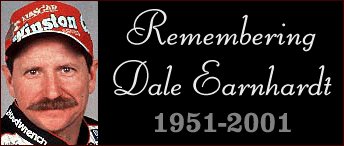
On February 18, 2001, Dale Earnhardt Jr. finished
second in Daytona 500. It was undoubtedly
one of the saddest days of his life; however,
because his father, Dale Earnhardt, Sr. died in a
hospital after a crash in the final lap of the
same race. Dale Earnhardt, Sr. was 49 years
old. No son deserves to lose a father who
hasn't reached 50, especially in such a way.
I heard the news as I was walking
on a treadmill, and I nearly fell off. I
don't watch NASCAR, but my father does, and the
Intimidator was his favorite driver. This
event, however, is not the first to connect
father and son, car racing and death, for me.
My father and I are very close. He would
probably be the best man at my wedding if it were
not for the fact that he belongs with my mother
during that ceremony. My father and his
father were not as close. I wish I knew
this first hand, but I never got to see Dad
interact with his father. You see, my
grandfather died before I was born, just a few
months before my parents got married. He
never made it to age 50.
When I was thirteen, I found out that there was
one thing that my father and his father shared,
something that Dad did to honor his father and
their relationship each year. He watched
the Indy 500. Dad and I were on a Boy Scout
camping trip and one of my friends had brought a
boom box. Dad said very early in the trip
that he needed it for a few hours, to listen to
the Indy 500 on the radio. Dad and I had
always watched the big race, but then we watched
a lot of sports together, so I never made much of
it. When it came time for the race, Dad didn't
get the boom box because, well, my friends and I
were stupid kids. Dad was angry, which is
always terrifying because he so rarely gets that
way.
When we got home, I asked my mother about
it. She told me that Dad and my grandfather
had always watched the Indy together, and that he
always thought of his Dad during that race.
I, of course, felt like the biggest creep alive
for not making sure my dad got the radio, but of
course I didn't know about why the race meant so
much. From that day forward, I always made
an effort to watch the race, although that got
pretty tough for a few years there with the IRL
thing.
I called Dad tonight after I heard the news, but
he was at a dinner party. As it happens, he
had stopped watching the race at the moment after
the crash and didn't know what had happened until
he heard the voice message I left expressing my
sympathy. I also told him that I loved him and
Mom. I couldn't help but think that Dale
Junior would have given his second place finish
and about a million other things just for one
more opportunity to tell his father the same
thing.
Whether it is because my Dad and I are so close
or because he's the only paternal figure I knew
growing up (I don't really know my other
grandfather, although he's alive), father-son
relationships hit me where I live. It's why
I can't watch The Lion King, pathetic as that may
sound. Of course, more horrible than a son
losing a father is a father losing a son.
NASCAR showed us that recently, too, when Kyle
Petty's son Adam died on the New Hampshire
track. Watching the look on Kyle's face as
he told the media how he felt to have lost his
son was as excruciating as anything I've ever
seen on SportsCenter.
A lot of people are thinking today that there are
too many deaths in car racing, and that if we
can't prevent sons from losing their seven-time
Winston Cup champion fathers in races, we ought
to scrap the damn thing altogether.
Certainly, today, many of us are glad that our
fathers are not NASCAR drivers. I myself
thank God almighty that my dad is well known for
driving a bit too slowly rather than at 180 miles
per hour.
I'm not, however, going to jump on that bandwagon
on this day. For although car racing took away
Dale Junior's father, and Teresa Earnhardt's
husband, car racing also undoubtedly brought that
family closer together. And there are
hundreds of thousands of fans brought together
with their families watching those races.
Darrell Waltrip, the recently retired brother of
2001 Daytona 500 victor Michael Waltrip, once was
asked what he thought of the hard-driving
Intimidator. He asked the reporter what
that reporter saw in the grandstands, and the
answer was: a bunch of hard-working people,
havin' a good time on Sunday. Waltrip replied,
"There's your answer; Dale is one of
them."
The fact of the matter is that the drivers know
the horrible risks they take, and that we
probably couldn't keep them from driving at high
speeds no matter what we did. Race car
drivers are simply built differently from the
rest of us.
It is still a shock and will be for some time
that the black number 3 car that was so central
to NASCAR for so long will be absent, especially
given the reason. The 2001 season will
undoubtedly be a grim one, with racers feeling
guilty or dubious about being a slot higher in
the standings than they would otherwise be.
One of those racers, of course, will have so much
more to be grim about. Today my heart goes
out to him and, for better or worse, my thanks go
out to him and the other drivers who risk so much
to provide entertainment to so many.
The only consolation that can be
offered to Dale Earnhardt Jr., and it is very
small consolation indeed, is that the father now
taken away from him undoubtedly brought many
other fathers and sons closer together in his
glorious, long, but still too brief career.
This
column first appeared in TOTK.com Sports (www.TOTK.com) and is
reprinted here with the express consent of
TOTK.com Sports. © 1995 - 2001 TOTK.com
Sports. All rights reserved.
REMEMBERING
DALE EARNHARDT HOME
|
|
|