 |
| The Tavern |
 |
 |
 |
|
 |
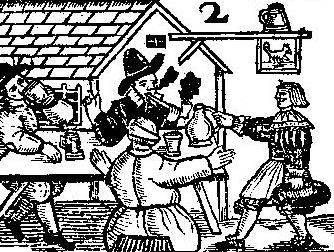
| No man, but a very impudent dog indeed, can as freely command what is in another man's house, as if it were his own. Whereas, at a tavern, there is a general freedom from anxiety. You are sure of a welcome; and the more noise you make, the more trouble you give, the more good things you call for, the welcome you are. . .. No, Sir, there is nothing which has yet been contrived by man, by which so much happiness is produced as by a good tavern or inn. |
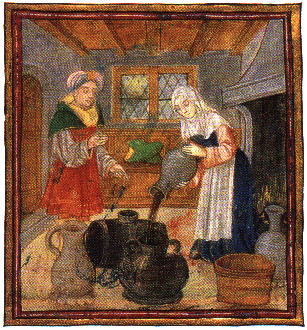
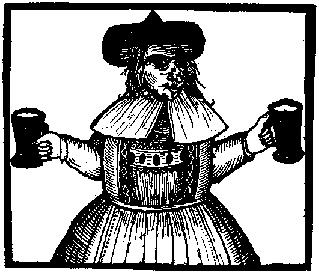
| Alewife: The alewife is ubiquitous, and can be found in every city, town and village. Her ale is of highest quality, and hardly a man can match her craft. But the brewster is not allowed to sell her product, not even her excess to her neighbor. Just revenge is hers, for though the innkeeper holds the franchise to sell ale, it is often his wife who brews it. The practice of old was for the woman to brew, and to pass on the art to her daughters. It was a most convenient craft for her, as the waiting between steps allowed her time to attend to her other household chores. So essential to the economy of a woman was her craft, that even to this day laws in many kingdoms state that her brewing vessels are her personal property. |
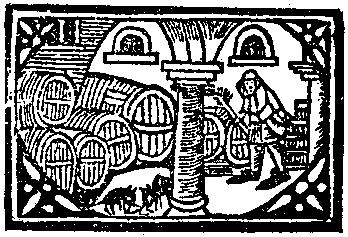
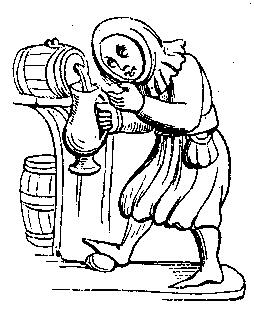
| An inn's brews are often stored in kegs, the result being that they are lively, and not at all flat. Upon pouring one from the keg, the mug will overflow with the most joyous foam. But one should time their visits well, for the ale from the top of a keg will gush, leaving one with but a sip or two of drink, while that from the bottom will be flat, with the barest hint of a head. It is interesting to note that the practice of the Ivinian is to plunge a hot poker into the tankard, stirring up the life in the ale, and giving the brew a mighty head of foam. |
 |
| Innkeeper: The Tavern & Innkeeper may be one of several sorts. He may brew an insipid ale, not knowing the art but making it anyway. Or he may be one of those wonderful people who brew that excellent ale which attracts the townsfolk and travelers to his inn. It takes no learning to understand which of these provides best for his family. If an innkeeper cannot make a palatable brew, it behooves him to hire one who can. |
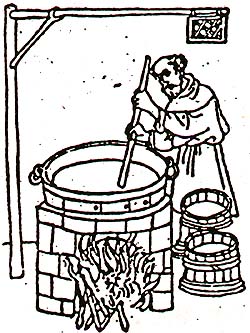
| Abbey Brewer: Betwixt the alewife and the innkeeper is the Abbey brewer. He brews on a larger scale, but only for the benefit of the abbey clerics and visitors. He is not allowed to sell his ale except to an innkeeper (and quite a few inns buy it). Every church approaches its brewing differently. For example, the Ilviran abbeys view brewing as an art, but to the Laranian abbey, it is a discipline. In many abbeys, the scullery is the brewery. But a few, especially those that profit from sales to inns, devote entire abbey buildings to its production. Meticulous records are kept, and if one is so inclined, a complete history of barley harvests for the previous centuries can be gleaned from them. |
 |
| Abbeys will tend towards brewing only one kind of ale, never altering the recipe. There is little difference between the ales of the abbey and the inn, except one. Quite a few churches have periods of fasting in which the clerics may not partake of food, only beverage. The abbeys of these churches brew an ale that makes up for the lack of meat and bread. It is quite dark, almost black. It is very sweet, and brewed with a wondrous variety of herbs. It serves its purpose well, for a tankard of this "fast ale" will both quench the thirst and sate the hunger. |
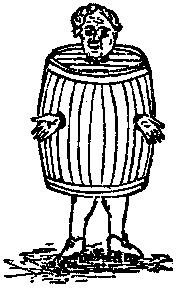 |
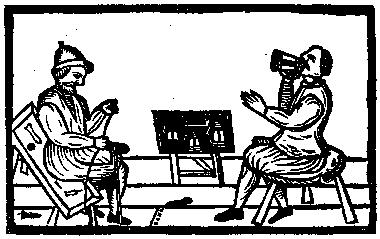
| A drunkard: I need say no more..... |
 |
| Last update Nov. 2004 |