| The Great Hall |
 |
 |
|
 |
|
|
|
 |
|
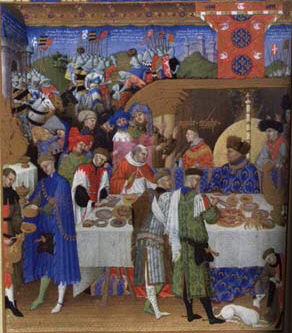
| Feasting after Christmas |
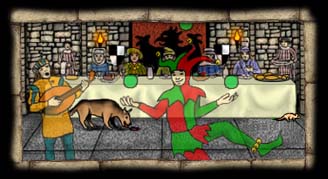
| The most important room in a castle was the great hall. This room housed most of the main ceremonies and feasting in the town. It was where the people who worked and lived in the castle ate. The room and the seating arrangements were in accordance with the medieval feudal structure. The lord and other important members raised up and at the front of the rooms, and the lower members of the fiefdom spread out farther and farther away from the main table. The lord and his guests sat on a dais at one end, from which he could look down upon his lesser subjects. Also, at the far end of the hall, was an open space for entertainers to perform. These entertainers were often wandering minstrels, poets, or an acrobat that could liven up the sometimes dreary atmosphere of the castle. |
| Eating Habits: In the Middle Ages, forks did not exist, but everyone used their own knife, spoon, and their own square pewter trencher, along with wooden bowls and a drinking vessel. People generally shared bowls, cups, and plates. In some places, people ate off of hard pieces of brown bread called trenchers. Trenchers were rarely eaten, because of their bad taste. The lord would often have many elaborately decorated bowls and cups adorning his table, displaying his wealth to his subjects. The lord's table would each get their own bowl of food, but the people of lower rank would have to share with up to four other people. These halls often became crowded and quite smelly with all the people gathered together for prolonged periods of time. |
| Feasts: Feasts occurred for special occasions, such as a wedding, a noble's christening, saints' holidays, and Christmas. There was also a large town feast to celebrate the harvest each year. The feast was a major celebration for the town and all around. It usually lasted for up to four hours, and the meal contained four to five courses. The main course would include salted beef; fresh fish; a variety of fowl; and tough, chewy pork. The meats were made to taste more interesting ( and hide the tastes of rotting) with expensive imported spices. Salt was also a favorite spice, and important nobles and guests were always seated nearest the elaborate saltcellars at the tables. Honey was used from the castles' beehives to sweeten the foods. The lord of the castle and his guests drank milk; wine; mead, which was a kind of beer. Water had to be boiled before drinking, so most people preferred wine. |
| Structure and Decoration: Great hall shares a wall with inner curtain The great hall was the largest building of the inner ward. It was often half the length of the wall it was built into. The great hall was often nestled back into a corner of the inner ward. In this way two walls of the great hall could actually be parts of the inner ward wall. This saved time and building space. The great hall was usually the tallest structure in the inner ward, except for the massive towers. Its high, pointed roof was supported by a series of parallel wooden arches. These arches were in turn held up by corbels. These were stone outcroppings built into the wall that the wooden arch could sit on. These sides of the hall usually had many stained glass windows to let in light. Also, along the sides there were three or four fireplaces to heat up the room. Tapestries were also hung on the walls to help keep in warmth. There were also two or three doors in the hall, one usually leading to the kitchen. |
| You are listening to, "Six lute pieces of Renaisance music" c.(14th Century) Anonymous |
 |
|
 |
|
| Last update Jan.16,2002 AD |
|
|
|
|
|
|
 |
|
|
|
|
|
|