|

Habitat:
Commonly place nests on open ledges, holes, or recesses of either igneous or sedimentary rock. Reintroduction efforts have resulted in them utilizing nesting structures on tall buildings or smoke stacks in cities. High ledges near open water are.preferred for nesting.
|
|
Description:
Falcons are sleek, crow-sized birds of prey, famous for their speed and beauty. For hundreds of years, peregrines have been prized for the sport of falconry. Recently, however, they have become well known as a species endangered due to pesticide contamination. These magnificent birds are now making a comeback in many parts of their former range.
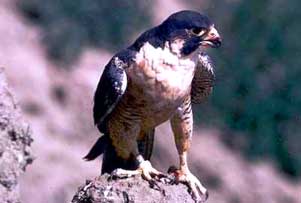
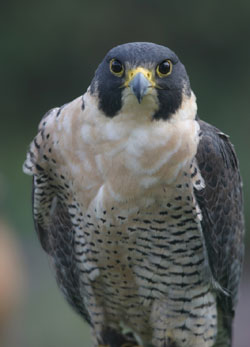
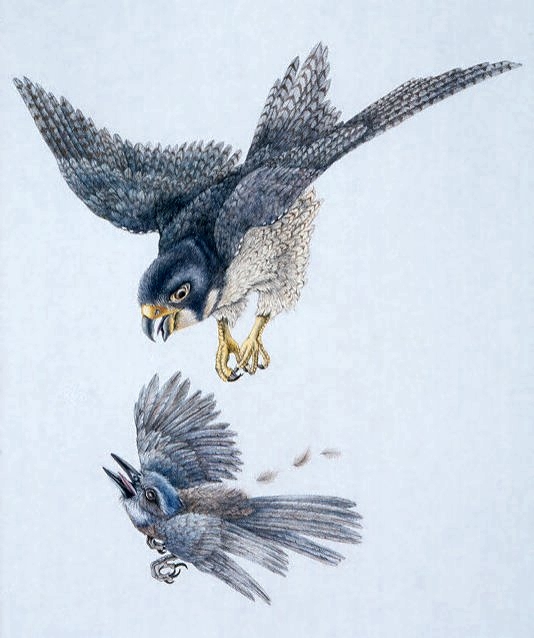
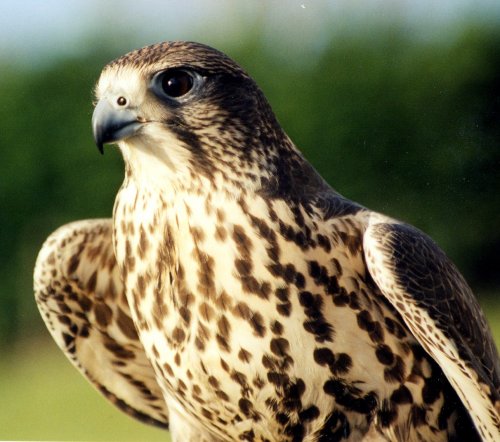
The Falcon's bluish upperparts, black cap, black moustache below the eye, white chin and buffy under-parts barred with brown give it a striking appearance. It has dark brown eyes with yellow eye rings, a slate-blue beak and yellow feet and legs. Large, strong feet and a powerful, hooked beak enable the peregrine to carry and eat its prey. They are compact, fast birds with pointed wings.
As with most birds of prey, male peregrines are smaller than females. Male falcons are called tiercels , which means "one-third"; they are one-third smaller than females.An immature peregrine falcon is similar to the adult, but has brown upperparts, a heavily streaked breast and a blue-gray beak, legs and feet.
|
|
Food:
Falcons eat small to medium-sized birds. They were formerly called "duck hawks" because they occasionally prey on ducks. Those living in urban areas eat large numbers of pigeons and starlings. They will eat a great variety of species, however, depending on what is available.
|
|
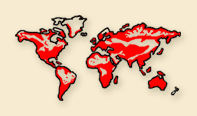
The Latin name " peregrinus " means "wandering" or "coming from foreign parts." Peregrine falcons are distributed worldwide, occurring on every continent except Antarctica. Some northern populations migrate long distances.
There are three subspecies of peregrines in North America. They differ slightly in appearance, breed in distinct regions and migrate different distances. Peale's peregrine ( F. p. pealei ) nests and winters along the coasts of Alaska and British Columbia. The tundra peregrine ( F. p. tundriu s) breeds in the Canadian arctic south to treeline and migrates as far south as Argentina. The subspecies F. p. anatum , native to North America south of treeline (including Wisconsin), tends to overwinter in the southern U.S., Central America and the Caribbean. This subspecies no longer exists east of the Mississippi.
Historically, peregrines nested in Wisconsin on cliffs along the Wisconsin and upper Mississippi rivers and in Door County. Between 1965 and 1985, however, no peregrines nested in the state. Birds breeding in Canada have continued to migrate through Wisconsin in the spring and fall, following age-old migration routes along the Mississippi River and shore of the Great Lakes.
|
|
History:
Falcons have had a long association with people. Falconry, the use of birds of prey in hunting, dates back to the year 2000 B.C. in ancient Egypt and China. The practice reached Europe by 300 B.C. Because of its strength, intelligence and maneuverability, the peregrine falcon was a prized possession among falconers. The peregrine falcon was the bird used by royalty in the Middle Ages, and its nests were sometimes the exclusive property of the nobles
Peregrine falcons have always been somewhat rare on the North American continent. It's believed that in the 1940s, there were approximately 5,000 peregrines on the continent, and only 350 breeding pairs in the eastern U.S. After World War II, DDT was heavily used throughout the eastern U.S. The decline in peregrine numbers began in the 1950s, continuing through the 1960s and early 1970s. Populations of this species were essentially extirpated by the 1960s in the eastern U.S., and only a third of the nests in the Rocky Mountains were still occupied. Peregrine falcons were placed on the federal endangered species list in 1970. Regional teams prepared recovery plans to assist governmental agencies in the protection and recovery of the species. Ohio is included in the Eastern Recovery Plan. A captive breeding program began in 1974 to introduce the peregrine falcon back into its previous breeding range. One such effort began in the mid-1980s. The Midwest Peregrine Falcon Restoration Project was initiated in an effort to restore the peregrine to the Midwest. Coordination and administration of the project is provided by the Raptor Center at the University of Minnesota and Bell Museum of Natural History. Ohio is a cooperating state and received peregrines for release through this project. Since then, over 600 young falcons have been released in the Midwest and eastern U.S. through a technique known as “hacking.”
|
|
|