 The chances are that when you
think of Sri Lanka, the images that come to your mind are those
of cricketers and LTTE terrorists. But much to our delight we
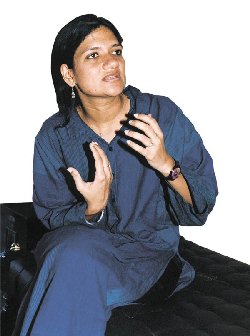
found a totally different type of Sri Lankan in the 24-year-old
playwright, Ruwanthie de Chickera.
"I am a terrible terrorist and a lousy cricketer. So I'm
afraid I'll be a failure in both," says the playwright,
putting us totally at our ease. De Chickera is an English Honours
student in the Faculty of Arts, University of Colombo. She has
won quite a few scholarships and awards for play writing,
including the British Council International New play writing
Award for South Asia, 1997, for her play The Crutch, now
renamed as Middle of Silence. The enactment of just this
play, by the Bangalore-based Artists Repertory Theatre, is what
brought her to Mumbai, mid September (see review ). During
her visit, she spoke to me generally about theatre in Sri Lanka,
and in particular, about her own plays.
The chances are that when you
think of Sri Lanka, the images that come to your mind are those
of cricketers and LTTE terrorists. But much to our delight we
found a totally different type of Sri Lankan in the 24-year-old
playwright, Ruwanthie de Chickera.
"I am a terrible terrorist and a lousy cricketer. So I'm
afraid I'll be a failure in both," says the playwright,
putting us totally at our ease. De Chickera is an English Honours
student in the Faculty of Arts, University of Colombo. She has
won quite a few scholarships and awards for play writing,
including the British Council International New play writing
Award for South Asia, 1997, for her play The Crutch, now
renamed as Middle of Silence. The enactment of just this
play, by the Bangalore-based Artists Repertory Theatre, is what
brought her to Mumbai, mid September (see review ). During
her visit, she spoke to me generally about theatre in Sri Lanka,
and in particular, about her own plays. How important is theatre in the life of your countrymen?
Not too important. Cricket is the main form of entertainment. Essentially, I do English theatre and a little bit of Sinhalese theatre. There is this huge difference between the two. Sinhalese theatre is very political, very cutting edge. It's for the mass audience with cheap tickets, just Rs 10. The troupes tour the countryside and the plays go on to the early hours of the morning. English theatre, since it caters to English-speaking people is a niche kind of thing -- small audiences, not so political. Though I think it is changing a little bit now. We used to have mainly British comedies and musicals with not much scope for original writing. But now that's changing. The two types of theatre were moving parallel but now they are coming together, with English theatre becoming more political.
What about Tamil theatre?
We are seeing less and less of it in Colombo. There are some very active groups up in the north, most of them very political, though there are non-political groups as well. I have been in several workshops for Tamil theatre and I think for the Tamils it is a very much a way of life .. of survival. Theatre is more important for them than for us because for us it still remains as a sort of entertainment.
Does this theatre draw from the traditional forms?
I am not really aware of traditional Tamil theatre. It is their modern theatre that interests me more. As for Sinhalese, there are theatre traditions that have come down the ages. It is very much like Greek theatre with a chorus and lots of singing and dancing. There are many types of dances like that of the devil dancers -- with people dressing up like devils -- and the ever popular Candian dance.
 You mentioned political
theatre. What sort of ideas are portrayed in that?
You mentioned political
theatre. What sort of ideas are portrayed in that?Generally there are protest plays. There are a lot of youth in Sinhalese theatre who write their own scripts or translate from English plays. Theatre provides them a platform for political expression against a society that bogs you down. They are not overtly political in that there are no party politics involved. They take up issues like: the insignificance of man, deterioration of relationships, etc.
Do you face censorship from the government?
Censorship is just a procedure. They hardly ever censor anything. There are no strict guidelines. If a play is very, very politically overt, then they might change it. But I have not come across anything like that, and we've done some pretty political stuff in English theatre as well. It gets passed off as a foreign play, but it is very obvious that it applies to our political situation -- corruption, dictatorship, terrorism etc.
On the other hand, is there any support, as such, from the government?
I and a couple of my friends received a grant last year to go abroad and study theatre. This was part of a whole scheme of about 100 scholarships of which four were given to the arts. This is about the first time that's been done. But that is a start. There are no government-sponsored shows as such, but on the other hand, they don't try to step on our toes either. We have a lot of freedom.
So, with no government support and small audiences, can you be a full-time playwright?
No, it's not possible to be full time in theatre, because there is no money in it. It's just that I have this passion for drama. After finishing my studies, I intend taking up teaching in a school.
But there are playwrights in Sri Lanka who have a popular following?
In Sinhalese theatre there are people who have made a name for themselves. If you are looking for someone who can be called a genius, there is this playwright called Saratchandra. He did something very innovative in the sense that he took some of the old stories and put them to dance and music. His plays have a faithful following. Other than him, there are people who have made small names for themselves as modern writers. In English theatre there was Ernest McIntyre, who wrote in the '40s-'50s. But he immigrated to Australia. Since then, there has not been a leading person in English theatre because it is considered very esoteric. But that's changing very fast. Up to a certain point, dramatists were making it an excuse saying that since there was no audience they can't do anything. It was the typical chicken and egg situation -- people were not putting up plays because they were scared and because they were not putting up plays, there wasn't an audience. But when people stuck their necks out, they found that there were audiences. Now it's mainly money to do a play which is important. But if you get the money and do the play you get the audiences, who are very perceptive. They just won't stand trash.
How successful have you been?
I have been very lucky. It was easy for me to break into English theatre because one of my plays was produced in England.
Maybe because it was good so it was produced there?
Yes, it was good, but there are other people who, I think, are as good as me but who have not had that luck. Like at the moment I am working with a group of 40 students who are making their own play. They have eight young writers aged between 14 to 17 and have done some incredible writing. Their writings are so mature that I know I wont be able to write like that. It's just the lack of opportunity. People are not willing to take the risk of producing their plays and they themselves lack resources. We have the big, well-equipped theatres which seat over 600 which can be very intimidating for start ups.
So what goes on in these theatres?
They have concerts, music programmes... there are enough things going on -- they are booked for two years -- but no real theatre theatre.
What about drama schools in Sri Lanka?
There are none. A few universities offer a degree, not in drama as such, but in fine arts where they do drama as well.
What about theatre groups?
There are many different groups but I don't belong to a particular group. There is a temptation to start a group, but they are mushrooming all over the place and unless you have a vision very different from the others, it runs the risk of surviving for about two performances and then crashing. The problem with a group is that sooner than later you start choosing plays for the actors you have instead of choosing plays for what they are worth and picking your actors accordingly. I find it better to remain independent. Looking for plays which your group can do is so limiting.
Coming now to your play, Middle of Silence. Is it your first play?
I have written other plays but this is the first that has been "successful." I have another play, which I directed myself, called Two Times Two Is Two, of which we have done a few shows. But so far, Middle Of Silence has proved the most successful.
What was the inspiration behind Middle Of Silence? Was it based on any real life happenings?
Saying yes would not be completely true. Most of the play is about a lot of happenings that I have seen and experienced. Three of the characters were solidly inspired by three people. The main inspiration came from an expression I once saw on a woman's face, and I built around that. Some of it is true, some of it is how I imagined it would be. A lot of people ask me where all this angst comes from. I don't know whether it is really angst, but it is a pretty hard play to watch. I realised that, but I tended to be really honest when I wrote it. If you camouflage some people's lives, soften the blows, it's not true any more. People live hard lives, and there is no point in making things pretty simply for the sake of a performance. It would be the same as making things unrealistically harsh for the sake of drama. But I have tried to be honest.
Don't you have to heighten things in a drama?
That comes in in the structure and timing. The emotions, the events themselves are not heightened. You condense these and you write it in such a way that it becomes dramatic. You take real life and put it into a dramatic structure and then it becomes drama. I think that's the real point of a drama. If you just try to create dramatic situations, it doesn't work, at least for me it doesn't.
Do you take up issues?
Never. I try very much to keep my opinions out of the play. Like people have read many things into Middle Of Silence, but if you ask me what character I believe in the play, I can't say any one because I identify with all of them. I think all of them have a right -- in their circumstances -- to be like that. Some people have a way of rationalising what they do. For me to bring my characters to life, I have to believe in all their rationalisation.
But there is Something called the truth, going beyond a person's rationalisation?
I may not say a character is correct. But I myself don't want to go to a play where I am being preached to. I don't want the writer down my throat, giving me the moral of the play. I think life is much more complex for that. There is right and wrong, but you can pick that out from the play. There is bad in the best of us and good in the worst of us. I think to write plays you need to give every one of your characters a chance. Like this man in this play -- on the one hand he is a complete bully and sadist. But I empathise with him. I can understand his process of rationalisation. I think that it is important to give a balance to the character. Then the audience has the right to make up their mind who the good and the bad are. But I don't think I can do that.
Review of Middle of Silence