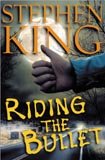
E-publishing received a big shot in the arm in March this year, when scary writer Stephen King put out his latest story, Riding The Bullet, for sale exclusively on the Internet. The 16,000-word (475KB) downloadable e-book is reported to have garnered 4,00,000 orders on its very first day of �publication� beating all records of sale of the author�s earlier books. "If ever there was indication if the e-book was here, this is it," said Gus Carlson, spokesman for Barnes & Noble.
So where does the print media go from here? The entry of radio and television in the last century were often perceived as threats to reading. Yet, they all found a way of co-existing, each in their own niche: print for data and static images; radio for audio or voice transmission; and films and television for both audio and video but with the requirement that the consumer stay put before a cinema screen or a TV box. However, the capability of the Internet embraces the transmission of data, voice and images and therein lies the perceived threat to traditional media. But these very same media have added Internet to their business. Every major publication in the world -- whether it�s Time, Newsweek, The Wall Street Journal or The Hindustan Times -- has an Internet site which provides the content of its print publication online. There is a school of thought which sees this as cannibalism. However, if the 1999 edition of Veronis, Suhler & Associates Communications� Industry Forecast is to be believed, "The Internet is emphatically not cannibalising on traditional media. It is, in fact, accelerating their growth."
The report paints an extremely rosy picture for all forms of media, especially online, which it says will contribute not to the erosion of print, TV, radio and outdoor, but will help boost them all to new record levels. One of the examples cited by the report is that of the highly successful Amazon.com whose CEO Jeff Bezos was named Time�s Man of the Year. The site specialises in selling books -- it uses the bits and bytes of computer parlance to actually market atoms. And people are buying books like mad. As digital guru Nicholas Negroponti wrote in 1996 while defending his writing of the book Being Digital, "... who wants to read Michael Crichton's next book, let alone the Bible, on screen? No one. In fact, the consumption of coated and sheet paper in the United States has gone from 142 pounds per capita in 1980 to 214 pounds in 1993." But then he goes on to end the same essay with: "Meanwhile, some of us in research [at MIT] are working really hard to make them [e-books] feel good and be readable -- something you can happily curl up with or take to the john."
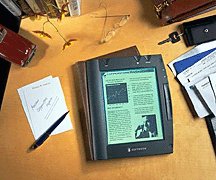
Now that is what is really getting the print publishing industry uneasy: e-book or electronic book devices which are slowly making their appearance in up-market stores around the world. Being highly portable, they would obviate the present inconvenient process of having to sit before a computer screen for reading pages of text. E-book reading devices are about the size of a normal paper-back but instead of pages you have a single screen which lets you flip �pages� with the press of a button. Gemstar's Rocket e-book and the leather-bound Softbook Reader are just two of the reading devices recently introduced.
Steps are also on to standardise the format of e-book software so that a digitised book can be read by any machine, much like the VHS format is read by video players. Amazon.com is offering the Glassbook Reader as a free download (6929KB). The Reader lets you view not just e-books but also HTML and PDF files in a neat, book-sized format. Last January, Microsoft too announced a deal with leading online publishers and book sellers Barnes & Noble to produce a barnesandnoble.com e-book superstore using Microsoft Reader software. The site, due in mid-year, will have thousands of e-book titles.
But what about the authors of the books? Titles that are out of the copyright laws are already available in electronic form at sites like that of the Gutenberg Project (www.promo.net/pg). The plain text version of these are available for free download, but reading the unformatted text is a painful exercise. However, you can buy the portable document format or PDF files which make for much easier reading.
Authors can also benefit from the reduced costs of producing and marketing an e-book. As Pubspace (www.pubspace.com), a site which promotes electronic publication, states, "Books are inexpensive to print only when you're printing hundreds of thousands of them -- which limits you to printing only books of interest to hundreds of thousands of people." So publishers may not risk taking on new writers unless they can be absolutely sure of the market. But for such writers, the Web is God-sent. Online Originals (www.onlineoriginals.com) which only publishes digitised books, has a large repertory of authors. And help is coming the way of these books through the print media -- last year, no less a paper than The London Sunday Times Literary Supplement reviewed an e-book, The Angels of Russia by Patricia le Roy, published by Online Originals. The reviewer, Professor John Sutherland, head of English at University College London, liked the novel so much, he nominated it for the Booker Prize!
And now, of course, Steven King�s foray into e-publishing will give a new �respectability� to even established writers to sell on the Web. His publishers Simon and Schuster are reported to have said that it is not easy to market a 66-page novella in the traditional way. Similarly, even songsters have taken advantage of the Net to market 'singles' which became near impossible after the abandonment of 45rpm records.
A publishing field that is truly threatened is that of professional journals which are the lifeblood of scientific, technical, and medical fields, in which they constitute the single most important means of conveying vital research findings. Paul Ginsparg, a particle theorist at Los Alamos National Laboratory in New Mexico, built a system that lets researchers exchange manuscripts in over 30 fields. Says Ginsparg, "We're asking our publishers, 'Why do we need you?'"
Way back in 1995, Forbes magazine stated that the number of electronic journals and newsletters grew 66% to nearly 700 titles, with 142 of those being peer reviewed. The electronic journals comprise what Ann Okerson, who follows the burgeoning field for the Association of Research Libraries, calls "the greatest time of experimentation in publishing since the 1500s... People have stopped saying, 'I don't know if the shift to electronic publication will really happen.' What they are now saying is, 'This is really happening, and how will it change the way we work?' "
In the final analysis, one can wager a guess that as the print medium withstood the onslaught of radio and television, it will also take the new medium in its stride. The biggest example of ho