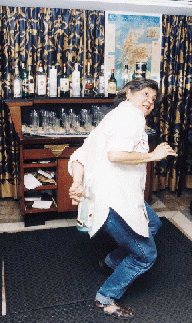
 Never mix, never worry. This
is an old adage for tipplers. However, after meeting Shatbhi Basu,
one realises just how to mix without worrying. Our first
encounter with the ebullient lady is at her training centre atop
the Revival restaurant, bang opposite Mumbai's famed Chowpatti
beach. We enter to encounter a flurry of activity with young guys
throwing up bottles, bouncing them on a rubber carpet, mixing and
stirring drinks and, seemingly, in general having a good time
with bottles of vodka, gin, tequila, whisky, brandy et al lined
up on the bar and tables. One of the guys offers you a light with
a flame in the cup of his hand. But it was not all for fun -- the
guys were, in truth, studying!
Never mix, never worry. This
is an old adage for tipplers. However, after meeting Shatbhi Basu,
one realises just how to mix without worrying. Our first
encounter with the ebullient lady is at her training centre atop
the Revival restaurant, bang opposite Mumbai's famed Chowpatti
beach. We enter to encounter a flurry of activity with young guys
throwing up bottles, bouncing them on a rubber carpet, mixing and
stirring drinks and, seemingly, in general having a good time
with bottles of vodka, gin, tequila, whisky, brandy et al lined
up on the bar and tables. One of the guys offers you a light with
a flame in the cup of his hand. But it was not all for fun -- the
guys were, in truth, studying!Basu has been training barmen in restaurants where she worked until finally, last year, she set out on her own training programme with the support of the Revival restaurant. And the Stir Academy was born. But much before, in 1997, Basu was the guiding spirit behind the Official Meet For Bartenders, which is a competition in cocktail making for both student and professional categories. This year the event was spread over three days, with seminars and competitions filling up the days. Basu also has to her credit the popular bartending book, The Can't Go Wrong Book Of Cocktails.
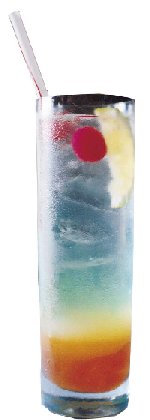
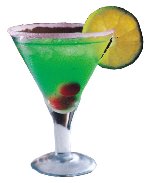
Today, she mixes us a varied spread of Autumn Leaves, a Blue Martini, a Kiwi Marguerita and, for a teetotaller, a Hot Wired. Drinks in hand, we settle down to talk.
When and how were you first 'called to the bar,' as it were?
 In
1981, I was working in this Chinese restaurant in Linking Road,
Mumbai, as assistant manager, when I was told that a customer
wanted a dry Martini. I had no clue how to do it and we didn't
really have a good bar there. I knew how to make a dry Martini in
my mind, so I went up to the manager and said, "Do you guys
have any dry Vermouth?" And he said no. I said, oh hell, how
do I make a dry Martini without any dry Vermouth? I had two
options: Either go up to the guest and say sorry, not available,
or I could very quickly figure out if I could use a substitute.
So I asked whether they had any dry white wine. They did. So I
just used that with Campari, which they had, and, of course, gin.
It worked. That's what made me start thinking that hey, I dont
know anything at all, so I'd better start learning if I have to
be in the business.
In
1981, I was working in this Chinese restaurant in Linking Road,
Mumbai, as assistant manager, when I was told that a customer
wanted a dry Martini. I had no clue how to do it and we didn't
really have a good bar there. I knew how to make a dry Martini in
my mind, so I went up to the manager and said, "Do you guys
have any dry Vermouth?" And he said no. I said, oh hell, how
do I make a dry Martini without any dry Vermouth? I had two
options: Either go up to the guest and say sorry, not available,
or I could very quickly figure out if I could use a substitute.
So I asked whether they had any dry white wine. They did. So I
just used that with Campari, which they had, and, of course, gin.
It worked. That's what made me start thinking that hey, I dont
know anything at all, so I'd better start learning if I have to
be in the business. You mention that you were an assistant manager when the bar bug bit you. So did you work as a bartender after that?
Not really. But I did think that wherever I worked I could do something with my bartenders and make sure that they made the bar a better place. In our time, it wasn't something we could do. First of all, girls were not even allowed to work behind the bar. Secondly, since I was in a higher grade, I could not actually work as a bartender. The difference was that I worked like a bartender but I wasn't a bartender. I used to be very happy the day my bartenders bunked, as that would mean I was totally in charge.
What were the experiences like?
Oh, they were pretty good. People used to be amazed when they saw me there and they used to wonder, "Is it safe to talk to her?" They used to be more in awe of me than I of them. Once they were at ease, they could talk and you are on a level where you can make conversation without a problem. They can see that you are in a position of authority. They don't think they can take you for granted. You got to start off with a kind of authority where they can respect you. You know what you're doing, you know your job and at the same time they can't really take you for granted. They can crack a joke and we can have fun and even perhaps flirt. But they just can't be nasty
Did you have any nasty experience?
No. I have been through it all but never had a really, really nasty experience.
So it's okay for a girl to be behind a bar?
Oh yes, more than okay! As long as you know what you are. As long as you know how to carry yourself, it works perfectly.
But were you the first girl behind a bar in India?
To my knowledge, I was probably the first one to start this idea of training bartenders. But there was another woman who was the first real bartender. She worked at the Sea Rock Hotel, Mumbai. Maybe I just started practicing much earlier because I am older than she is.
A girl in a man's world. How did your family take to that?
My family gave complete support. They knew how much I wanted to do this. In fact, one of the first books on bartending was bought for me from England by my mother when I was just 17. There were three books, in fact, and after going through them I realised the way my career would go. I treat them like a Bible. After that, whenever anyone came from abroad they brought for me lots of miniatures. Anything they could lay their hands on. They still do. They know that what I want is miniatures of any new product in the market. If they can't find miniatures, they bring in a big bottle.
What are the ingredients that go into the making of -- not a cocktail -- a good bartender?
He has to be passionate about what he is doing. He shouldn't be there just because he
 doesn't have a choice. He
must have a thirst for learning, because you can never stop
learning as new products come out all the time. He's got to keep
in touch with new products both in the local and international
markets. He must be very good with flavour profiles and possess
the skill of mixing and matching. He must be a very confident
person, must like people and music. He must possess communicative
skills, a sense of humour and be able to laugh at himself. He
will be a person who is a little laid back but who is extremely
alert. He must possess a creative mind and be open to trying out
new things. He must be very good at judging people and their
moods so that he knows whom to talk to, how to talk to them and
what kind of drink to offer them. Entertaining customers through
juggling comes only last. I always stress: make the drink first,
entertain later. If the drink is delayed because of your juggling,
then it is not acceptable.
doesn't have a choice. He
must have a thirst for learning, because you can never stop
learning as new products come out all the time. He's got to keep
in touch with new products both in the local and international
markets. He must be very good with flavour profiles and possess
the skill of mixing and matching. He must be a very confident
person, must like people and music. He must possess communicative
skills, a sense of humour and be able to laugh at himself. He
will be a person who is a little laid back but who is extremely
alert. He must possess a creative mind and be open to trying out
new things. He must be very good at judging people and their
moods so that he knows whom to talk to, how to talk to them and
what kind of drink to offer them. Entertaining customers through
juggling comes only last. I always stress: make the drink first,
entertain later. If the drink is delayed because of your juggling,
then it is not acceptable.Which recipes pose the greatest challenge to a bartender?
All are equally challenging, but most difficult to create consistently are the flamed cocktails. Sometimes just when you expect the damned thing to flame, it doesn't, which is most frustrating. The tempratures may be not right, the alcohol is too cold, the lighter won't work at that point of time, or you end up staining the glass, which is not what you dont want. Apart from that, they are all challenging in your mind, but if your technique is right, there is no drink that is difficult to produce.