
 | 2004: Now it gets interesting! |
| Welcome to NAB 2004 with your host, Lorin Thwaits! |  |
It's a great NAB so far, guys! So far I've been to the Sony, Canon, JVC, and Panasonic booths, and this is what I have to report:
At the Sony booth:
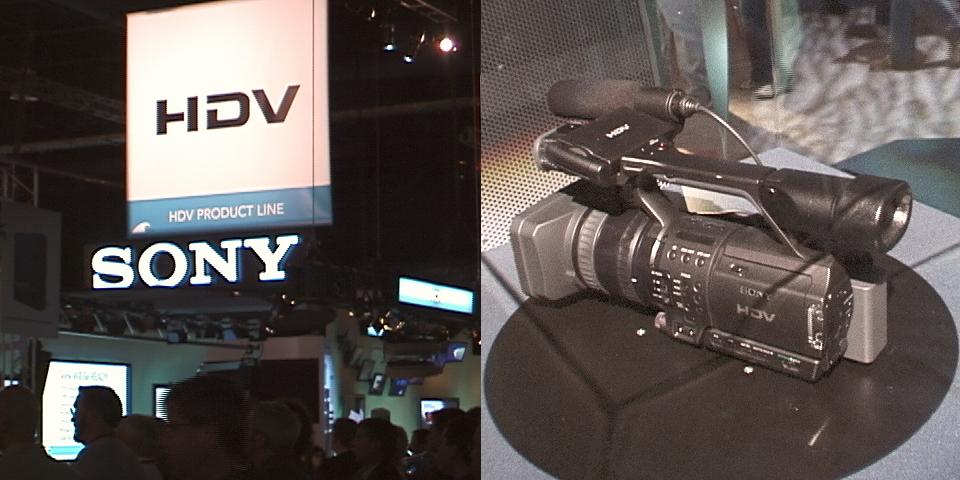
Prototype for a new HDV deck was displayed!
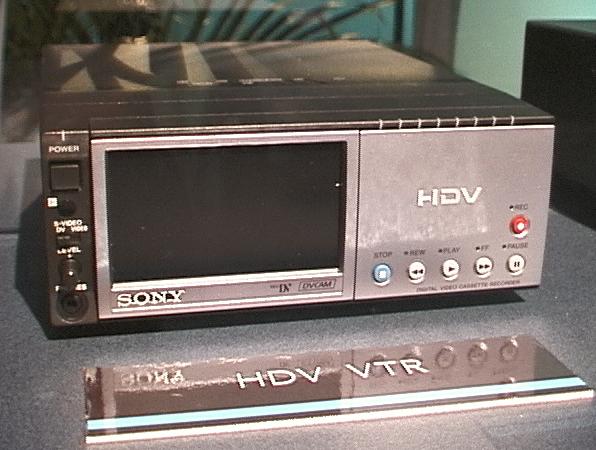
(You can also see a close-up of the Left Half and Right Half. On this non-working mock-up, there was only a blank panel on the back. The trace of an insignia you see embossed on the top is simply the HDV logo.)
As Sony rolls out HDV, above all else, they want to make sure they "Get it Right". In fact, that was the first slide in their whole HDV presentation:

Part of "getting it right" means making sure that the format is interchangeable with HD-SDI for all those newscasters out there eager to jump on the HDV bandwagon. They're partnering with Miranda to provide this converter:
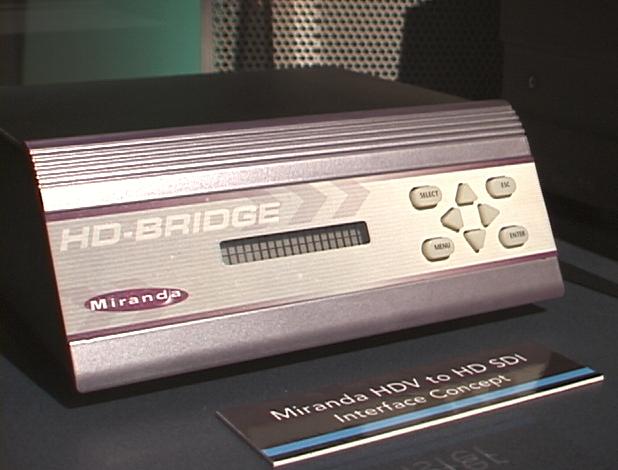
The four buttons there read simply "SELECT", "ESC", "MENU", and "ENTER". Unlike the HDV deck mentioned above, this was (apparently) a working prototype, or at least it had a power connection, two XLR jacks for audio, and these other connections around back:
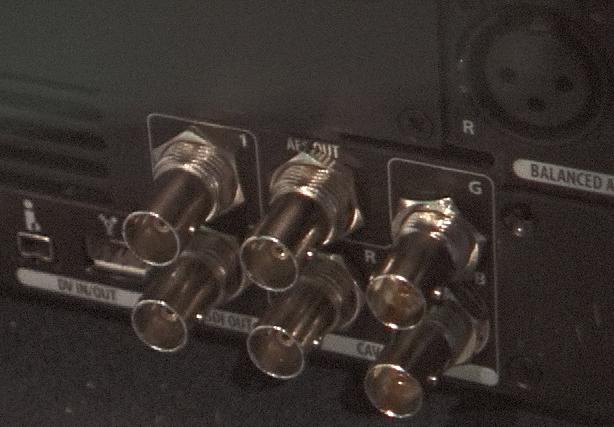
In with the HDV, and out with SDI in an inexpensive and convenient package. I wonder if it encompasses the JVC 720p variant of the HDV spec. Sony emphasized in their presentation that they are committed to the 1080i format, never even mentioning on any slide or anywhere that they are involved with 720p.
The same mock-up shown at CeBit was prominently displayed rotating in a glass case. Stay tuned for The Sony HDV Cam Shrine, a page I'm making to give you a real show-floor feel of what it looked like spinning around there, plus more close-up detail on the camera itself.
HDV was not at the front, and not at the back, but over on the side of Sony's area along the wall. Not as prominent as the rest of their HD presentation, but still accessible. A 10-minute HDV slide show presentation included the plea, "Add HDV to your DVCAM workflow!", giving an indication of where they feel the format fits for the moment. The theme of the whole booth was "Ride the HD Wave", accompanied by scenes with professional surfers carving up a massive curl on Hawaii's North Shore.
One thing that they wanted people to note was all the editing options currently available, which were shown running on HP computers (for some reason not Sony???). Six machines were set up to demonstrate Adobe, Avid, Canopus, Pinnacle, Sobey, Ulead, and Sony's own Vegas package.
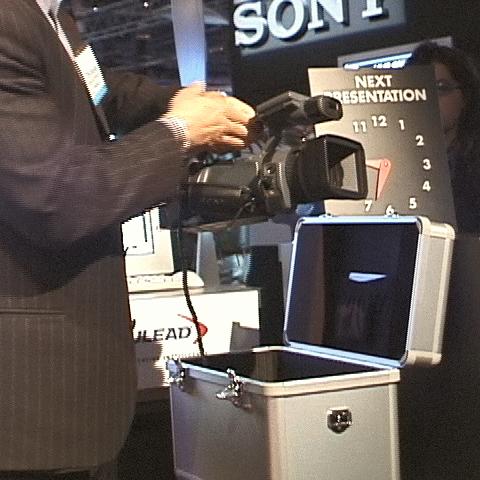
During the 10-minute dog and pony show, a working prototype is pulled out and demonstrated:
It has a tether with firewire and power connection:
When the image comes up, it is letterboxed in an interesting way:
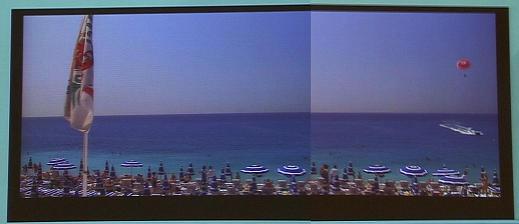
(Click for a larger image.) Okay, so this is two pictures out of my camcorder sewn together, and not really a whole image. My apologies. It was the best I could do. But interesting anyway is that the aspect ratio is approximately 2.35:1 instead of 1.77:1 (the aspect ratio of normal 16:9 HD). When I asked what was up with the letterboxed effect of the image, the presenter said that it was due to it being a prototype. I have to wonder if it though to emulate the popular Panavision aspect ratio used in many movies. An option for letterboxed 2.35:1 filming could serve to optimize the available bandwidth. This would still end up recording 1440x1080 frames, but without any motion or detail in the top and bottom black bands in the image. The active area would end up being 1440x816, which is a 25% smaller area. Thus the full 25Mbps signal devoted to a smaller area, potentially giving better quality results overall.
Colors were rich, and detail was good. I didn't have anything high resolution enough to really do justice to the image, but here is a piece I zoomed up on with my little SD camcorder. For reference, this was the lower-right corner of the entire image:

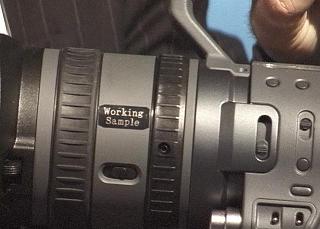
Just like the other mock-up, this prototype had no labels at all on it:
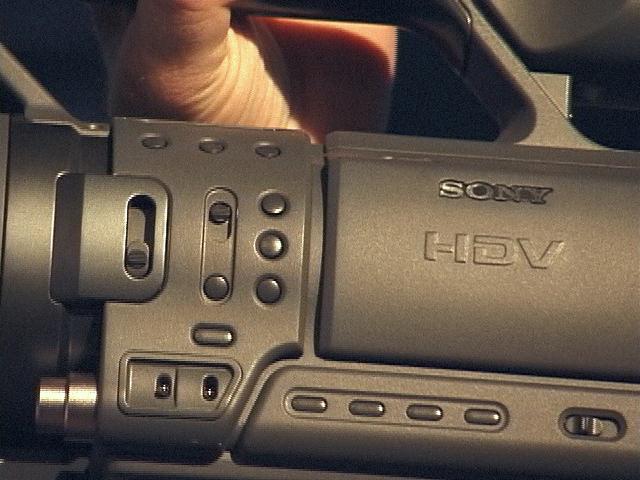
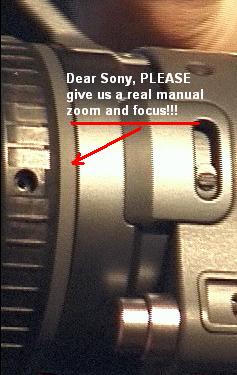
An annoying thing: in the high-res picture that was leaked to Sony's website a month ago, there was a holder that kinda gave us the clue that this thing would have true manual focus and zoom. In the working sample, the knob had been removed:
Two times during the rehearsed speech, the man explained that Sony is really backing the 1080i portion of the format. It will remain to be seen if the camera will actually down-convert to JVC's 720p.
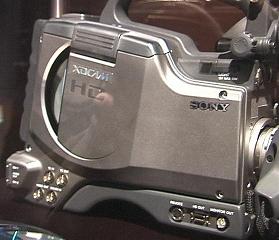
Coming later will be some close-ups of the controls themselves, and more info about the XDCAM HD, which sure enough looks very much like the PDW530, just as I had expected:
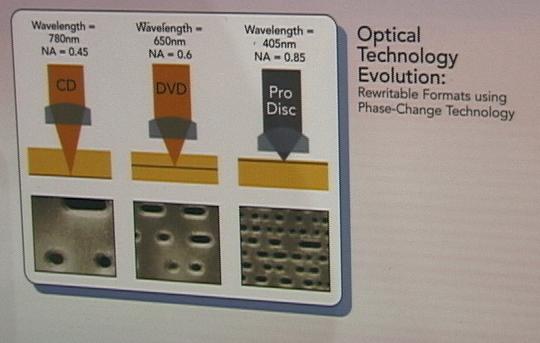
Speaking of the discs, there was this good Evolution of Optical Media chart:
Today's XDCAMs use 23-gig 5.25" media:
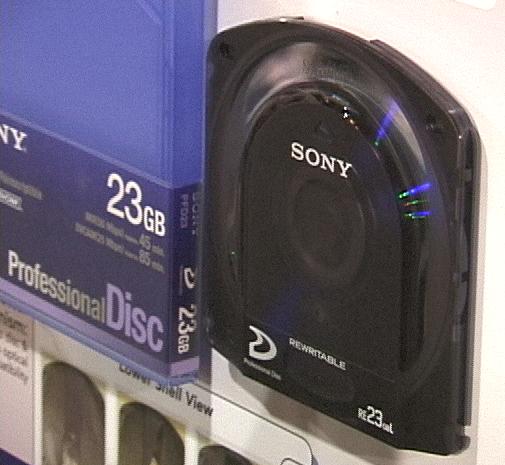
On display with the XDCAM HD was the dual-layer 46 gig media:
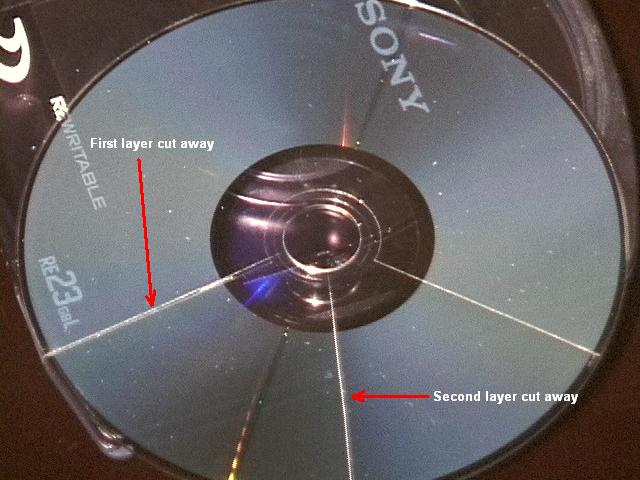
See how the media was cut away in two places to show the two layers? Okay, underneath the disc is a cartridge for the older 23 gig media which won't help much to convince people it's really 46 gig, but anyway, as you go around counterclockwise, there is one cut down a layer, and further a second layer cut away. In the near future, there will be 4-layer discs emerge with this same phase-change technology.
Also on the horizon are smaller diameter discs. . First 3.5" discs for pro cameras, then 3" Blu-Ray discs coming for the consumer. I'm still not totally clear on the differences between the XDCAM discs and the Blu-Ray discs, but for some reason (perhaps just marketing) Sony wants to maintain that there are fundamental differences.
Canon:
Nothing new in the camcorder department except the continuation of rebates on existing models.
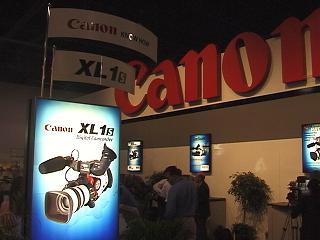
Being bored with this, I started counting how many rebate annoucnements I could find sprinkled amongst all the cameras, and wound up counting eight that were pomoting the $500 rebate on the XL1-s.
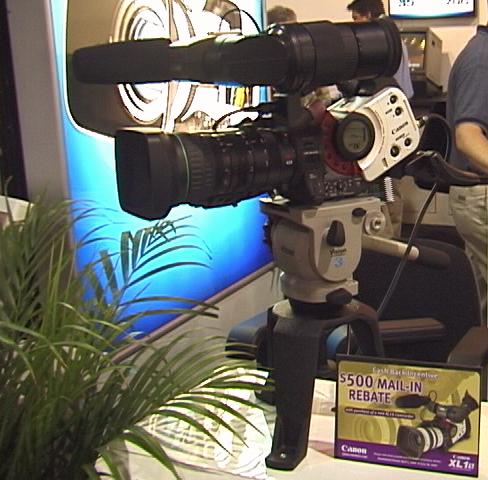
Of course they did have on display their fantastic HD lenses, all strapped onto high-end Sony HD cameras to strut their stuff.
JVC:
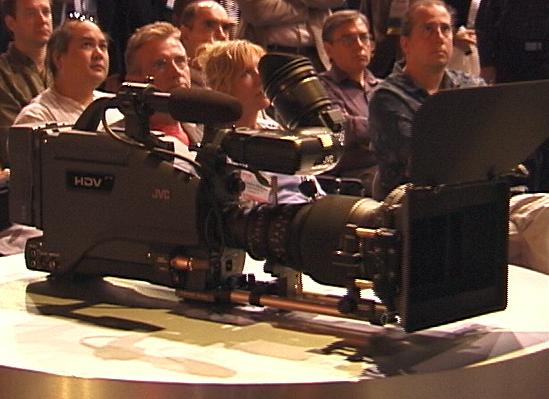
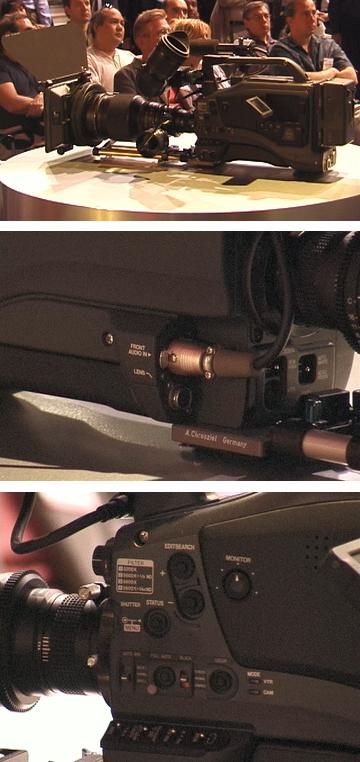
These folks were in FULL SWING with excitement over their new camera. Okay, so it's only 25 Mbps. It sounded like after talking with more of the technical folks that the same encoder used in their $25,000 rack-mount MPEG2 High Definition encoder has found its way to both here in the new camera:
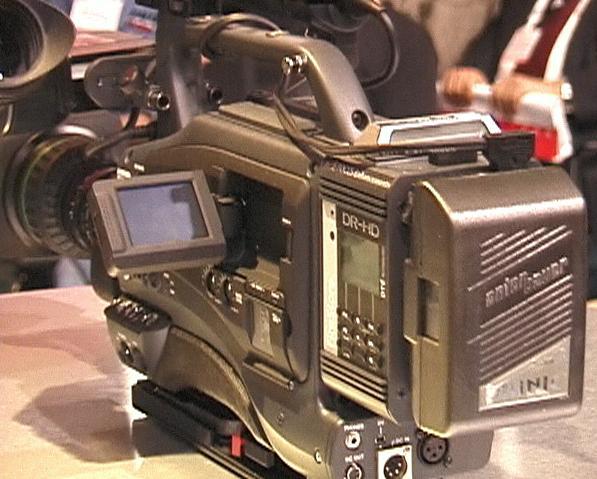
as well as into the new HDV studio recorder they're showing:
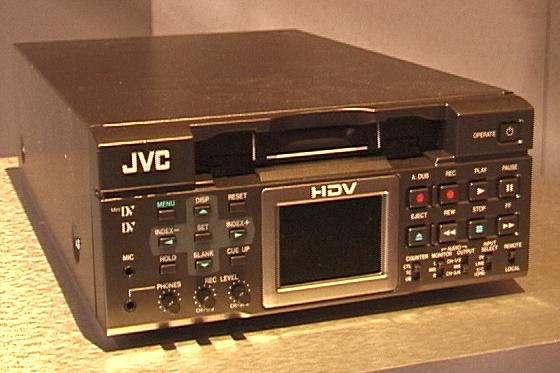
It takes full-sized DV tapes, just like the camera.
And here are all the connections 'round back:
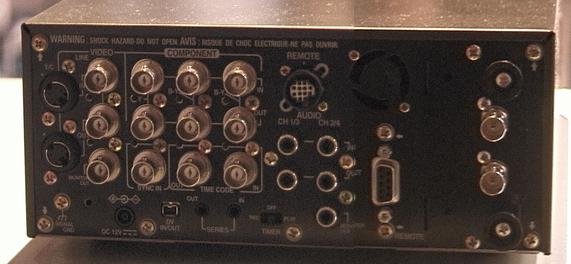
I had time to talk to Jeff and Martin from Kinetta in the evening, and from that learned that things aren't as finalized as I had thought they were earlier. I didn't really get an official interview with them, but rather was among a throng of eager film buffs who got the first glimpse of the Kinetta camera there at NAB. From that experience I've written my own analysis of how Kinetta is poised in the market.
Stay tuned for more info from NAB!
-Lorin
For a year we've been having fun working with this inaugural offering in the HDV world: | ||||
|
GR-HD1 and JY-HD10 Specifications: A year ago I wrote an article about this camera for camcorderinfo.com As well Steve Mullen has two great articles about it, one when it was released, and a later one specific to the unique color filter used in the camera. The GR-HD1 and JY-HD10 are actually the same camera. Okay, so the JY-HD10 is supposed to be the pro model. Whatever. It has the exact same internals and just adds a box with XLR jacks.
A successor to the HD10 was not ready in time to show at NAB, but one is anticipated with better manual controls, better color, and better focus in June of this year.
| |||
Soon it will be time to "up the ante" with something much more capable. On the rest of this page you'll find bits of rumor pieced together to form a possible look at what we can expect from NAB 2004 and for the rest of the year: | ||||
|
Anticipated Specifications: An early prototype was shown at NAB encased in glass. You can read a great article on the NAB press release from Robin at camcorderinfo.com. As well, there's an earlier article on abcdv.com, and a post on CreativeCow's HDV forum.
A consumer version with fewer features may be announced at the Summer CES! | |||
|
Kinetta enters the scene!
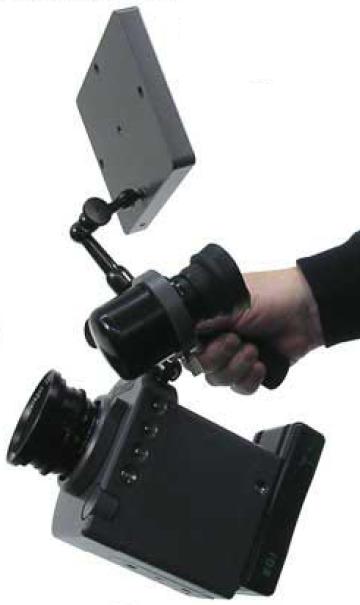
Another pro camera set to rock the world debuts at this NAB: the (relatively) low cost HD cinema camera from Jeff Kreines' new company Kinetta. Are you a purist? This is uncompressed, full-stream HD material recorded onto hard drives. Are you tired of fumbling with a bulky setup? This is small and portable. Kinetta's website already has some detail about this exciting new grassroots development. Features include:
There's a great post from Mitch Gross you should read. As well, I may have the opportunity of interviewing someone from Kinetta on Monday the 19th, so stay tuned for more interesting information! | |||
|
||||
|
Specifications: JVC will be better enabling the ENG and indie crowd with a great 3-chip camcorder. Here are the specifications:
The imaging block is actually the exact same as is used in the KH-F870U camera. This means 1936x1086 Rockwell Scientific CMOS sensors with a 12-bit ADC, and 68dB dynamic range. Virtually no blooming, no visible smear, and very low noise. That is awe-inspiring! Robin Liss at CamcorderInfo.com has some details in an article from last week on her site. Apparently recording will be possible to three different kinds of media: DV tape, hard drives, or flash cards. The latter two could allow for the benefit of VBR encoding, saving space where possible when recording low-motion scenes. It will be intereresting to compare the resolution of this camera to Sony's high-end HD cameras as it should be very comparable.
| |||
|
XL2 prototype delayed... The original plan was that by Photokina 2004 (which is in September) or soon thereafter, the successor to the XL1 would be available on the shelves. But now things clearly point to a delay in showcasing the upcoming HX1 camera. Most specific is Canon's NAB press release, which does not mention anything about a successor to the XL1-s. Robin Liss also has an article on her site eluding to this glaring omission. As well, March 31st, 2004 was supposed to be the day the XL1s rebate ended, but apparently the rebate has been extended until June 30th! Perhaps later in the year we'll hear more about this high definition offering, which is expected to become an extremely popular camera. Now on to the older rumor, circa February or so, which is a tidbit of information about Canon's HDV cam purportedly taken from a sticker made by a Japanese printing company:
Except for the HD capabilities, the other features sound quite a bit like today's XL1-s, don't they? Based on Canon's history of compatibility, existing Canon lenses will probably be compatible with this new model, with newer lenses offering better resolution. Pricing when it does become available? Here is a hint: On Canon's "now that you've had your | |||
|
Rumored Specifications: A new rumor has surfaced shedding light on where the original two cameras from Sharp at NAB2004 rumor (described below) may have had its roots. Apparently this was the original plan. You see, Sharp had been working jointly with JVC to develop a consumer-oriented 720p High Definition camcorder technology; the same work that gave birth to the GR-HD1. Too bad we'll never see what Sharp had up their sleeve as the plan changed when Sony came a' knockin'! Sharp is one of the largest and most capable manufacturers of small LCD panels, and Sony requires scads of these for their new Playstation Portable units. Samsung satisfies part of the demand, but not enough, so Sharp is now working a bit closer to Sony on that project. Anyway, as part of the negotiations, Sony was able to sway Sharp into using their 1080i format for their upcoming camcorders instead of JVC's 720p solution. So the two cameras that were to be (listed below) are instead set aside as final details get worked out for two 1080i offerings: first a single CCD 1080i unit in the summer at CES, and later a 3CCD unit that will do 1080/24p. In the original (now false) internal memo sent on January 20, 2004, two HDV camcorders were claimed. Features common to both units were an MPEG2 encoder developed in-house by Sharp, 1280x720 resolution, manual controls, spread-LED light on the accessory shoe, optical image stabilization, and a 10x zoom lens. Things that were to differentiate each camera were: On the higher-end ViewcamZ HD-Z3000:
On the lower-end ViewcamZ HD-Z2000, with very similar features to the GR-HD1:
| |||

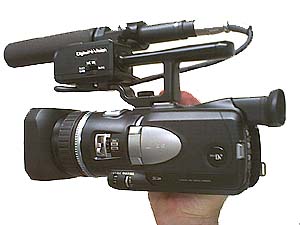

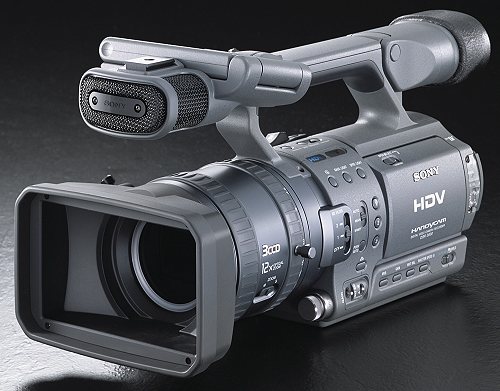



Stay tuned for all the happenings surrounding NAB 2004, which should prove to be quite a ride indeed! Pictures and specifications of the camcorders that do appear will be posted on this site throughout the day on Monday, April 19th. Maybe even before then we'll be able to "fill in the blanks" with a bit more information as manufacturers come forward with tidbits about their upcoming models. One thing is for sure: after 50 years, it's finally time to bid farewell to NTSC and PAL.