AUM SARASWATEYAYE VIDMAHE BRMHAPUTRAYE DHI MAHI TANNO SARASWATI PRACHODAYAT Let us contemplate on Saraswathi, let this power direct us. |
Who is Saraswathi?
Saraswathi is the mother of all Vedic knowledge & Goddess of the fine arts, including the art of love. She is the Goddess of learning, knowledge, and wisdom. She lends eloquence to the dumb. She is the Goddess of all arts, music, dance, literature, all sciences, crafts and skills. The Sanskrit word "sara" means "essence" and "swa" means "self." Thus Saraswathi means "the essence of the self."
Saraswathi is also regarded as the guardian ~ she never speaks anything but the truth. She was also called Smirtishakti (the power of memory), Jnanashakti (the power of knowledge), Kalpanashakti (the power of forming ideas), and so on. She is worshipped as a purifier, the auspicious one. Pray to her to give you wisdom and creativity, growth and evolution. She is an excellent Goddess for artists, writers and musicians.
In addition to being the active power of Brahma (her husband, the God of knowledge and Creator of the Universe), Saraswathi eventually became the Goddess of wisdom and learning, eloquence and the matron deity of music and the arts. To all devout Hindus, she is the daughter as well as the wife of Brahma. Her other names are Satarupa, Savitri, Gayatri, and Brahmani.
Saraswathis is also described in the Kama Sutra as being the Goddess of 64 arts. Some of these include singing, music, dancing, painting, writing, poetry, sculpture, games, magic, cooking, mimicry, languages, etiquette, chemistry, gambling, logic, religious rites, sports, and others. Pray to Saraswathi to achieve such balanced diversity. The Kama Sutra says ~ One should study the 64 arts and 64 aspects of sexual union to be a completely developed person. People who want to possess absolute knowledge worship Goddess Saraswathi. She is a great aid to all students, teachers, scholars, and scientists.
At the same time, Saraswathi is the only Goddess in the Indian pantheon who is not associated with sex. She represents wisdom behind and beyond fertility of her husband. She inspires people to rejoice in their existence, rather than crave the gratitudes of the material world. Saraswathi is also regarded as the highest manifestation of the Sattva guna, the quality of goodness, grace and purity. She creates a perfect balance with Brahma, who is the God of knowledge, but also the embodiment of lust, or creative energy - as a creator of the Universe.
She is a radiant Goddess, residing at the navel center with Brahma. The navel region is a subtle center of transformation, a lotus with 64 petals, or a sun with 64 flames. The color is golden and it's turned upward, corresponding to an energy of fire�an energy of creation.
History of Saraswathi
In early Aryan history, she was a river deity. The river Saraswathi, which does not exist today, is reputed to meet the Ganga and the Yamuna rivers, which represent Parvati and Lakshmi respectively, at the confluence of the three rivers in Allahabad, Uttar Pradesh. Vedic references associate Saraswathi with a mighty river originating in heaven and flowing down to the earth. In later Hinduism, however, Saraswathi's connection with a river steadily decreases and she begins to symbolize the magical power of words.
The hymns of the Rigveda that praise her are however tumultuous and energetic: Saraswathi surpasses all the waters in greatness, she is mighty and powerful (the first historical reference to female deities of power). Her roaring waters break down mountains. She is ever active, the great amongst the great, the heavenly stream that pervades the triple creation of earth, sky and the heavens. Saraswathi ensures the fertility of the earth, and as such she is asked to also take care of the needs for humans to be fruitful and multiply, both in progeny as well as in bank balance and store of cattle. She is praised as an invigorator, one who revitalizes the tired land and gives strength to men, who provides immortality in her role as Subhaga, the bountiful one. She is the first Goddess in all literature to be called Mother. She is also called upon to be a protector of her worshippers "as does a sheltering tree or an iron fort". Saraswathi in the Veda has a distinct touch of the warrior Goddess about her, slaying those who revile the Gods and is even credited with Indra's great feat - the destruction of the chaos-demon, Vrita.
Conflict with Goddess Lakshmi?
There is a belief that Saraswathi cannot live in harmony with Lakshmi, the Goddess of wealth. It's not true, since anyone can be both rich and intelligent, so long as you develop both aspects in yourself harmoniously. Everyone has potential of both, it is only a matter of concentration or focus. The proverb occurred because knowledge, intelligence, and wisdom were highly prized in ancient India, far above merely being rich and powerful. As the old saying had it, "Swadeshe pujyathe raja Vidwan sarvatra pujyathe", meaning, "The king is worshipped in his own land, but the man of wisdom is worshipped everywhere". Let us work on having both, wisdom and money - since we have both Lakshmi and Saraswathi present.
Representaations and Symbolism of Saraswathi
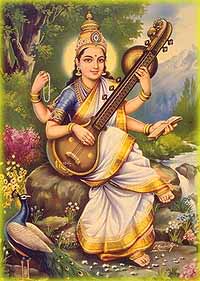
Saraswathi is represented in Hindu mythology as the divine consort of Lord Brahma. Since knowledge is necessary for creation, Saraswathi symbolizes the creative power of Brahma. Goddess Saraswathi is worshipped by all persons interested in knowledge, especially students, teachers, scholars, and scientists. In Her popular images and pictures, Saraswathi is always represented as a Goddess of dazzling white complexion in a white sari and seated on a white lotus. She is usually depicted with four arms (some pictures may show only two arms). She holds a book and a rosary in Her rear two hands, while the front two hands are engaged in the playing of a lute (veena). Her right leg is shown slightly pushing against Her left leg. She uses a swan as Her vehicle. There is a peacock by Her side gazing at Her.
This symbolism illustrates the following spiritual ideas:
The lotus is a symbol of the Supreme Reality, and a white lotus also denotes supreme knowledge.
By sitting on a lotus, Saraswathi signifies that She is Herself rooted in the Supreme Reality, and symbolizes supreme knowledge.
The white color symbolizes purity and knowledge.
The white sari that the Goddess is wearing denotes that She is the embodiment of pure knowledge.
The four arms denote Her omnipresence and omnipotence.
The two front arms indicate Her activity in the physical world and the two back arms signify Her presence in the spiritual world.
The four hands represent the four elements of the inner personality.
The mind (manas) is represented by the front right hand, the intellect (buddhi) by the front left hand, the conditioned consciousness (chitta) by the rear left hand, and the ego (ahankara) by the rear right hand.
The left side of the body symbolizes the qualities of the heart and the right side symbolizes activities of the mind and intellect.
A book in the rear left hand signifies that knowledge acquired must be used with love and kindness to promote prosperity of mankind.
The rosary signifies concentration, meditation, and contemplation, leading to samadhi, or union with God.
A rosary in the rear right hand representing ego conveys that true knowledge acquired with love and devotion melts the ego and results in liberation (moksha) of the seeker from the bondage to the physical world.
The Goddess is shown playing a musical instrument called the Veena, that is held in Her front hands, which denote mind and intellect.
This symbol conveys that the seeker must tune his mind and intellect in order to live in perfect harmony with the world.
Stringed instruments represent the letter A in AUM, and stand for all creative unfolding.
She plays and sings out of joy of creation, riding on the back of a white swan in the blue skies.
Such harmonious living enables the individual to utilize acquired knowledge for the welfare of all mankind.
Two swans are depicted on the left side of the Goddess.
A swan is said to have a sensitive beak that enables it to distinguish pure milk from a mixture of milk and water.
A swan, therefore, symbolizes the power of discrimination, or the ability to discriminate between right and wrong or good and bad.
Saraswathi uses the swan as Her carrier.
This indicates that one must acquire and apply knowledge with discrimination for the good of mankind.
Knowledge that is dominated by ego can destroy the world.
A peacock is sitting next to Saraswathi and is anxiously waiting to serve as Her vehicle.
A peacock depicts unpredictable behavior as its moods can be influenced by the changes in the weather.
Saraswathi is using a swan as a vehicle and not the peacock.
This signifies that one should overcome fear, indecision, and fickleness in order to acquire true knowledge, according to Bansi Pandit.
Connecting with Saraswathi
The union of Brahma and Saraswathi is a harmony between spirituality and materialism, that everyone needs to establish. Chant the Saraswathi mantra to bring this kind of harmony into your life and obtain "liberation from the wheel of existence without disrupting the cycle of life".