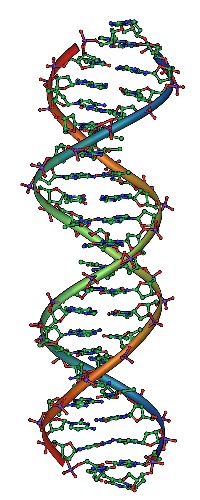
Deoxyribonucleic Acid, or DNA, is a material found in all biological cells. It is a material that determines many physical inherited traits, such as eye color, hair color, height, and many other features. DNA consists of strands, or chromosomes. Each of these strands is made up of only four unique building blocks, or bases. These bases, Adenine, Thymine, Guanine, and Cytosine, are represented by their first letters, A,T,G, and C. Each strand contains millions of these. Different combinations of these bases code for different traits. All chromosomes occur in matching pairs. One side is the opposite of the other, with A's matching with T's and G's matching with C's. Cells can read DNA and use it to determine what protiens to make. Many DNA sequences code for important information, but some do not. These non-coding DNA are sometimes called "junk DNA." DNA is passed on from parent to child. Children get half of their DNA from their mother and half from their father. Because DNA varies from person to person, it is as unique as a fingerprint, and can be used to identify people.
The structure of DNA eluded scientists for many years. The problem arised with dublication of DNA. A structure had to exist that could be compacted into small cells and yet still be able to expand and duplicate itself when the cell underwent mitosis. Eventually, James Watson and Francis Crick discovered the molecular structure. It was a double helix, two strands spiraling upward in unison. As DNA duplicates, these two strands split and each strand matches with excess A's, T's, G's and C's, making two new segments of DNA, each containing one old strand and one new strand.