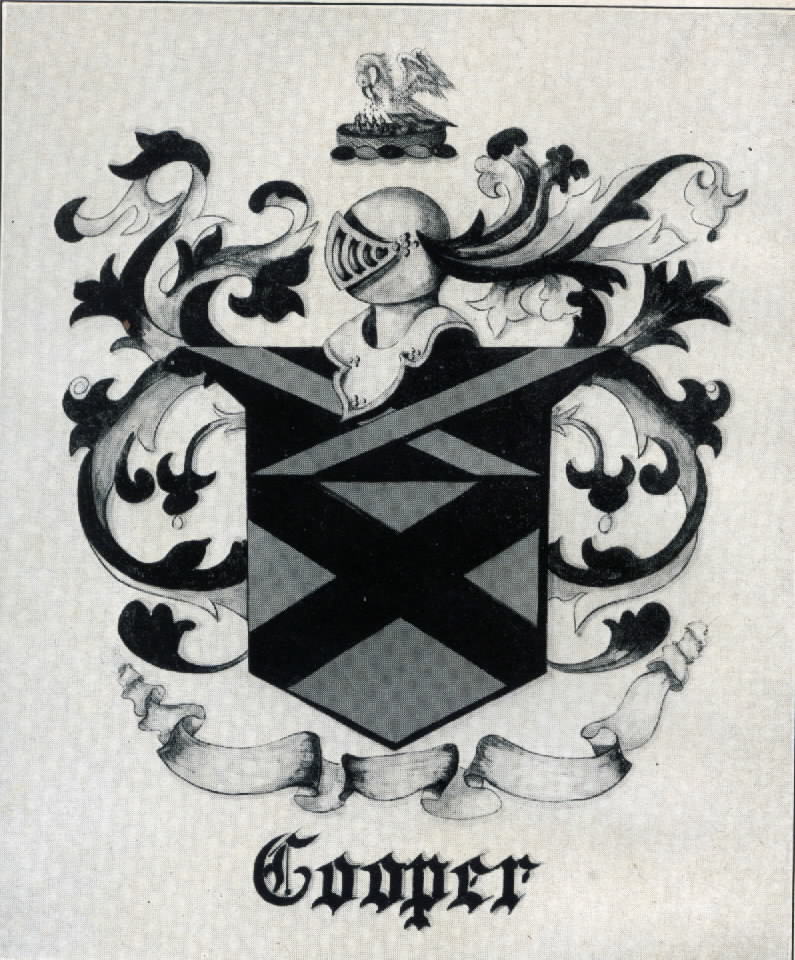
THE RISE OF THE SURNAME - If, for example your name is COOPER, William COOPER, you can trace the COOPER family back to the time when the first of that name arrived on our shores, And you may be able to trace that name COOPER back many more generations, if your patience and your bankrool hold out, because the English, as a people, have alsways been such painstaking record-keepers. It will take a lot of doing, to be sure, but as long as there is that name COOPER to look for in the musty old tax rolls, you can keep on digging till you find yourself far back in the Middle Ages.
But sooner or later something happens - the name COOPER disappears. You can thumb through every record in England without finding any more COOPERS. Just were you think you should be able to locate more of them, there may be a CUVER, a KITTYWRIGHT, a HOOPER, or even a PAYLOR, but no more COOPER. All is not lost, however, because each and every one of these names (and many more) were Coopers. The names have become disguised over the centuries and one may not be able to recognize their ancient medieval origin. The earliest record of the name is Robert Le Cupere in 1176 but, over several generations, the name went through numerious changes in different parts of the island. Some of these variations survived, other did not. COWPER is an example of one that is still with us. (3)
ENGLISH ANCESTRAL NAMES - Coopers, Cabinetmakers, Toolmakers, Molders, and Minters - COOPERS. The name BARREL is quite obvious, but BUSS and BUSSE are more obscure. Buss was an Old French word for "cask". A man named BUTT made a container, but the name could also refer to the man in charge of the butts (longbow) practice. CASKER is self-explanatory, and CADMAN was from the Anglo-Saxon word caedmon, also meaning a maker of casks. The CHURN names referred to men who made the special vessel in which butter was made. (4)
Cooper, Couper.- Occup. 'the cooper', a maker of tubs, casks, &c.; v. Cowper. A common and early trade-name leaving many descendants.
English: occupational name for a maker and repairer of wooden vessels such as barrels, tubs, buckets, casks, and vats. ME couper, cowper (apparently from MLG kûper,
a deriv. of kûp tub, container, which was borrowed independently into Eng. as coop). The prevalence of the surname, its cogns., and equivalents bear witness to the fact that this was one of the chief specialist trades in the Middle Ages throughout Europe.
Jewish (Ashkenazic): Anglicized form of Kupfer and Kupper(e).
Var: (of 1) Copper, Coupar, Cupper(e), Kooper, Coop(e), Coupe. ( of 2) Cooperman.
Surname of Occupation:
'William le Cuppere' and 'Richard le Kuppere', while ongaged in the same occupation, are, speaking nominally, absorbed, I doubt not, by our 'Coopers' and 'Cowpers'.'Cooper' may be but another antique form of the same. Langland speaks of :
"Coupes of clere gold.
And coppes of silver".
I shall have occasion almost immediately to mention Chaucer, as speaking of 'turning cups', which would seem to infer that they too were often made of wood. (p 394) Turning for a moment to vessels of a more general expression, our 'Coopers' or 'Cowpers' (1) or 'Coupers' have ever flourished extensively. Such forms as 'Thomas le Cuper', 'Warin le Couper', or 'Richard le Cupare' are found on every side; while even such entries as 'Richard Cowperman' or 'Roger Cowperese' may be occasionally alighted upon. The term 'coop' is not in itself in common use now - indeed, saving in composition, as in hencoop, for instance, it is all but obsolete.
(1) We find this now well-known surname thus spelt in a statute passed in Elizabeth's reign, in which are included the 'lynnen-weaver, turner, cowper, millers, earthen-potters'. (2)
Alan le Cupere, col Camb. 1273.
Henry le Cupper, co. Notts,.
Richard le Cupare, co. Oxf.,
Jordan le Cupere, co. Oxf.,
Willelmus Couper, 1379: P.t. Yorks. p.5
Robrt Cupper, bailiff of Yarmouth, 1425; FF. xi. 324.
1607. Married - William Cooper and Winifred Cope : St. Michael, Cornhill, p.18
London, 275, 4; New york, 213,
(4)
Researching: Frederick William Harbour
COOPER - 1840 Bermondsey/Eng via Nelson/Can to NSW/Aus
Interesting Links: COOPER Surname DNA Project
A | B | C | D | E | F | G | H | I | J | K | L | M | N | O | P | Q | R | S | T | U | V | W | X | Y | Z
TOP | HOME | SURNAMES | REFERENCES | LINKS | EMAIL
