|
|
GENERAL INFORMATION
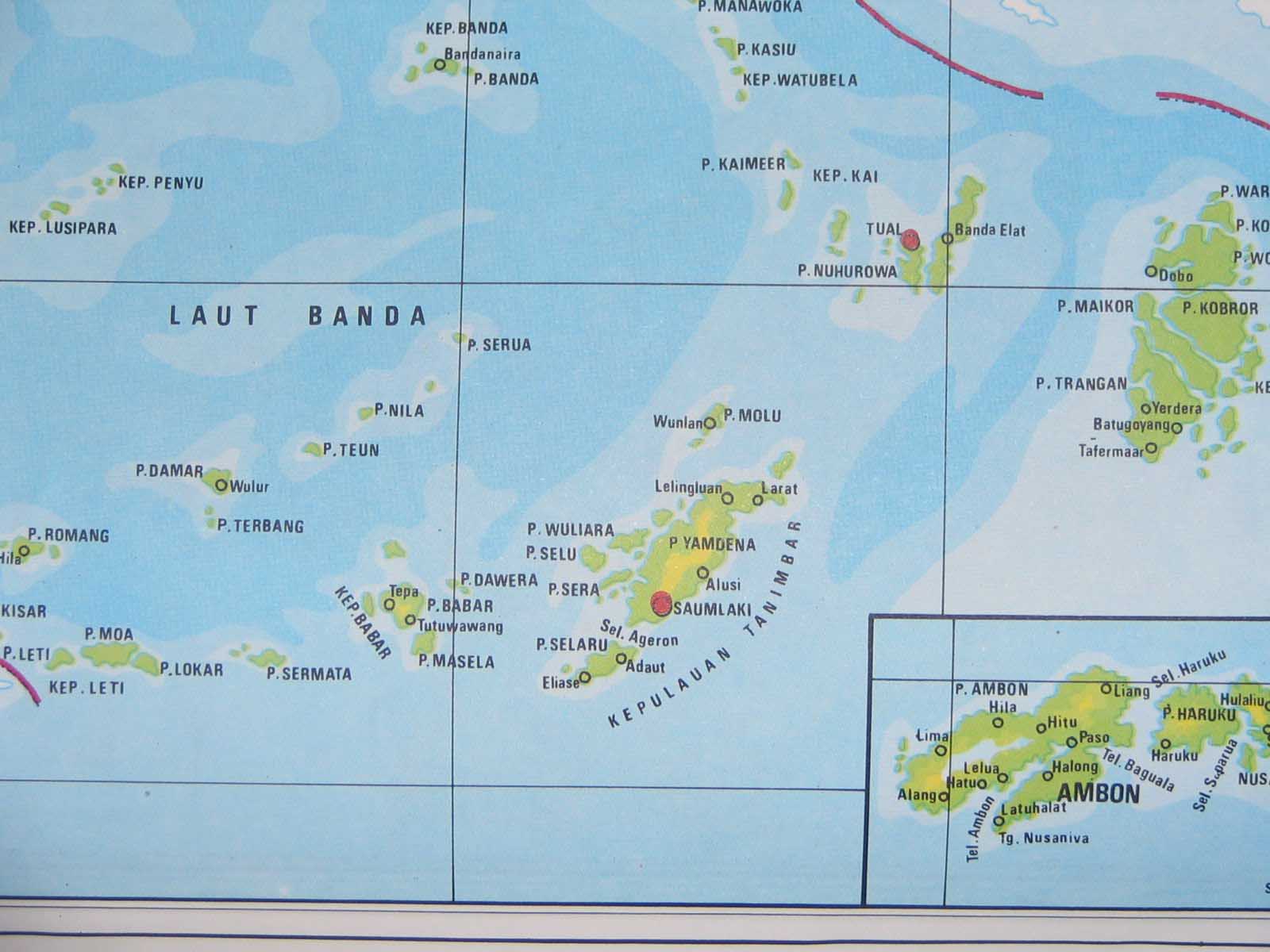
Kei islands is an archipelago, part
of South East Maluku distric, in the spice islands of Maluku. The district,
lies between 131º-135º east Longitudinal and 5º-7ºSouth Latitude. Kei islands
cover the Kei islands sub district, which consist of 101 islands where only 17
Kei islands sub are inhabitted; and Kei Besar islands sub district, consists of
110 islands where only 3 islands are inhabited. Tual, the capital of the South East
Maluku district, is also the capital of Kei kecil sub district. Tual is located
on Dullah, kei kecil (known locally as Nuhu Roa) and Fair islands, are
interconnected by two bridges, Watdek bridge and Fair bridge in Kei kecil
subdistrict. Elat, the capital of the Kei besar sub district is located on Kei
Besar islands. The main towns on Kei kecil and Dullah islands are, respectively
Langgur and Tual. Kei kecil islands are almost a low
land area and flat, with average altitude 115m above the sea level, white the
largests island, kei Besar island is mountainous along the island with 500-800m
of height and “Dab” as the highest peak. The
people of Kei islands, belong to Kei race, which is very tightly to their
tradition. Some villages in Kei besar islands is home to many original
Bandanese people, who fled the Banda islands during colonial times. ECONOMYBecause most of the south east maluku area is sea, the district has a huge of fishery and other maritime pruduct potency. It is the only major resource in the the Kei islands. Hundreds of motorized fish boats only go along the coast line. Large fish caught on the reefs and exported alive to singapore and hongkong have their status symbols served at Banquest or expensive restaurants. The fishery port in Ngadi, Dullah islands serve also export fishery vessels. The district and the people earn the most from the trade and export of fishery and other maritime products. Most of kei people on the little islands are very specialized in making their own traditional vessels, tecnically known as Prahu Kalulis, a light weight elegant sailing hull which they used for sailling to the main islands. The Kei Besar islands has also forest potency, but not so much as before when Alfred Wallace explored the Kei islands. Alfred Wallace, a naturalist first saw the Kei in 1856 from the deck of a large trading prahu in his explorer journey to the more remote Aru islands. Wallace is famous in the context of the “Wallace Line” named in his honour as the devising between the Fauna of Asia and Australia. When he entered kei besar islands, Wallace knew, that he was on the threshold of unknown territorry for any naturalist, where bo other collector had managed to get close look at the animals and plants of the islands. He wrote “I was in new world and could dream of the wonderfull production hidden in those rocky forest.” In 1996, the spice voyage was made to
ridescover wallace explorer usigng the same type of prahu would have been
available to wallace in 1856. they calculated that about one – third of kei
besar’ s forest cover, remained as it had been in walace’day. Mots of the
timber has been cut, but the old art of boat building is still carried on at
kei besar. Coconut dominated the people ‘s
plantation now, baside root plants which is most cassava, for local
consumption. The human settlements are located along the
coast ,so that most of the people live as fisherman and tradional dry land
farmers. The people along the coast still preserve their original forms of
customs, “sasi” especially to sustain the standing stock and quality of the
maritime products and protect the environment. If the stock reach a certain
size and volume, which is feasible to be harvested according to the related
regulation, then the people is allowed to harvest. Traditional fines are levied
when some one trespasses the “sasi”. The people’s staple food is “ambal” , cassava
dried cake, sold in a veriety of sahpes. The ambal is very popular, and one can
get nice cuisine and taste if the anbal is taken combined with a fish dish.
Because the islands are small coral islands, during the lowest tide called
“meti kei”, some islands could be linked together, and the people, most woman
and children seeking for hours, the sell fish for their consumption or dried to
be sold. The people of kei islands have several social
relationship, based on the genealogic, marriage relationship and on certain
agreement among the villages. Genearogic relationship rules among others is the
rule that the younger most obey the older ones in the family even the older in
their clan. The female family member is the honor symbol of the family, so that
if one of the female member is hurt, the male member will give prompt reaction
to protect their sister. It’s said, that a kei young man, will always protect
their land and the honor of his sister with their own life and prossessions.
Marriage relationship rules, is almost to set a culture oerder among the
families and even family members who become in relations due to the marriage,
while most of the relationship among the villages is to help one another in the
society especially in facing the difficulties. The kei people have their original form of
clans in their culture which are known as ursiw (nine clans), lorhim (five
clans) and lorlabay (the neutral clan). These three clans are based on lor as a
totality which is based on their customary law, larvul ngbal. Lavrul Ngabal has
very strong norms, which regulate the social relationship among, moral ethichs
and justice among the people in kei islands. Larvul means red blood and Ngabal
means spear. Any one who does contrary to Larvul Ngabal rule, will be level
according to his or her trespasses. In kei culture, the people is devided into
three stratas. The higest strata is Mel-mel (aristocrat), Ren-ren (midle
strate) and Iriri (the lowest strata). Mel-mel strata is devided into seven
levels. The first until third levels, of Mel-mel are believed to have the power
and capibility to become their tradition or customary leader. They are
diligent, honest, rich and brave. The forth until the seventh level are lower
then the first ones. Ren-ren is devided into three groups. The first, are the
land owners or those who have the power ro decide the land use, the second, who
have the responbility to conduct the cultural ceremony; and the third, who has
no role in the society. The lowest strata is Iriri who is actually subordinate
to the other two stratas, usually appointed as redemption to Mel-mel or
ren-ren. Ren-ren is actually also Mel-mel, but their capability is lower, not
like Mel-mel. Although Iriri is the lowest, the other two stratas have to
protect and to take care of them. The culture of Kei islands is very unique and
attractive to be studied by anthropologists. The sources of data from Maluku Provincial Tourism Office - Ambon
|
Copyright by Maluku_traveling 2005/2006 . All rights reserved.