



|
|
Maledpun Music ทางเลือกประสบการณ์ฟังเพลงคุณภาพ | ||||||
|
|
|
|
|||||
CD |
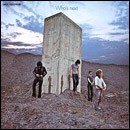
Who's Next The Who - 1971
|
||||||||
| อัลบั้มที่ใครฟังก็ต้องชอบ | |||||||||
| อัลบั้มแยกตามแนวดนตรี | |||||||||
| MP3 | |||||||||
| เพื่อนักดนตรี | |||||||||
| DVD & VCD | |||||||||
| คอนเสิร์ตและ MV คุณภาพ | |||||||||
The Who's Next, regardless of what you may have been led to believe to the contrary, is neither the soundtrack to the realization of Pete Townshend's apparently-aborted Hollywood dream, the greatest live album in the history of the universe, nor a, shudder, rock opera, but rather an old fashioned long-player containing intelligently-conceived, superbly-performed, brilliantly-produced, and sometimes even exciting rock and roll. Having said which, I will digress ... If, instead of a Heavy!-loving barbiturated kid who discovered in the wake of all the jumpin' and jivin' that accompanied the release of their last two albums that the Who resemble Led Zeppelin and so-on on a gross aural level and must therefore be far-out!, it's an age-long admirer of theirs you are, you'll doubtless have noticed that the Who's stage act, snazzy as it remains, has toned down subtly over the last couple of tours. Most noticeably, they've discarded the dazzling fop finery in which they first arrived on these shores for comfortable, functional clothing that's easier to rampage about in, And recently they've given the impression of consciously attempting to complement one another's physical presences, where in days past each strove with maniacal tenacity to focus the attention of every eye in the audience on himself alone-John Entwistle, for instance, has owned up that playing bass for the Who doesn't bore him nearly so much as it once did and that he's recently taken to pretending he's bored on account of he reckons it looks nicest with him standing very still. And, most important, Townshend, whose semi-psychotic need to brutalize his audience used to drive him to smash shit out of his guitar at the end of every performance, has abandoned that mutually liberating strategy in favor of safer and saner climaxes during which he improvises on the ax long enough to render even a speeder comatose. All those changes, it seems to me, derive from the group's perception of a need to demonstrate themselves Serious Artists instead of gimmick-mongering punks-to make themselves a little more accessible and a little less offensive. That same compulsion to selfvalidate that's left their stageshow a four-stone apology for what it once was has also led the Who to tidy up their records to the point where they're dangerously close to sterile. It's a monumental testament to their greatness, therefore, that a lot of Next, their first studio album since self-consciousness set in heavily in the wake of so many people decreeing Tommy a work of genius, transcends its calculatedness to emerge mostly exciting as well as awesomely admirable. It is to be borne in mind, of course, that a period during which they would concentrate on technique at the expense of the spontaneous expression of feelings was inevitable for the Who for a variety of reasons. First, they must surely have gotten good and sick of having people dismissing them with a fast fart for having some terrific gimmicks but only minimal musical competence. Moreover, Townshend has surely been drooling with anticipation of the day that he could produce his own stuff, considering what a perfectly dreadful job Shel Talmy and other early Who producers did. And also, with all sorts of people in recent years, from Led Zeppelin to Alice Cooper, exploiting stuff they learned from them, it was only natural that the Who should want to make a clearly-defined stylistic statement. They've taken care of all that business with Next. The musicianship is indisputably excellent, with Moon thrashing and bashing more precisely than ever before on record, Entwistle dreaming up all manner of scrumptious melodic and rhythmic flourishes (listen especially to what he plays beneath the chorus of "Won't Get Fooled Again"), and Townshend, be it with chunky acoustic rhythm, resounding monster chords of the classic sort, or cogent and lyrical soloes, playing with exemplary efficiency and taste. As for the album's production, Townshend has, with the able assistance of Glyn Johns in the dual role of engineer and co-producer, come up with one of the most masterfully-recorded rock records in recent memory. Whether so precise a sound as this record's becomes the Who is, at this point, less relevant than the consideration that they've now satisfied their curiosity about whether or not they could be recorded as crisply as, say, Thunderclap Newman. And with the long LP version of "Won't Get Fooled Again," an ingeniously - constructed panoramic view of methods of attack they've grown fondest of over the years, they've succeeded in committing to vinyl a comprehensive primer of basic Whostyle. Such dynamics! The beautiful quietly lyrical moments of such selections as "The Song Is Over," "Gettin' In Tune," and "Behind Blue Eyes" are juxtaposed with the thundering rock that is the marrow of those songs so that each is rendered even more poignant. To further frost the confection, Townshend wrings more than his money's worth out of his £14,000-worth of synthesizers, making, I daresay, shrewder at once more adventurous and better-integrated-use of them than any rock experimenter before him. In "Baba O'Riley," for instance, he sets the stage for the band's dramatic entrance with a prerecorded VCS3 part he obtained by programming certain of his vital statistics into a computer hooked up to the synthesizer, then treats the part as a drone while the song's two major chords are transposed over it, and later has the band playing against it (that is, piling a few gigantic chords on it while it keeps going "Meepmeep-meep-meep-meep ...") to lead into a solo by guest fiddler Dave Arbus. Next, on "Bargain," he uses his ARP both as a solo instrument and as a backdrop to his own beautiful guitar solo. There's just so much to be astonished and delighted by on this album once you get used to its kinda chilly perfection ... There's Roger Daltrey singing, "And I'm gonna 'chune' right in on you," during "Gettin' In Tune," which is so wondrous that it's enough to keep the listener's mind off the possibly unpleasant implications of "the straight and narrow" being what's been gotten in tune to. There's Daltrey bestowing an excellent dramatic reading (note especially his intonation of the world "vengeance") on interesting lyrics in front of the prettiest Who harmonies in ever so long in "Behind Blue Eyes." There's Imbecile's stupendously catchy and stupid "My Wife," which deals with the danger of being both married and fond of lazing about in the boozer until all hours. (What a pity that The Ox's pleasantly adenoidal voice is all but lost beneath the instruments "Can this be a result of jealousy on Townshend's part?" you'll long to know for sure.) And, ultimately, there is "The Song Is Over," one of a few survivors on Next from the recently-aborted Bobby project, an unutterably beautiful song in which Townshend sings exquisitely over a gentle piano background before and in between Daltrey charging in exhilaratingly over a hard part with breathtaking chord changes in the manner of the "Listening to you I hear the music ..." refrain from Tommy. Definitely up there with "Rael" and "Pinball Wizard" and "I'm The Face" among their very best work is this one. And, just to make it clear to any cretins out there in Radioland that this is just a plain old-fashioned long-player, there are a couple of throwaways: The faintly pretty but negligible "Love Ain't For Keeping" (which most certainly does not deserve to succeed "Heaven And Hell" as the group's stage-opener, unless they play it live about ten trillion times harder than they do on record), and the faintly inane "Goin' Mobile," which celebrates the joys of, ho hum, being free to roam the highways and byways in one's trailer. And there you have it, chums, an album that, despite a degree of sober calculatedness that would prove fatal to a lesser group, ranks right up there with David Bowie's and Black Oak Arkansas's and Crazy Horse's and Procol Harum's and Alice Cooper's and Christopher Milk's as among the most wondrous of 1971. In view of the fact that Pete's resumed smashing shit out of his guitar at the end of performances and that they've hopefully now resolved all their anxieties about technique, it's eminently reasonable to assume that subsequent Who albums won't be no shrinking violets either. 5/5 All Reviews It kicks off with the energetic "Baba O'Riley", which is simply about the concept of waste. It begins with an accelerated synthesizer melody until blaring piano chords join it. The drums soon follow, as well as Daltrey's vocals which sing "Out here in the fields, I fight for my meals, I get my back into the living. I don't need to fight, to prove I'm right, I don't need to be forgiven". Immediately you can see that this was one of the songs that was going to be used for the rock opera, but instead becomes one of the most recognizable and best tracks on this album full of classics. Also, it has a great violin solo at the end of the song played by Dave Arbus, which makes it a memorable and exciting track. Song number two is "Bargain", which is another syncopated power chord fueled rocker. Great drumming from Moon and powerful vocals from Daltrey combine for a strong overall impression on this song. This is followed by the acoustic "Love Ain't For Keeping", which contains fantastic guitar from Townshend. This is an all-round great song with good vocals, back-up vocals, and is a very well written song. This goes to "My Wife", which is written by bassist John Entwistle, who is known as the 'musician' in the band. He is the only member that knows anything about music theory and history, and it shows in the beautiful composition displayed here. This was the best song ever written by Entwistle, and contains a delicious brass hook. It's a highlight on an album full of highlights. This is followed by "The Song Is Over", a gentle piano ballad that features the piano skills of Nicky Hopkins. It is an anthem of sorts, with Daltrey singing "I sing my song to the wide open spaces, I sing my heart out to the end of the sea, I sing my visions to the sky on a mountain, I'll sing my song to the free". It's a song with lots of great individual musicianship, which can be heard in the drums, the guitar, the piano, and has some great bass that is more difficult to hear. This optimistic ballad is a brilliant song to end the first half of the album. The opener for the second half is "Gettin' In Tune", which starts out as another piano ballad with unusual lyrics, such as "I'm singin' this note 'cuz it fits in well with the chords I'm playin', I can't pretend there's any meaning here in the things I'm sayin, but I'm in tune". The song is beautiful satire because it dissects what the belief of a song should be while sounding heartfelt. This is followed by the acoustic "Goin' Mobile", which is one of the many songs from this album that can be (and are) used in car commercials. It's a great song with a well done wahwah guitar solo and pounding drums. It also includes some unexpected but not unwelcome synthesizer accompaniment, and, on a personal note, I love when Daltrey screams "whip woo!". The next song is the amazing "Behind Blue Eyes", which is another highlight on an album full of highlights. This is one of my favourite all-time pieces of music, and it has incredible acoustic guitar from Townshend and great bass accompaniment by Entwistle. Two and a half minutes in, the song erupts with drums and electric guitar in one of the best moments on the whole album. A brilliant song by Townshend which is second in quality only to the closer. Simply put, "Won't Get Fooled Again" is eight minutes of bliss. It begins with a strange synthesizer loop played by Townshend, who was big into electronic experimentation at the time. It is another Who anthem, with opening lyrics "We'll be marching in the street, with our children at our feet, and the morals that we worship will be gone". The main verse is similar, with such memorable lyrics such as "I tip my hat to the new constitution, take a bow for the new revolution, smile and wave at the change all around, pick up a guitar and play, just like yesterday, then I get on my knees and pray, we won't get fooled again". Great vocals deliver these lines, and this song is probably the crowning achievement in Keith Moon's drumming career. It's very syncopated, complex, and unpredictable, but never feels at any time out of place or intrusive. Townshend's crushing power chords and Entwistle's bass rock this song, which throughout all eight minutes never seems boring at all. It is full of energy and power, and features some great little guitar solos from Townshend. There is even a break from all the instruments except the synthesizer about six and a half minutes in, until Moon's drums enter and is followed by the rest of the instruments to end the song in a dramatic fashion. It is a brilliant song to finish off a brilliant album. This album is the Who's magnum opus, and after making such a pinnacle of rock 'n roll, they eventually tumbled into mediocrity because of over-experimentation with synthesizers and loss of focus. Few remember the Who like that though, because most like to visualize them at their absolute best. This was the Who's best album, it contained three of their finest hit songs ("Baba O'Riley", "Behind Blue Eyes", and "Won't Get Fooled Again"), and is the Who at the peak of their career. It is a flawless album, which rocks harder than any Who album previously released, but also has a soft side that is equally as powerful as the explosive guitars and amazing drums. It is the Who at their finest, and no album collection is complete without it. The Who were the first real old rock group that I was able to get into. My father was very enthusiastic about their Amazon Barnes & Noble Q Salon By that order of deduction, I reasoned that most of the music on the radio in 1982 -- at least the music that my 9-volt, battery-powered radio could pick up from the faraway radio signals of Chicago -- sucked. For every decent "Jack and Diane" there were many "Up Where We Belongs," for every OK "Tainted Love" there were 10 maudlin "Open Arms," for every J. Geils Band there were 15 Quarterflashes. But hold that top-30 ditty. I was about to discover the bloody Who, a band whose members fought constantly, it seemed, onstage and offstage, and whose music vacillated between banal teenage angst and sophisticated adult angst. And the album I was on the verge of discovering, by way of public library checkouts and worn, borrowed eight-tracks, was "Who's Next," released more than a decade earlier, in 1971. It's an album that should have been a failure on many levels. On song after song, it blatantly mutes, deletes or ignores the Who's most combustible musical qualities and replaces them with elements that seem superfluous, or even grievously mistaken. Yet because of this album-long, stereotype-defying, musical running of red lights, "Who's Next" has remained a brain-blowing masterpiece of sonic joy. One afternoon following an after-school band practice, the radio in my parents' sky-blue Ford LTD picked up that haunting synthesizer break toward the end of "Won't Get Fooled Again." Suddenly that synth pulse was broken up by a furious drum break that hiccuped to a halt and started right back up again. Then a scream that sounded like Satan on the rack, followed by menacing guitar chords and an epigram -- "Meet the new boss/ Same as the old boss" -- that I would hear repeated in some manner every day the rest of my life. Finally, six heavy downbeats signaled the end of the song -- no pussified fade-outs here.
Twenty years later I am still unable to look at any of the band's work objectively, particularly the record that contains "Won't Get Fooled Again." That record is of course "Who's Next," which, at least on paper, looks like it should have been a total dud. Before the final copy had even been pressed, the album had nearly destroyed its creator. Initially, the songs on "Who's Next" were part of a grandiose science-fiction film/concert concept called "Lifehouse" that even Who guitarist/songwriter/idea man Pete Townshend could barely grasp (although he has since resurrected it). After that bigger, ambitious project fell apart, Townshend suffered a nervous breakdown and a regular old album was patched together so the band could salvage whatever it could from the "Lifehouse" failure. In fact, the tracks that were left off the album -- "Pure and Easy," "Naked Eye," "Join Together," "Water" and others that have surfaced on compilations and CD reissues since -- could have made up a great, completely different Who album on their own. As it stands, however, the nine songs that make up the initial "Who's Next" present the same contradictions and masterly ensemble work that made the Who so fucking great to begin with. From beginning to end, "Who's Next" showcases Townshend's fascination with the synthesizer, an instrument that really had no business being embraced by the Who. Months earlier the band had released "Live at Leeds," a roaring, soaring, daredevil guide to improvisational ensemble playing if ever there was one. The 13-minute rendition of "My Generation" the Who pulls off on "Leeds" is so wild it needs a traffic cop. A synthesizer on "Leeds" would sound like Britney Spears auditioning for Metallica. Yet Townshend's mastery of the primitive ARP synth -- at the time more complicated than a NASA launch and bigger than most London neighborhoods -- added a spectral presence to the band, and on this album it really became a fifth member. On "The Song Is Over," the synth adds a lush, orchestral-yet-funky feel to the stew. On "Bargain," it brings a deified presence to a song that's really a prayer. And on "Won't Get Fooled Again," the synth's meter brings a precise rhythm track that allows the rest of the band -- especially bassist John Entwistle, who was usually the group's de facto percussionist behind Keith Moon's maniacal drumwork -- to play wildly around it without fear of getting lost. Ink Blot Magazine Though Who's Next is mostly hard-hitting, driven rock 'n' roll, there's something a little different about each song, which gives every song on the album more power. The music and the lyrics combine to create an incredible musical effort. It opens with the fabulous single "Baba O'Riley," which starts with an unusual electronic intro before launching into Roger Daltrey's powerful vocals and ending with a long and fast violin run. This is immediately followed by "Bargain," which starts with ten seconds of ballad-sounding slow guitar before becoming pure rip-it-up rock. The inspirational "The Song is Over" features primary songwriter Pete Townshend singing half the song in ballad style and Daltrey completing it with power rock. "Behind Blue Eyes," quite possibly one of the best songs ever written, is melancholy in its opening before launching into some of the most uncompromising rock I've ever heard with Daltrey singing passionate lyrics like: "...if I swallow anything evil, put your finger down my throat." And, of course, Who's Next features one of the band's signature songs, "Won't Get Fooled Again," which remained their closing song for every show they subsequently played. The 1995 MCA re-release of this album contains a number of bonus tracks, mostly music recorded for the Lifehouse project and released either as b-sides or in compilations, or exclusively performed live. All excellent songs that fit in just fine on this album, they are well worth a listen. Every song on this album is a masterpiece of its own. Whether the concept of Lifehouse would have resulted in a whole that was even better, I don't know, but given the to-die-for result that is Who's Next, this listener is glad they pissed on that monolith. |
http://www.geocities.com/maledpunmusic/
Updated October 2004