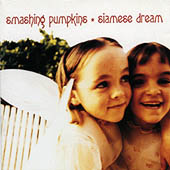
1. Cherub Rock
2. Quiet
3. Today
4. Hummer
5. Rocket
6. Disarm
7. Soma
8. Geek U.S.A.
9. Mayonaise
10. Spaceboy
11. Silverfuck
12. Sweet Sweet
13. Luna
amazon
An introductory drum roll drops out and is replaced by a single suspended electric guitar, which is then paralleled by a snare, filled in with the bass, and--crash!--"Cherub Rock," the opening track, is enveloped in an explosion of metal guitar. So the journey begins. This album is pre-experimentation vintage Pumpkins. Produced by Butch Vig (Garbage, Sonic Youth, Nirvana's Nevermind), Siamese Dream is first about guitars. Lots and lots of guitars. A very close second is Jimmy Chamberlain's unquestionably excellent power drumming. Throughout each song, Billy Corgan delivers angsty lyrics in his signature breathy whine. "Disarm" is a nice intermission halfway though the album. As the title of the song suggests, it throws the listener into a different mood with its full string arrangements and radiant orchestral chimes. But then it is back to the aural masochism--a pain that rarely sounds so sweet.
adrian denning
The sound is much improved for the second Pumpkins album, with better separation of the instruments. The overall feel of 'Siamese Dream' is softer than 'Gish' with a song like 'Today' coming across as a pop song. A beautiful vocal, a truly lovely vocal and the song that got me interested in the Smashing Pumpkins all over again after 'Gish' had proved less than welcoming for me. The singles 'Today' and 'Cherub Rock' are both strong songs, well structured and both share a warm melodic sound. 'Quiet' is a fairly generic Pumpkins rocker with only that improved production and mixing distinguishing this from an average 'Gish' song. The near seven minute long 'Hummer' rides along on strong bass melodies and shockingly, isn't at all boring for a single one of its minutes or seconds. Shockingly? It's just a regular mid-tempo Smashing Pumpkins song, not obviously better than before, but it sure sounds better - and that's half the battle won for me. 'Rocket' has a nice 'throb' about it, 'Disarm' features plenty of acoustic guitar, occasional cello and is a very nice pretty song. Maybe you don't want your Smashing Pumpkins to be pretty? Well, if they do 'pretty' better than they 'do' Grunge or Hard Rock, then maybe that's the way to go? Whatever, for those who want rockier Pumpkins, 'Soma' provides it well across its closing sequence, other songs provide it in places too but usually mixed in with the softer music and melodies that 'Siamese Dream' provides. A few too many mid-tempo songs are here through the albums second half, although 'Siamese Dream' still works and these are well written songs. If this review sounds like 'Siamese Dream' is too soft for your liking, maybe you'll prefer one of their other albums. But whilst we're here, let's not forget 'Cherub Rock', which I mentioned right at the start of this review. Great drums, good riffs - good Rock music. Let's not forget the thrash and wild playing ( although playing 'with chops' ) of the more than decent and hard hitting 'Geek USA'. 'Siamese Dream'? It's a keeper. 7.5/10
all music guide
While Gish had placed Smashing Pumpkins on the "most promising artist" list for many, troubles were threatening to break the band apart. Singer/guitarist/leader Billy Corgan was battling a severe case of writer's block and was in a deep state of depression brought on by a relationship in turmoil; drummer Jimmy Chamberlin was addicted to hard drugs; and bassist D'Arcy and guitarist James Iha severed their romantic relationship. The sessions for their sophomore effort, Siamese Dream, were wrought with friction — Corgan eventually played almost all the instruments himself (except for percussion). Some say strife and tension produces the best music, and it certainly helped make Siamese Dream one of the finest alt-rock albums of all time. Instead of following Nirvana's punk rock route, Siamese Dream went in the opposite direction — guitar solos galore, layered walls of sound courtesy of the album's producers (Butch Vig and Corgan), extended compositions that bordered on prog rock, plus often reflective and heartfelt lyrics. The four tracks that were selected as singles became alternative radio standards — the anthems "Cherub Rock," "Today," and "Rocket," plus the symphonic ballad "Disarm" — but as a whole, Siamese Dream proved to be an incredibly consistent album. Such underrated compositions as the red-hot rockers "Quiet" and "Geek U.S.A." were standouts, as were the epics "Hummer," "Soma," and "Silverfuck," plus the soothing sounds of "Mayonaise," "Spaceboy," and "Luna." After the difficult recording sessions, Corgan stated publicly that if Siamese Dream didn't achieve breakthrough success, he would end the band. He didn't have to worry for long — the album debuted in the Billboard Top Ten and sold more than four million copies in three years. Siamese Dream stands alongside Nevermind and Superunknown as one of the decade's finest (and most influential) rock albums.
Q
Unfairly lumped in with the grunge also-rans, Chicago's Smashing Pumpkins never quite broke through with their debut, Gish. It was seemingly too complex for pop and too slick for grunge while obviously aspiring to both. They were the sort of band nobody seemed able to quite place, let alone care about. Nonetheless, Gish displayed an admirable musical openness, which meant that just as they threatened to turn into Big Black, along came the sort of harmonies Crosby, Stills, Nash and even Young might have cherished. Their live shows were excellent too and, almost stealthily, Smashing Pumpkins began making the right sort of impression. For Gish's follow-up, they've roped in Nevermind's Butch Vig and tidier-up of hopeless indie acts, Alan Moulder, to produce and engineer a more assured, focused album, destined it would seem, to fulfil previously glimpsed potential. There's a metallic, progressive element here. Subtract the keyboards from Emerson, Lake & Palmer's Tarkus, add enough dirty, infectious grunge to disguise that retro aspect and maybe Smashing Pumpkins aren't that difficult to pin down. Their success derives from the eyebrow-raising ability to thrill. Siamese Dream is something of a white-knuckle, rollercoaster ride, leavened by moments of sometimes quite staggering beauty. Highlights are many: Disarm is the sweetest cut of all, with a rolling motif of isolation peeking through. The ironic Cherub Rock is straight out of the Dinosaur Jr book of riffy whining, but there's a crispness and a killer instinct J Mascis would instinctively shy away from. Suma dawdles over a lost love, almost movingly despite the ever-present inkling that Billy Corgan's tongue is more likely to be in his own cheek than someone else's. Silverfuck's eight minutes aren't wasted: Corgan's clear and mock-plaintive, feminine singing, plays against James Iha's butch guitars like a couple of frolicking foals against a backdrop one part Alice In Chains, one part White Plains. Their only weakness is typical for such a musically complex group. As if they'd skipped a lesson in songwriting classes, they lack the knack that Mick Hucknall or Pete Waterman have in roughly equal doses with Kurt Cobain or Axl Rose of penning a tune that's memorable over the distance. Smashing Pumpkins sound terrific, their songs are multi-hooked and not once do they sacrifice melody for bluster. Yet, deep down, Siamese Dream is virtually impossible to sing along to. Just like Dark Side Of The Moon was. Still, Smashing Pumpkins are so exciting, it's patently obvious they're a (if not the) Next Big Thing. This is big music indeed; fine music, certainly 4/5
rolling stone
With Butch Vig co-producing, Siamese Dream is guitars and more guitars -- streamlined or sludgy and often aping such dinosaurs as Boston and Queen, stacked in sonic layers. Seattle's gunslingers and the Lollapalooza vibe made the waters safe again for six-string assault, and Chicago's Smashing Pumpkins benefit from the buzz. But little of grunge or primitivism adheres to this foursome.
Successor to Gish, their blockbuster indie debut, this 13-song collection asserts mainman Billy Corgan's fondness for the thick tone and hot chops beloved of postmetal '70s-crazed players. But as he hauls out the Mellotron and strings, he reveals a thirst for the epic, melodic gesture that's often closer in spirit to the Moody Blues than the Stooges. Juxtaposing whisper-thin vocals against his own and the second guitarist James Iha's instrumental blitz is a neat pop maneuver, too. With lyrics about dysfunctional love and "that little child inside of me," Corgan works both the hard and soft sides of blank-generation concerns. Ruthless virtuosos and studio ghouls (it took five months to make Dream), the Pumpkins seem committed to an intriguingly perverse crusade: to prove that less is never more. (RS 672-673) 4.5/5
nude as the news
In 1993, the Smashing Pumpkins dropped a bomb called Siamese Dream on the alternative rock world. The follow-up to the group's acclaimed debut, Gish, Siamese Dream catapulted the group into superstardom, solidifying their status as rock gods. Taking the piercing, visceral energy of Gish and tempering it with an even more acute production effort from Butch Vig, Siamese Dream stands as one of the most complete and fully realized rock albums of the 1990s.
Siamese Dream didn't come easy, though. In fact, mainman Billy Corgan's iron-fisted rulership over the recording and arranging of the album threatened its very completion on a number of occasions. It is even rumored that he erased the tracks laid down by guitarist James Iha and bassist D'arcy Wretzky so that he could play them himself -- to his satisfaction.
And although the precise drum rolls from Jimmy Chamberlin's kit begin the album, and "Cherub Rock," with subtlety, within seconds, a tightly orchestrated barrage of layered guitars comes crashing in, quickly establishing the agenda: world domination by way of guitar. Things get even harder on "Quiet" and "Geek U.S.A.," where amphetamine-addled drum hits pummel the listener into submission. Yet, Corgan shows his knack for contrast, off-setting these bottom-heavy rockers with the shimmering "Today", the fuzzy/crunchy "Rocket," and the string enhanced "Disarm," which became a massive radio hit.
The album really begins to take shape though, with the longer, more complex songs. After three concise rockers, "Hummer" finally shows Corgan opening up his songs and letting them breathe. The track begins with a mixture of sampled static and looped sitar, segueing into a clean E-bow solo that feels like a sine-wave of red, sonic light. After the main, soft-to-loud structured portion of the song concludes, the track descends into a guitar lullaby atop a jazzy backbeat.
The effect of these transitions is amazing, one minute Corgan is using his guitar to scream his angst to the world, and the next he's using it to softly sing you to sleep. The epic "Silverfuck" pushes the envelope further. Beginning with a frenzied guitar explosion, the noise soon drops out completely, leaving the listener to swirl in the ambient rumblings of D'arcy's bass. Just when the song appears to drift to a conclusion, Corgan chants the lines "Bang, bang, you're dead / Hole in your head" with the aid of some spooky tape manipulation, and the song screams back into the thrashing groove from minutes previous.
Lyrically, Siamese Dream shows Corgan to be a powerful -- albeit somewhat repetitive -- songwriter, in which angst overflows like hot coffee. While Corgan's musings can be grating at times ("Disarm" being a prime example), the tone is never gloomy enough to marr the album's overall beauty. On tracks like "Mayonnaise", the lyrical pleas compliment the music perfectly. When Corgan screams, "Can anybody hear me / I just want to be me" during the climax of the song, you just want to scream back, "Hell yeah, I can hear you. Preach on!"
While the Pumpkins' music took an ugly shift toward pomposity and derivative '80s pop on subsequent efforts, Siamese Dream still stands with Gish as two of the most powerful rock albums of the '90s. Perhaps someday, Corgan will throw in the goth-pop towel and "return to form." Until then, find yourself a copy of Siamese Dream and rock out.
|