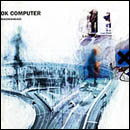
1. Airbag
2. Paranoid Android
3. Subterranean Homesick Alien
4. Exit Music (For A Film)
5. Let Down
6. Karma Police
7. Fitter Happier
8. Electioneering
9. Climbing Up The Walls
10. No Surprises
11. Lucky
12. Touristthe
Barnes & Noble
The creative leap Radiohead made between its first album, 1993's Pablo
Honey, and its second, 1995's The Bends, was both unexpected and
expansive, effectively unburdening the group from the one-hit-wonder
status they'd lugged around since the success of their gimmicky debut
single, "Creep." But if The Bends garnered the English quintet some
much-needed artistic credibility, the astonishing emotional and
compositional complexity of 1997's OK Computer catapulted the group into
the realm of idolatry. Essentially a post-Orwellian meditation on the
debilitating clutter of modern life and the desire to escape from it, OK
Computer is art-rock at its most rewarding and contradictory -- subtly
layered but startlingly bombastic, melancholic but beautifully serene,
fractured and chaotic but completely sure of its own sonic ambition. With
Thom Yorke's cracked yowl as its center, the album takes countless
schizophrenic twists and turns -- from the multi-segmented anxiety opera
"Paranoid Android" to the bleak, languorous despair of "Exit Music (for a
Film)" -- all the while maintaining its sense of dark, slowly unfolding
drama. Figure in waves of disorienting guitar effects, barely there
rhythmic undercurrents, and eerie, ambient washes, and you've got one of
the few rock masterpieces of the '90s. Colin Helms
All Music Guide
Using the textured soundscapes of The Bends as a launching pad, Radiohead
delivered another startlingly accomplished set of modern guitar rock with
OK Computer. The anthemic guitar heroics present on Pablo Honey and even
The Bends are nowhere to be heard here. Radiohead have stripped away many
of the obvious elements of guitar rock, creating music that is subtle and
textured, yet still has the feeling of rock & roll. Even at its most
adventurous -- such as the complex, multi-segmented "Paranoid Android" --
the band is tight, melodic, and muscular, and Thom Yorke's voice
effortlessly shifts from a sweet falsetto to vicious snarls. It's a
thoroughly astonishing demonstration of musical virtuosity, and becomes
even impressive with repeated listens, which reveal subtleties like
electronica rhythms, eerie keyboards, odd time signatures, and complex
syncopations. Yet all of this would simply be showmanship if the songs
weren't strong in themselves, and OK Computer is filled with moody
masterpieces, from the shimmering "Subterranean Homesick Alien" and the
sighing "Karma Police" to the gothic crawl of "Exit Music (For a Film)."
OK Computer is the album that establishes Radiohead as one of the most
inventive and rewarding guitar-rock bands of the '90s. Stephen Thomas
Erlewine
-Taylor Parkes
Melody Maker
14.06.97
I'VE had so many arguments about millennarianism these last few
years, I'll be glad when the millennium finally f***s off, even if the Third
Antichrist does rain down his terror from the East, aliens come and eat us and
Jesus Christ Almighty turns up on Holloway Road wearing knuckledusters and
murder in his eye. You know what I mean? It's hard enough just to get through
the days.
But it only really struck me relatively recently just how it all works, this
vague unease, this unspecified sense of pressure and awful, muggy millencholia.
I was thinking about the propagation of millennial angst by the media in general
and Channel 4 in particular, and I realised: like everything else, it's not
"reflected" by the media, it lives in the media - a goodly part of this global
angst has actually been imprinted on our subconscious by TV, the internet, by
electronic communication itself - but maybe it stems in part from a dim
awareness of the process itself, the creation of real fear by an external,
inhuman influence. The realisation we've been invaded this deeply by strangers
and machines; a hint of a future far worse than any possible clean-kill
apocalypse. A perfectly good reason to feel frightened.
See, I was thinking of that BT advert, with the little girl gazing puzzled at
aeroplanes and tea-time commuters and putting on that confused child's whimper
that, as far as advertising exectutives are concerned, immediately implies the
eternal wisdom loose in an immature mind: "Why do people work in big offices so
far from where they live?". The inference being that, once we've all abandoned
the outmoded tribulations of business meetings and travelling abroad for work,
handing over the effort to modems and email and video conferences and
ultimately, a virtual workplace, we'll all spend a lot more time out in the
fields with our families, the lead to an Irish setter in one hand, the other
holding a kite. A triumph for communications: a world in which nobody ever has
to meet anybody else.
And I thought of "Fitter Happier" from the new Radiohead LP, an incredible
piece, perhaps because of the obviousness of approach. A computerised voice
intones an artless, inarticulate litany of modern-living buzz-prases ("FITTER
HAPPIER MORE PRODUCTIVE COMFORTABLE GETTING ON BETTER WITH ASSOCIATE EMPLOYEE
CONTEMPORARIES AT EASE EATING WELL A PATIENT BETTER DRIVER KEEP IN CONTACT WITH
OLD FRIENDS ENJOY A DRINK NOW AND THEN") across the kind of tragic, piano piece
more commonly heard on wartime documentaries over black and white film of
smashed cities and Flanders mud. Finally, bars of white noise cut across and the
music trails away, leaving the metal voice unaccompanied: "NO LONGER EMPTY AND
FRANTIC LIKE A CAT TIED TO A STICK DRIVEN INTO FROZEN WINTER SHIT. THE ABILITY
TO LAUGH AT WEAKNESS. CALM. FITTER HEALTHIER MORE PRODUCTIVE. A PIG IN A CAGE ON
ANTIBIOTICS."
And I was thinking: maybe in the Nineties, tortured rock stars are a little
easier to emphasise with, because the times have lent us, the audience, that
requisite sense of isolation and unfocussed alienation.
I was thinking about Thom Yorke, a man who gives the impression he gets paranoid
watching "Wanted", not sleeping on a Sunday night for the realisation of how
exposed we all are, how easy we are to find. If the unstable, quick-slow
existence of pop stardom offers Thom both the free time and the necessary stress
and disorientation to think in terms as absurdly anxious as "Climbing Up The
Walls" ("I am the pick in the ice...we are friends till we die/Do not cry or hit
the panic button/You'll get the loneliest feeling that either way you turn I'll
be there"), maybe half of us though our sense of inertia and unspecified angst
have an idea of what he's talking about. When the vocals dissolve into a distant
storm of rabid, distorted screams, it's not the snortings and foot-stampings of
a petulant ingrate, rather a snippet of that same rage that drives us into lousy
self-mollification or else off the hinge. A very modern terror, an unreachable
itch.
On these terms, it's even possible to overlook the vague sliminess of sound of
OK Computer; the way some of these arrangements are so fucking overblown it
beggars belief, that horrid Nineties airlessness about the production - in
context, they only serve to heighten the sense of being stranded amongst pixels.
Specifically on "Airbag", a tale of death narrowly avoided, inspired by car
commercials, where an awful U2-like backing track is sufficiently subverted by
Thom's uneasy croon to sound positively pertinent. It sounds like a car
commercial, charged with vague psychosis, as if Yorke's already been absorbed
into the oppressive banality of modern living and can only scream out from the
inside.
If The Bends tended towards the pleasingly maudlin, OK Computer takes it all
head on. Mostly, it's crimson music, as grotesque and claustrophobic as those
videos of internal organs filmed by a camera in a pipe shoved up inside the
body. Purely as rock, in terms of composition and performance, it's very
impressive. That's not the point. It doesn't sound like a rock record, it sounds
like a facsimile of unwanted feelings on wet weekday afternoons, or in the
middle of the night. I can't think of any time I'd ever want to listen to it. I
can imagine a time when I might feel as though I needed to listen to it. "Exit
Music", which could possibly document a double suicide, builds to a climax as
dense and choking as carbon monoxide. "Let Down" details the crushing of an
insect and sounds like hell. "Paranoid Android", the interminable single, is the
weak point - much of the rest of OK Computer is far more concise and clear, and
all the more unsettling for it. It sounds like gristle, "the crackle of pig
skin", steady and sickly, molten guitars and abject horror. It's unlike anything
I've ever heard before, but has none of the vivacity that generally accompanies
originality (even audible on The Holy Bible). It's as pained and as slow-moving
as the emotions that inspired it. I can't work out whether I like it, although I
think I like it very much indeed. I definitely know it isn't good for me, and
I'm certain it says more about my life than I'd like.
In one way or another, Radiohead have excelled themselves. They've seen the
future. It is murder. Who's going to join them there?
NME
LOOK OUTSIDE and you'll see it. A typical view: cars in the street, wires
overhead and, somewhere above, the distant trails of an already departed plane.
Step away from the window and there's more of the same: a video recording, a TV
screen full of flickering images and a newspaper plastered with remote news. You
sip a glass of water, but even that tastes of chalk and chlorine. There's no way
to clear your vision. Ever felt that you needed to escape from it all?
Oxfordshire 1996, and Radiohead finally begin to record the follow-up to 'The
Bends'. Thom Yorke's brain is accelerating. The aforementioned view amplified by
the conditions in which he's working. Recording at night, he goes to bed at dawn
and wakes at ten to continue the lyrics. His state of mind is sleepless and
fractured. Nerve endings are frayed and the atmosphere is intense. When 'OK
Computer' is finished, Yorke describes the 12 completed songs as "Polaroids in
my head", a succession of snapshots that form a larger whole. Away from
distractions and shrouded in secrecy, Radiohead have created an album motivated
and unified by one overriding theme: three years away from the millennium, Yorke
wants to leave the planet and escape from the routine and clutter of life. Not
that Radiohead have chosen to follow a 1.5 million-selling record with a concept
album; at least, not consciously. It's just that virtually every track on 'OK
Computer' is driven by a feeling of impotence with the world around it. You can
gaze out of your window, flick on a TV or read a newspaper, but unless your
power matches that of a fictional superhero or a multinational corporation
there's no way you can alter your surroundings. The world speeds around on an
axis of its own, and there's nothing you can do about it. And it's that
realisation which makes 'OK Computer' both age-defining and one of the most
startling albums ever made. Here are 12 tracks crammed with towering lyrical
ambition and musical exploration; that refuse to retread the successful formulas
of before and instead opt for innovation and surprise; and that vividly
articulate both the dreams and anxieties of one man without ever considering
sacrifice or surrender. In short, here is a landmark record of the 1990s, and
one that deserves your attention more than any other released this year. What
makes it so important is its context. After all, 'The Bends' elevated Radiohead
into the sphere of stadiums. When they eventually tour Britain later this year,
you will be watching them in the largest venues in the country. The transition,
however, has been made with the soul of the band kept intact. Any temptation to
follow U2 - and equate an increase in audience size with the necessity to
generalise emotions and pontificate witlessly - has thankfully been avoided. The
conscious decision with 'OK Computer' is to stretch rather than stagnate
imaginations, both the band's and their audience's. Because, while Thom was
dreaming daily of planetary escape, the rest of the group were fashioning alien
sounds from earthly instruments. In much the same way as Spiritualized's Jason
Pierce became obsessed with new sound when recording 'Ladies And Gentlemen We
Are Floating In Space', so it seems did Radiohead. Jonny Greenwood, in
particular, admits he became bored with the sound of his guitar, and
subsequently what the listener is treated to is a myriad of distorted effects,
disguised echoes and electronic refuse. Of course, the first single - 'Paranoid
Android' - was designed to prepare you for that: six minutes of disconcerting
sound and lyrical distress, half of which is dominated by freakish guitar spasms
and jolting time changes, half by neo-classical choirs and calming acoustics.
Surely one of the only comeback singles ever to summon up images of cascading
snowfalls and the Napoleonic retreat from Moscow? And certainly one of the most
bizarre songs ever to find its way into the British Top Five. Still, as far as
Radiohead are concerned that's just the beginning... The album itself opens with
the slashed riff and sucking electronics of 'Airbag', a song that at once sets
the scene for all that's to follow. Yorke's ambivalence towards modern
technology (that's also present in thealbum title) and supernatural insistence
that he's "back to save the universe" are both made immediately apparent. Any
hope such a feat might actually be possible, however, is quickly extinguished by
the realities of the rest of Side One. There are simply too many obstacles in
the way. Not that the album immediately descends into hopelessness and morbid
introspection because, while avenues of earthly escape are explored and
ultimately rejected, there remains throughout a tangible sense of purpose and
uplifting sentiment. Once you've negotiated the real dissatisfaction of
'Paranoid Android' (a possible hymn to the vagaries of music journalism: "When I
am king you will be first against the wall / With your opinions which are of no
consequence at all"), what unfolds is a curiously positive experience. The
lyrics of 'Subterranean Homesick Alien' might crave abduction from this planet
and a chance to see the world from outer space ("Take me on board... / Show me
the world as I'd love to see it") and 'Let Down' might recount the feeling of
being "crushed like a beetle" under "motorways and tramlines" but at no point
does he feel dispiriting or self-pitying. It's just a snapshot of the external
world, a view from the window. It's the moment when cynical sentiment meets
beautiful sound. If anything it's a feeling of detachment, as if Thom Yorke
really is an observer from another galaxy rather than a neurotic resident of
Oxford. And that's the contrast that's present in almost every track. As the
world speeds by ever faster, Radiohead have attempted to retreat to calmer
climes to voice their concern. 'Subterranean Homesick Alien', 'Exit Music' and
'Let Down' are all apparently peaceful: guitars materialise then fade, blissful
hidden melodies drift by unnoticed, and previously still songs are suddenly
given momentum by a change of the tide. Listen closer, however, and you will
just about be able to distinguish the sounds of daily existence: of playground
babbling and overloaded electrics, of surface noice and indistinguishable
drones. The reality, as Yorke finally realises on 'Fitter Happier', is that
there is "no chance to escape". You just have to accept it. Occasionally,
however, that proves impossible. After the fading noise of 'Karma Police', Side
Two opens with a spate of ill-natured cacophony and dehumanised cynicism.
'Fitter Happier' sees Yorke wiring himself up to a synthesized voice machine and
delivering a series of increasingly curious lifestyle slogans, while
'Electioneering' buries his rage at the power of multinationals under an
avalanche of uncomfortable guitar noise. It's the last (and perhaps only) moment
of fight, and it's from here that 'OK Computer' soars towards its climax. The
claustrophobia of 'Climbing Up The Walls' is rapidly replaced by a trio of songs
that equal - if not surpass - 'Street Spirit (Fade Out)'s beatific conclusion to
'The Bends'. Here the band truly dazzle. 'No Surprises' (billed as the band's
attempt to rewrite 'What A Wonderful World') marries the resignation of Yorke's
lyrics ("A job that slowly kills you / Bruises that won't heal... I'll take a
quiet life") to a spacious wall of melancholy and bright xylophone chimes, while
'Lucky' - previously released on the 'War Child' compilation - brings the
conclusion nearer with the continuous surge of Pink Floyd-esque slow-motion
guitars. The album ends with the sound of Thom Yorke's brain decelerating.
Buried within 'The Tourist's monastic chanting and stately guitars, you can just
about make out his voice (as grief-ridden and emotive as ever) trying to make
sense of what's happening to him: "Where the hell am I going? / At 1000ft per
second / Hey man slow down / Idiot slow down". It's the final, futile attempt to
alter the progress of his - or indeed anyone else's - life and it's perfect
finale. In the space of under an hour, Thom Yorke has reached the same
conclusion a dozen times about the need (and ultimate impossibility) of an
escape from this life and this planet. The end result, though, is not one of
despair but of acceptance. Love, work, sleep and politics have all failed - and
all you can do is accept it. Such stoicism renders 'OK Computer' a spectacular
success: a true articulation of the anxiety of late-20th century man backed with
music not only of extraordinary grace and melody, but also of experimental
clarity and vision. Truly, this is one of the greatest albums of living memory -
and the one that distances Radiohead from their peers by an interstellar mile.
Escape might be impossible, the amount of information to take in daunting, but
take a step back and have another look at life. This time you might find the
view is beautiful.
Rating: 10
Entertainment Weekly
...Techno knob twidlers aren't the only enterprising musicians in the uk. Even
those rooted in rock traditions - pop hooks, guitars, neurotic lead singers -
are moving toward a grandeur not heard since the days of art rock. Oasis'
upcoming album Be Here Now is said to include songs as long as "Stairway To
Heaven." They've already been beaten to the punch by Radiohead, whose new
single, "Paranoid Android," runs over six minutes long. With its celestial
call-and-response vocal passages, dynamically varied sections, and Thom Yorke's
high-voiced bleat, this torturously long and winding ode wants to be nothing
less than the "Bohemian Rhapsody" of the 90's.
The Bends, Radiohead's 1995 album, found them banishing the neo-grunge of their
initial hit, "Creep," for a more expansive ambiance. OK Computer, the album that
includes "Paranoid Android," moves even further afield - into a pastoral field,
in fact. On "Subterranean Homesick Alien" and "No Surprises," Yorke incites us
all to break free of societal constraints. The music aims to do the same:
shrouded in wafting guitars, swoony rhythms, and moody-blue strings, it shrugs
of mosh-pit conventions for a poignant delicacy and breadth, with Yorke's
cracked-throat voice the album's melancholy center. (his asides - "when i am
king/you will be first against the wall" - are as acerbic and world-weary as the
best Leonard Cohen.) When the arrangements and lyrics meander or sprout
pretensions, the album grows ponderous and soggy. For all of Radiohead's growing
pains, though, their aim - to take british pop to a heavenly new level - is
true...
Rating: b+
Mojo
"The MOJO Masterpiece"
Never ones to take the easy route to work, Oxford 's finest have crafted their
new album somewhere at the outer limits. Freaking out in their moonage daydream,
Nick Kent.
Because it 's so damnably hard to pigeonhole effectively, you 'll probably be
seeing the new Radiohead album described in all manners of half-hearted ways
over the next few weeks. Some will glance at titles like Paranoid Android, hear
what sounds like a mellotron (but probably isn 't) swelling up on two or three
tracks, note the strange song structures throughout, and lazily conclude that
the Oxford quintet have decided to come over all prog rock, like some late 90 's
manifestation of early King Crimson. Others will hear the spacey mix and all
those freaky guitars buzzing around and immediately think, This must be their
"psychedelic" record. But I can only imagine someone listening to it on
hallucinogenic drugs having a pretty grim time.
It 's not punk rock, lad-rock, Britpop or grunge, either, and you can forget
about "easy listening" right now. There 's little that 's "easy" about this
record, little sugar coating on the pill this time, no temporary oasis of
perfect pop escapism and calm to bury yourself in while you try to come to terms
with the trickier stuff. Thom Yorke may be big mates with the lofty likes of
Michael Stipe these days, and he may accept the odd prestigious music industry
award standing alongside Brian Eno, but on this record, fame and success haven
't removed the considerable chip still weighing on his shoulders.
From the very outset of their career, Yorke and Radiohead have always taken a
pride in their perceived status as rock 's rank outsiders. They 've never
belonged within any easy community-minded groups, while their best known song,
Creep, is as close to a definitive anthem for outsiders as has been written in
the last 20 years. Now they 've been allowed to produce themselves - and it can
't be overemphasised: the fact is, they 've done a great job - Yorke and co have
finally created their own little sonic galaxy, part enchanted planet, part
outsiders club, with Yorke the ultimate anti-glamour rock star sneering and
seething - often with tongue not altogether out of cheek, while his co-workers
content themselves by performing some of the most ingeniously arranged
guitar-bass-drums-with-a-bit-of-synth based music ever made.
Airbag has a stately but slightly tortured "lost-in-space" feel, a bit like
early Pink Floyd but more melancholy. The mix is alive with flanged guitars
weaving among each other like snakes: "I am born again", sings Yorke, but the
abjectly mournful tone his voice elicits would lead one to feel this could be a
curse and not a blessing. Next up, Paranoid Android is the frankly audacious
choice for first single, so you 've doubtless already been confronted with its
deeply eccentric "plaintive acoustic ditty to paranoid screaming electric noise
and back" navigations, topped off with a sequence that sounds not unlike a bunch
of pissed monks chanting in an abbey somewhere in the depths of Czechoslovakia.
Subterranean Homesick Alien counters Android 's giddy changes by being a slow,
beautifully languid piece led by a jazzy electric piano that features one of
Yorke 's most beguiling vocals to date as he sends out a touching message of
comfort and sympathy to alien life-forms trapped discontentedly on this planet.
It helps to know that Exit Music was written for the close of Hollywood 's
recent grunge re-styling of Romeo And Juliet. Lyrically, all hell is about to
break loose, the song 's heroine is having trouble with her breathing yet the
music moves at such an eerily calm pace it feels as if everyone - singer and
musicians - are on the verge of losing consciousness.
Let Down is the album 's one potential anthem-rocker, full of luscious chiming
guitars and a haunting melody that could easily charm its way into the higher
regions of the international singles chart. Then things swiftly turn weird and
ugly again with the arrival of the vindictive Karma Police. "That 's what you
get/ when you mess with us", Yorke snarls/ sings by way of a chorus, but the
slightly turgid rhythm makes you wonder whether he ;s being malicious or just
being ironic. Echoes of White Album John Lennon are well evident here,
specifically the somnambulist lurch of I 'm So Tired and certain of the chord
changes of Sexy Sadie.
Electioneering is the full-tilt anarchic rock bash-up and sounds like a
splendidly warped deconstruction of dear old Alice Cooper 's School 's Out. On
the edgy Climbing Up The Walls, Yorke takes a detour onto Tricky 's turf with a
claustrophobic trip-hop vibe and distorted vocals before bringing in the rest of
the group to return the sonic thrust closer to the guitar-based heart of
Radioheadland. No Surprises is the other potential hit here: an enchanting
guitar ballad - somewhat in the vein of the Velvets' Sunday Morning - this could
be Radiohead 's very own Losing My Religion. Lucky you probably heard on the H.
E. L. P. benefit album a couple of years ago. As haunting as ever, it fits in
here perfectly as an extended melancholy farewell alongside The Tourist, the
remarkable last track. Deep slow, deeply soulful - just beautiful.
What does it all add up to? Certainly a record to which the adjectives "dour"
and "dense" seem particularly appropriate when hearing it the first few times.
Because there 's so much going on here it can get a bit hairy in the beginning.
It opens up quickly enough, though, and once you 've been hooked, it never stops
growing on you. Better than The Bends? Probably. Record of the year?
Conceivably. Others may end up selling more, but in 20 years time I 'm betting
OK Computer will be seen as the key record of 1997, the one to take rock forward
instead of artfully revamping images and song-structures from an earlier era.
MTV
Radiohead has always been a little otherworldly. Though their music
is composed of concrete, familiar elements culled from the venerable
legacy of British pop, the quintet gives that tried-and-true
tradition their own slightly surreal, elegantly angst-ridden twist.
The group's first two albums combined pristine pop with a
distinctive, art-tinged, post-punk musical attack. Frontman Thom
Yorke_s vocals, delicately haunting one minute, piquant and raw the
next, worked with and cut against the mutable guitar dynamic
(generated by Jonny Greenwood and Ed O'Brien) gusting around the
rock-steady rhythm section (bassist Colin Greenwood and drummer Phil
Selway). This time around they've augmented that mixture with
discrete doses of electronics that hint at, but don't glom onto, the
aesthetic of electronica. Far from bandwagoneering, on OK Computer
Radiohead make the subtle intrusion of silicone-based sounds enhance
the heart and soul of their music.
In "Karma Police" they deliberately whip up ghosty Beatle harmonies
to punctuate an ironic '90s epitaph for '60s idealism. Moving past
the summer of love and into the dark, lush world of latter-day Pink
Floyd, "Exit Music (For a Film)" conjures images of the schoolyard
in "The Wall," with sampled children's voices hovering eerily in the
wings; more poignant than gloomy, ""Subterranean Homesick Alien""
packs a woozy beauty reminiscent of "Deep Blue Day," the Brian Eno
track featured on the soundtrack to "Trainspotting." Clangorous
guitar, clanging percussion and instrumental altercations break out
here and there, intermingled with delicate threads of synthetic
sounds, making for an experience that is, by turns, trippy, anxious,
furious and serene. "Paranoid Android," a snapshot of the inherent
neuroses of modern life, encompasses a little bit of everything.
Underpinning all twelve tracks is the delicate emotional theme that
gives the album its character -- a meditation on the future imbued
with the sense of pessimistic optimism that is the essence of
|