|
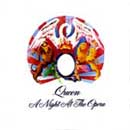
“นี่คือก้าวกระโดดที่นำพา Queen ขึ้นสู่ตำแหน่งราชินีแห่งร็อคอย่างสมภาคภูมิ (Freddie Mercury คงดีใจมากที่ได้เป็นราชินี ) เป็นอัลบั้มที่แสดงความเหนือชั้นในด้านการแต่งเพลงและรวบรวมเสียงประสาน คงไม่มีใครปฏิเสธความยิ่งใหญ่และคลาสสิกของโอเปร่าร็อค Bohemian Rhapsody ที่จะต้องถูกเล่นซ้ำไปซ้ำมาจนถึงวาระสุดท้ายของโลกอย่างแน่นอน ไม่แน่ใจว่ามนุษย์ต่างดาวมาขอซื้อลิขสิทธ์ไปเผยแพร่หรือยัง เสียงกีร์ต้าร็อคหนักๆที่เป็นเอกลักษณ์ของ Brian May กับเบสไลน์ที่เฉลียวฉลาดของ John Deacon ทำให้ความหวานของเมโลดี้มีเสน่ห์และไม่เลี่ยนเกินไปสำหรับเพลงร็อค ถึงแม้วงจะหยุดไปแล้ว เพราะการจากไปด้วยอาการป่วยของโรคเอดส์ของนักร้องนำ Freddie Mercury แต่ตำนานราชินีร็อคจะยังคงอยู่ตลอดไป ”
- Death on Two Legs (Dedicated to...)
- Lazing on a Sunday Afternoon
- I'm in Love With My Car
- You're My Best Friend
- '39
- Sweet Lady
- Seaside Rendezvous
- Prophet's Song
- Love of My Life
- Good Company
- Bohemian Rhapsody
- God Save the Queen
all music guide
Queen was straining at the boundaries of hard rock and heavy metal on Sheer Heart Attack, but they broke down all the barricades on A Night at the Opera, a self-consciously ridiculous and overblown hard rock masterpiece. Using the multi-layered guitars of its predecessor as a foundation, A Night at the Opera encompasses metal ("Death on Two Legs," "Sweet Lady"), pop (the lovely, shimmering "You're My Best Friend"), campy British music-hall ("Lazing on a Sunday Afternoon," "Seaside Rendezvous") and mystical prog-rock ("'39," "The Prophet's Song"), eventually bringing it all together on the pseudo-operatic "Bohemian Rhapsody." In short, it's a lot like Queen's own version of Led Zeppelin IV, but where Zep finds dark menace in their bombast, Queen celebrates its own pomposity. No one in the band takes anything too seriously, otherwise the arrangements wouldn't be as ludicrously exaggerated as they are. But the appeal - and the influence - of A Night at the Opera is in its detailed, meticulous productions. It's prog-rock with a sense of humor as well as dynamics, and Queen never bettered their approach anywhere else. 5/5
internet ed
Freddie Mercury and crew really made a breakthrough into rock and roll history with A Night At the Opera. Most of this album's notoriety is due to the pompous but loveable "Bohemian Rhapsody," which was given a second chance at chart-topping life thanks to the Wayne's World movie. A Night At The Opera offers a few other impressive songs on it besides "Bohemian Rhapsody" that cover all sorts of musical genres. Amazingly, the album comes across as a focused and cohesive assortment of songs, despite the traces of '50's rock, Broadway pomp, and metal guitar riffing. This leaves only Queen's intentional cheesiness as a barrier to enjoying the diverse music on A Night At The Opera.
The first track, "Death On Two Legs (Dedicated To...)" has some piercing neo-classical metal riffs, while "Lazing On A Sunday Afternoon" is driven by a surprisingly bright and bouncy piano line. "I'm In Love With My Car" is a great song with a huge vocal performance, and although "You're My Best Friend" features a Beatles sounding vocal harmony, it manages to stand out in its own way. The pulsing "'39" adds even more variation to this unusual album, while "Seaside Rendezvous" has a comical and pretentious showtune vibe. Mercury's strong voice carries the soft "Love Of My Life," and the vibrant "Good Company" is a swinging rock tune that utilizes a smooth retro sound. If you appreciate lively rock music and can handle a tongue-in-cheek approach to songwriting, then A Night At The Opera is an essential for your CD collection.
keno
A nice happy go lucky album put out by Queen. Freddie Mercury's vocals are super once again, especially on "Bohemian Rhapsody" which goes down in my book as the best rock opera ever done by anyone. Freddie's vocals also stands out on bassist's John Deacon's "You're My Best Friend", which is the next best song on the album. Then you got drummer Roger Taylor's heavy metal number, "I'm In Love With My Car", which is yet another winner. This band never had a problem when it came to hard rockin'! Throughout A Night At The Opera is the fine over laying guitar work of Brian May. This album will put a smile on your face.
rolling stone
In less than three years, with four albums, Queen has risen from the heavy-metal minor leagues to a position approaching that of Led Zeppelin and Deep Purple. But the group has some annoying weaknesses, notably a tendency toward lyrical abstraction. In addition, the imagination that inspired the slick ragtime jazz (with vaudeville overtones) of Sheer Heart Attack's "Bring Back That Leroy Brown" becomes obsessive on A Night at the Opera, where the same stylistic idea is reworked into three songs. But ultimately, the group's willingness to experiment, even when they fail, makes them interesting.
They have the ability to write first-rate pop/rock songs. Guitarist Brian May's "'39" is his best attempt yet at Paul McCartney-style crooning, but it's on side two that the vocals really take command. On "The Prophet's Song," the best track, May's powerful guitar perfectly complements the rich, multi-tracked harmonies of lead singer Freddie Mercury. Throughout the record, the group makes the most effective use of vocal rounds, choruses and harmonies in the heavy-rock genre since Argent's Ring of Hands. Like all heavy-metal groups, Queen's most easily distinguished trait is a knack for manipulating dynamics. But what sets them apart is their selection of unlikely effects: acoustic piano, harp, acapella vocals, no synthesizers. Coupled with good songs, Queen's obviously the strongest contender in this field.
Billboard
Queen is back with a much more versatile set than any of the British heavy rockers' previous three efforts. While the quality, not overdone, straight ahead rock is still a major factor, good use is also made of folky melodies, fine harmony vocals (both with musical backup and a cappella) and some good soft rock. Some interesting classical influences also present. Writing from three of the quartet adds variety, as does the use of Brian May as lead vocalist on one cut. Classical arrangements also work well and the "No Synthesizers" legend in the credits is a welcome addition these days. Feel of the '20s on several cuts is probably the most fun, but as a total effort, the album works extremely well. Best cuts: "You're My Best Friend," " '39," "Seaside Rendezvous," "The Prophet's Song," "Love Of My Life," "Good Company."
soundstage
Queen's A Night At The Opera has long been regarded as a classic because of its skillful mix of progressive-arena rock and Broadway theatrics. Pretentious and flamboyant it may well be; however, without the pretension, A Night At The Opera would undoubtedly have been less musically successful. Even if you are one the unfortunate few who haven't heard it, you probably know its centerpiece, "Bohemian Rhapsody." Few songs are as instantly recognizable -- it is, and always will remain, a classic. Even Wayne and Garth recognized its greatness, rockin' out in their Gremlin -- that scene epitomizes the emotions I feel every time I hear the song. If it won't rock you, perhaps the album's other certifiable classic, "You're My Best Friend," will.
DCC has re-mastered A Night At The Opera and as compared with its last incarnation [Hollywood Records HR-61065-2], let's just say that DCC's re-master sounds far better in every respect. Sometimes, differences between re-masters are subtle -- not here! Immediately upon cueing the disc, one hears quite clearly its improved bass, warmth, timbre and balance. It possesses an analog naturalness that the Hollywood Records version doesn't even come close to. Freddie Mercury's vocals and Brian May's guitar have never sounded better acoustically or musically. The DCC version represents a dramatic improvement over the Hollywood records release. Of course, this begs the question: Is the Hollywood Records re-master that bad -- or is the DCC simply that good? Maybe a little of both. Does it matter? "Bohemian Rhapsody" and the rest of the CD sounds glorious. I can't imagine anyone getting more out of the original tapes than Steve Hoffman has accomplished here. Now, if only I had an old Gremlin to play this in, life would be complete.
|