



|
|
Maledpun Music ทางเลือกประสบการณ์ฟังเพลงคุณภาพ | ||||||
|
|
|
|
|||||
CD |
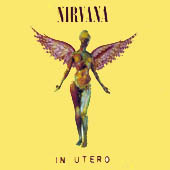
In Utero Nirvana - 1993
|
||||||||
| อัลบั้มที่ใครฟังก็ต้องชอบ | |||||||||
| อัลบั้มแยกตามแนวดนตรี | |||||||||
| MP3 | |||||||||
| เพื่อนักดนตรี | |||||||||
| DVD & VCD | |||||||||
| คอนเสิร์ตและ MV คุณภาพ | |||||||||
Q It gets better. In "Very Ape," a two-minute corker cut from the same atomic-fuzz cloth as the band's 1989 debut album, Bleach, Cobain gets right down to brass tacks, against a burning-rubber lead guitar squeal and the mantric rumble of bassist Chris Novoselic and drummer Dave Grohl: "I am buried up to my neck in/Contradictionary lies." (Nice pun, that.) The kiss-off quickly follows: "If you ever need anything, don't hesitate/To ask someone else first." Cobain slightly overplays his hand with the title of "Radio Friendly Unit Shifter." Nirvana have been called many things over the past two years; that, as far as I can tell, is not one of them. But Cobain cuts right to the heart of the mire with a torrent of death-throe guitar feedback and a brilliant metaphor for the head-turning speed with which one man can suddenly sire a nation: "This had nothing to do with what you think/If you ever think at all.... All of a sudden my water broke." Frankly, Nirvana as a band and Cobain as the point man have earned the right to spit in fortune's eye. Generation X is really a generation hexed, caught in a spin cycle of updated 70s punk and heavy-metal aesthetics and cursed by the velocity with which even the most abrasive pop under-culture can be co-opted and compromised. One minute, Nevermind is jackbooting Michael Jackson out of the No. 1 slot; the next, grunge jock Dan Cortese is screaming, "I love this place!" on behalf of Burger King. Even the hippies got a summer or two to themselves in the mid-'60s before the dough-re-mi boys horned in. So it's hardly a stretch to suggest that in "Frances Farmer Will Have Her Revenge on Seattle" (a slash-and-burner named after the locally born actress, whose rebellious streak brought her to the brink of insanity), it is really Cobain who wants to torch the town and send the A&R hounds packing. None of this unrepentantly self-obsessed rant & roll would be half as compelling or convincing if Nirvana weren't such master blasters - Novoselic and Grohl deserve a few extra bows here - and Cobain wasn't a songwriter of such ferocious honesty and focused musical smarts. Cobain essentially works according to one playbook, but it's a winner no matter how he runs it. His songs invariably open with a slow-boil verse, usually sung in a plaintive groan over muted strumming and a tempered backbeat. Then Cobain vaporizes you with a chorus of immense power-chord static and primal howling. That, in a nutshell, is "Teen Spirit" and "Come As You Are." It also covers, to varying degrees, "Rape Me," "Penny Royal Tea" and "Milk It" on In Utero. But the devilry is in the details. "Rape Me" opens as a disquieting whisper, Cobain intoning the title verse in a battered croon, which sets you up beautifully to get blind-sided by the explosive hook line. In the sepulchral folk intro of "Penny Royal Tea," Cobain almost sounds like Michael Stipe at the beginning of R.E.M.'s "Drive" - before the heaving, fuzz-burnt chorus comes lashing down with a vengeance. Steve Albini's production, an au naturel power-trio snort that is almost monophonic in its compressed intensity, is particularly effective during those dramatic cave-ins. The word grunge, of course, doesn't do this kind of ravishing clatter justice. But Nirvana never bought into the simple Black Flag-cum-Sabbath hoodlum shtick anyway. From Bleach on, they have specialized in a kind of luminous roar and scarred beauty that has more to do with Patti Smith, the Buzzcocks and Plastic Ono-era John Lennon. Actually, the icy tension of the part ballad, part punk-rock blues "Heart-Shaped Box" and the amorous chamber-punk urgency of "Dumb" ("My heart is broke/But I have some glue/Help me inhale/And mend it with you") confirm that if Generation Hex is ever going to have its own Lennon - someone who genuinely believes in rock & roll salvation but doesn't confuse mere catharsis with true deliverance - Cobain is damn near it. In "Heart-Shaped Box," the kind of song Stone Temple Pilots couldn't write even with detailed instructions, Cobain sets up a hypnotic coiled-spring tension between the frayed elegance of the verse melody and the strong Oedipal undertow of his obsession ("Throw down your umbilical noose so I can climb right back"). The last track, "All Apologies," is another stunning trump card, the fluid twining of cello and guitar hinting at a little fireside R.E.M. while the full-blaze pop glow of the chorus shows the debt of inspiration Cobain has always owed to Paul Westerberg and the vintage Replacements. It's the last thing most people would expect from Angst Central, and it's an inspired sign-off that shows how Nirvana have been reborn in the face of suck-cess. In Utero is a lot of things - brilliant, corrosive, enraged and thoughtful, most of them all at once. But more than anything, it's a triumph of the will.3.5/5 The second side of the album opens with the kind of primitive riffing punk thrash that would have sat quite easily on 'Bleach'. 'Very Ape' is pretty good though, 'Milk It' rather strange but Kurt screams very well. Nobody could scream quite like Kurt Cobain, another Pixies influence brought into Nirvana, obviously. 'Pennyroyal Tea' has lyrics that sound like they were made up in the studio just prior to recording, and the whole song sounds strained and like it's about to collapse, but not in an enjoyable way. This is very difficult listening. 'Radio Friendly Unit Shifter' isn't so great either, although the Punk thrash of 'Tourette's' is an exhilarating, brilliant ride. 'All Apologies' closes the album, closes it well. This was one of the songs re-mixed, but it's a fabulous song in any case, another wonderful vocal performance. 'In Utero' survived an initial media back-lash to become recognized as another important and more importantly, great, album by the group. For me, there are a couple of songs here that probably shouldn't have been, that prevent this quite reaching the heights of 'Nevermind'. This is still a damn fine album, though. Seeing the Bushes and Tools of the rock and roll world follow In Utero's formula for the better part of the decade makes me really wonder just what would have happened if Cobain hadn't taken his own life. Surely with him in the lead, most of modern rock music would not be stuck in the rut it has been for the past few years. Grating at first listen, classic every time after, In Utero picks up where Nevermind left off and improves on the former exponentially. Where much of Nevermind owed a great debt to the Pixies and Hüsker Dü, In Utero's riffs are like nothing we've heard before. Cobain turns the classic rock guitar riff on its side, marrying dissonance with rhythm and offering twisted takes on classic pop structures. (No wonder Courtney Love stood outside the door as Cobain was writing, hoping to catch a discarded riff for her own use.) "Serve The Servants" delivers Cobain's trademark irony with amazing and innovative fret work and a pop backbeat. "Teenage angst has paid off well / but now I'm bored and old / self-appointed judges judge / more than they have sold," Cobain challenges to open song and album. Clearly the stakes have changed since Nevermind's runaway success. His aversion to that success and mainstream approval well-documented, Cobain purposely made In Utero difficult and abrasive. He dares you to listen, burying his pop hooks under avalanches of distorted guitars, drums and screams. Cobain is still a man at odds with his place in the world - musically and otherwise. At one point he reassures, "I just want you to know that I /don't hate you anymore," only to follow that line lamenting, "There's nothing I could say / that I haven't thought before." This dichotomy is the blackened heart of In Utero. For half of the songs, Cobain gives his fans sublime ballads that even manage to transcend his past genius. In the other half, the singer lashes out, seeking to turn off many of the multitudes who had bought Nevermind but hadn't really gotten the point. To achieve the latter, Cobain enlisted famed indie producer Steve Albini to rough up the band's sound. To Albini's merit though, the plan backfired. His sparse production simply highlighted the virtuosity of the album's players and placed emphasis on Cobain's biggest strength - his songwriting. Even a song as inflammatory as "Rape Me," with lyrics begging to be misunderstood, became a radio hit and sort of '90s rallying cry for those of us being bent over backward by The Man. Cobain's efforts at caustic songwriting just made the album all the more brilliant. In Utero is truly one of the few albums made this decade that sounds like nothing that came before it. Nevermind is definitely the more influential album (It was the catalyst that started the whole damn thing). But Nevermind is a nod to the past with a new twist. In Utero is alien territory. As musically brilliant as In Utero is, its overall tone is darkly disturbing. Images of corrupted life fill the album. The anatomical model on the album's cover has its hands open in a Christ pose with angel's wings on its back and transparent skin revealing inner organs. The back cover (which almost got the album banned from Wal-Mart, pricks.) is a collage of dead fetuses. And a gaunt, sickly Cobain peers out from In Utero's liner notes. Over a driving, urgent rhythm and ultra-distorted, slash and burn guitar, Cobain screams "You can't fire me because I quit / Throw me in the fire and I won't throw a fit" on "Scentless Apprentice." Escape, to heaven or hell, is a recurring theme on the album. On "Dumb," Cobain sings "I'm not like them but I can pretend" and "I think I'm dumb / Or maybe just happy," seeking tranquility in naivete of the mentally handicapped. "Dumb," along with "Pennyroyal Tea" and "All Apologies" are those aforementioned ballads that transcend the album's irony and cynicism. Cobain thought so much of "All Apologies" that he had R.E.M.'s producer, Scott Litt, remix it. A more fitting suicide note than anything he could write on a piece of paper, these songs speak straight from Cobain's heart. On "Dumb," Cobain yearns for a better, simpler life, free from the burden of rock stardom and money. "Pennyroyal Tea" chronicles the singer's struggle with chronic stomach ailments and the heroin he used to escape the pain. "Pennyroyal tea, distill the life that's inside of me," Cobain pleads. "All Apologies" wraps up more than the album. "What else could I write? I don't have the right," Cobain laments. It's a sadly poignant line, as on top of all his other struggles, Cobain faced writer's block in his final months. "Everything's my fault / I'll take all the blame / Aqua seafoam shame," he sings to his family, his band, his friends, us. He ends repeating "All in all is all we are" fading into the silence. It was the last new song we'd hear from Kurt Cobain. And it was so magical, the best thing he'd ever done, a simple circular guitar riff, repeated over and over. All in all was all he was. And we are all the better for having been a part of it. The album's lead-off track, "Serve The Servants," is one of the best. "Teenage angst has paid off well/now I'm bored and old" is probably Kurt Cobain's anthem of life now. The album progresses with "Scentless Apprentice," and "Heart Shaped Box," which has been getting almost constant radio airplay. "Dumb," "Milk It," and "Pennyroyal Tea" are three other notable tracks. "Radio Friendly Unit Shifter" and "Tourette's" - an incomprehensible array of Kurt Cobain's rasping, bellowing screams, - follow. The album closes with "All Apologies," the only song on the album with so many Top 40 commercial qualities, it's stomach churning. It is probably safe to assume that phenomenal success has taken its toll on Kurt Cobain, Dave Grohl, and Chris Novoselic. Listening to "In Utero," you get the feeling that this is not Nirvana: Multi-platinum chart-toppers; this is Nirvana: one hell of a punk band. I don't know, and neither did they. No artistic growth is displayed here. It's just an attempt to appease two different fan bases, neither of which Kurt felt fully comfortable with. The songs seem stilted, forced, false, and ultimately, mostly unsatisfying. But that's just me talking. What do I care if two of the songs are complete rip-offs of "Smells Like Teen Spirit?" That's irony, right? Like The Knack? Hmm. It's an intriguing record, especially considering what Kurt did soon after its release, but it's not terribly consistent |
http://www.geocities.com/maledpunmusic/
Updated October 2004